Exploring Birdlife in the Yorkshire Dales: Stories and Conservation

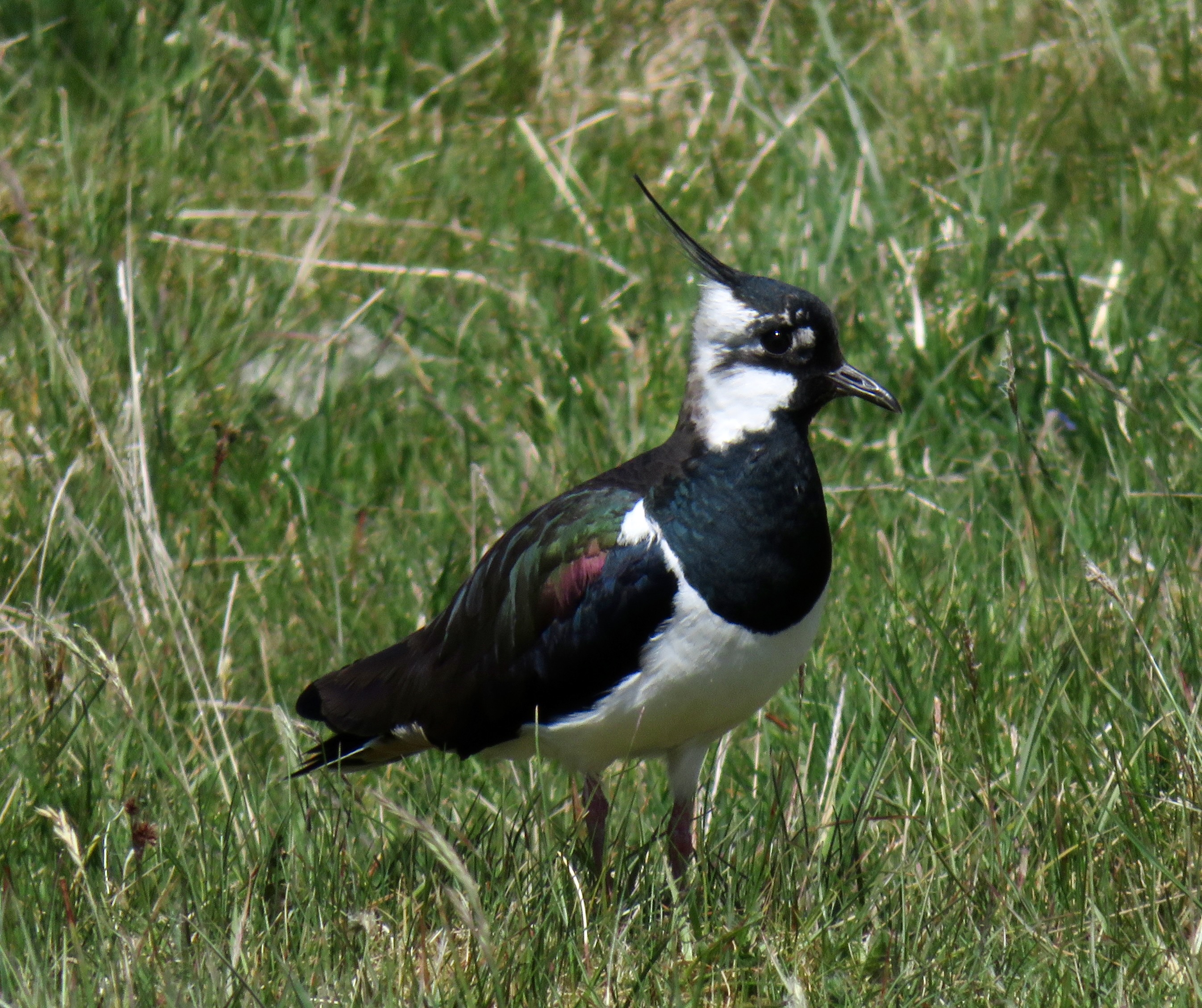
Lapwing encountered near the side of the road in Silverdale

Yesterday I spent a happy few hours in the archive at the Dales Countryside Museum (DCM). I’m carrying out research for Cherish which explores the history and celebrates priority species birds in the Yorkshire Dales National Park. I’m looking back at various books and accounts where the authors talk about their experiences of birds in the dales and I started with the diaries of Marie Hartley and continued to the books of Richard Kearton (1862-1928) (illustrated with his brother Cherry’s (1871-1940) gorgeous monochrome photographs).

Richard and Cherry Kearton were naturalists and pioneers of nature photography. They were born and brought up in the Yorkshire Dales at Thwaite in Swaledale. For more information about their fascinating lives see this blog HERE
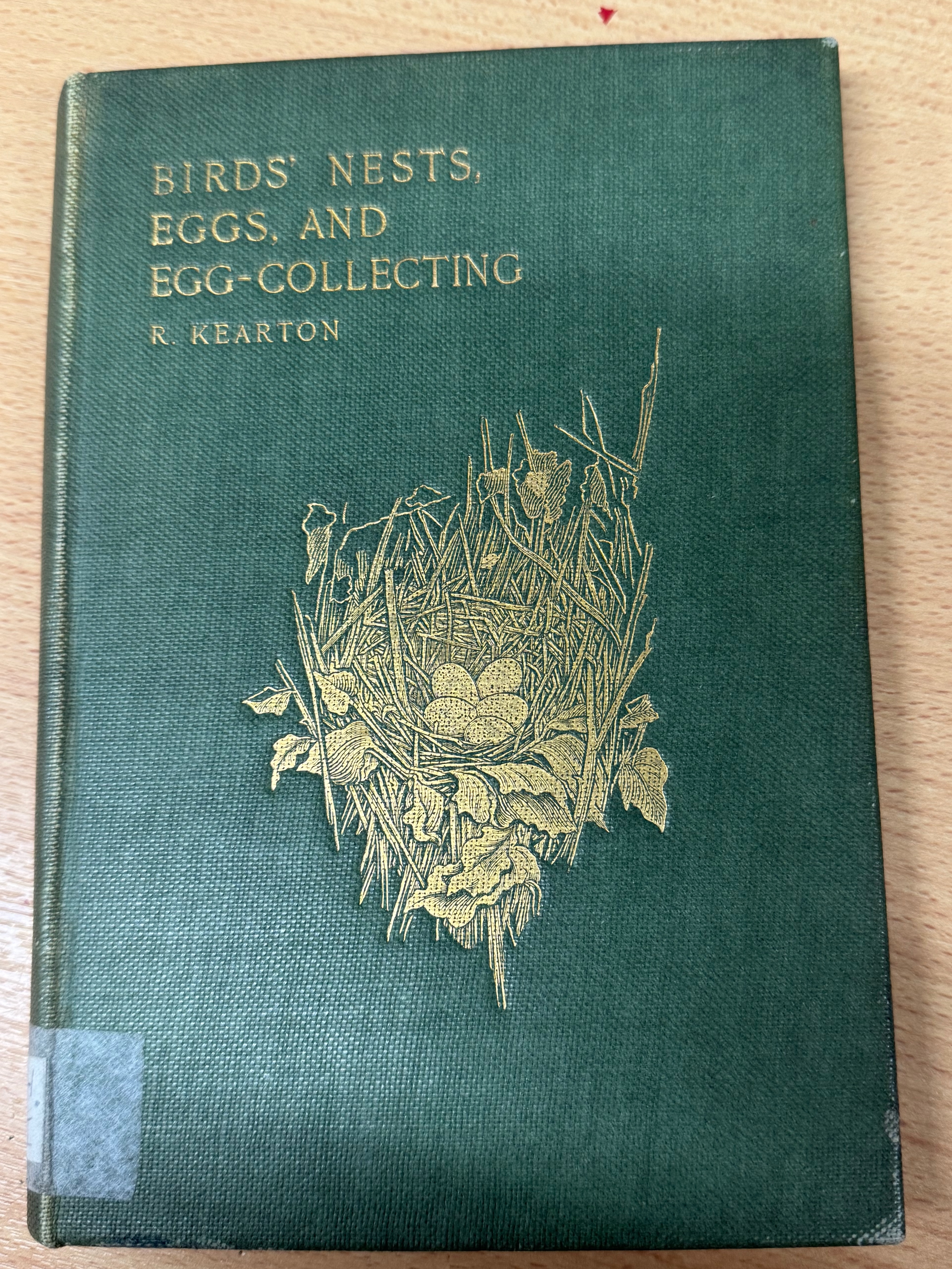
I began by looking at Birds’ Nests, Eggs and Egg Collecting which was published in 1890 and revised in 1896. Richard says “this book is not intended to encourage the useless collecting of birds’ eggs from a mere bric-à-brac motive, but to aid the youthful naturalist in the study of one of the most interesting phases of birdlife” and he goes on to share his ideas and philosophical approach to studying birds and their reproductive behaviour. In it he provides guidance on the subject of egg collecting and preserving and provides information about the nesting behaviour and eggs of individual species . He states that he hopes “that the Act of Parliament empowering County Councils to protect either the eggs of certain birds, or all birds breeding within a given area, will be of great benefit to our feathered friends”.
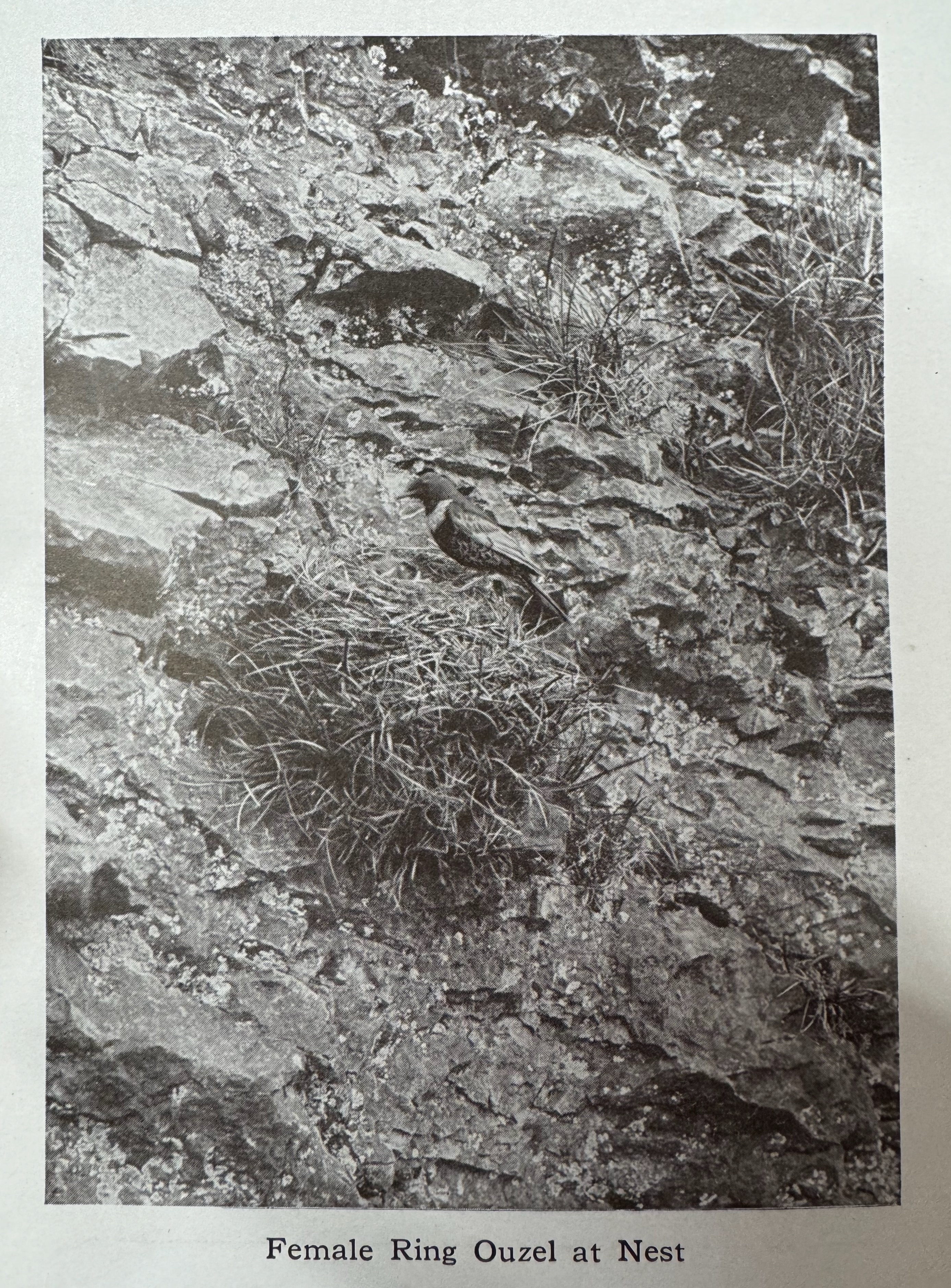
A plate from At Home With Wild Nature

Egg collecting was a regular past-time for naturalists during the nineteenth and early twentieth century and many children growing up in the Yorkshire Dales in the 1940s and 1950s may well have spent time doing so too. With this pastime often came the kind of general knowledge of nature and the landscape that has been lost amongst many of our current generation which is why I am encouraged by the recent successful campaign to instate a nationwide Natural History GSCE in schools.
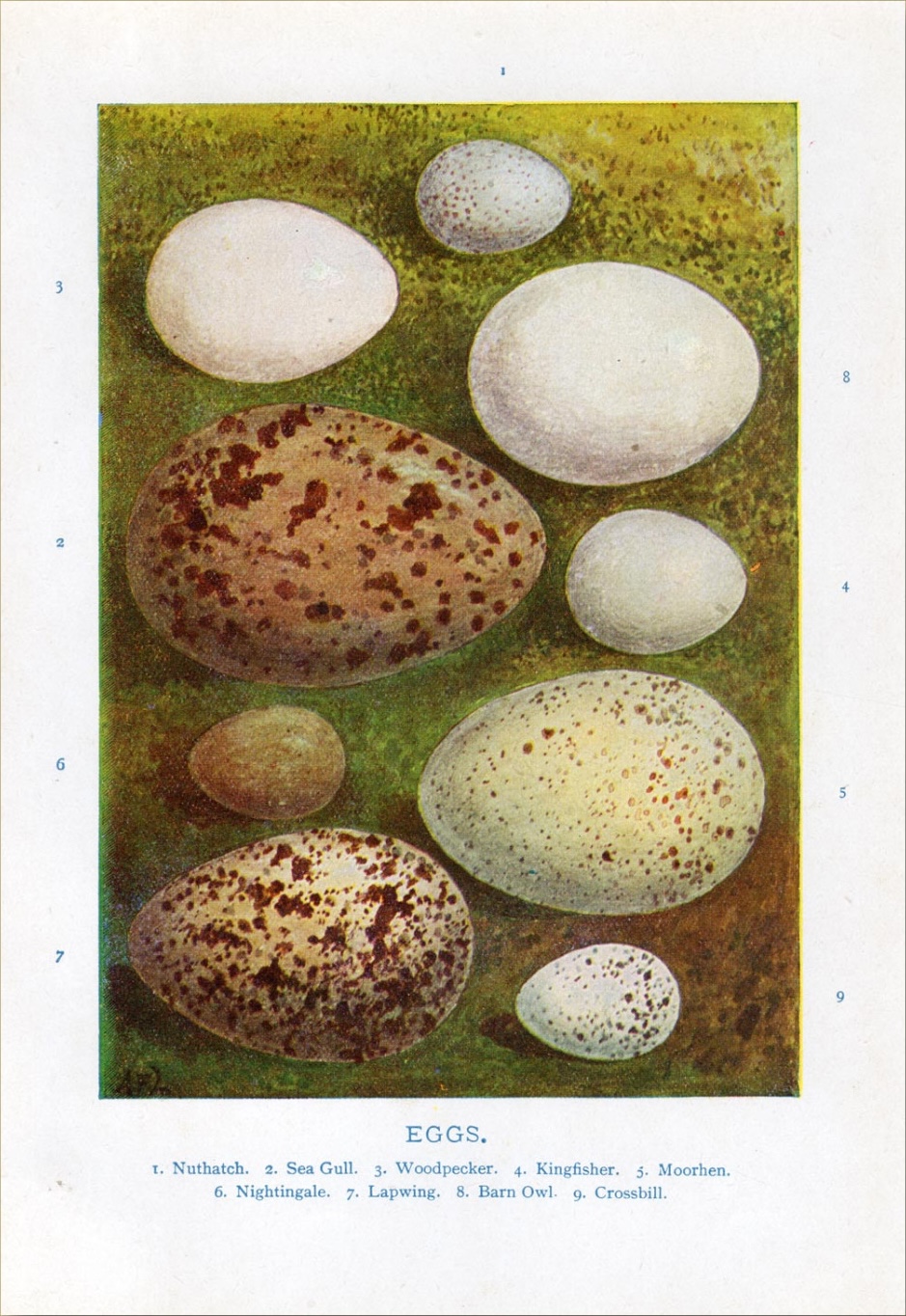
Plate from Birds’ Nests, Eggs and Egg Collecting

The Protection of Birds Act 1954 made egg collecting generally illegal but there was also an earlier bill, The Protection of Lapwings Bill 1928, that I find particularly interesting. Lapwings are one of my selected birds for this project and I am very fortunate to see them fairly regularly. At one time they were abundant across the country, so much so that their eggs were taken in the thousands to sell as a culinary delight in London. In his book At Home With Wild Nature published in 1922, Richard Kearton says “I wish some epicure would try a boiled rook’s egg for breakfast and proclaim from the house-tops of Belgravia its superiority over that of the plover or lapwing. It would be a great boon to the latter bird, which is being slowly but surely exterminated, to the detriment of the farmer in particular, and the public in general”.
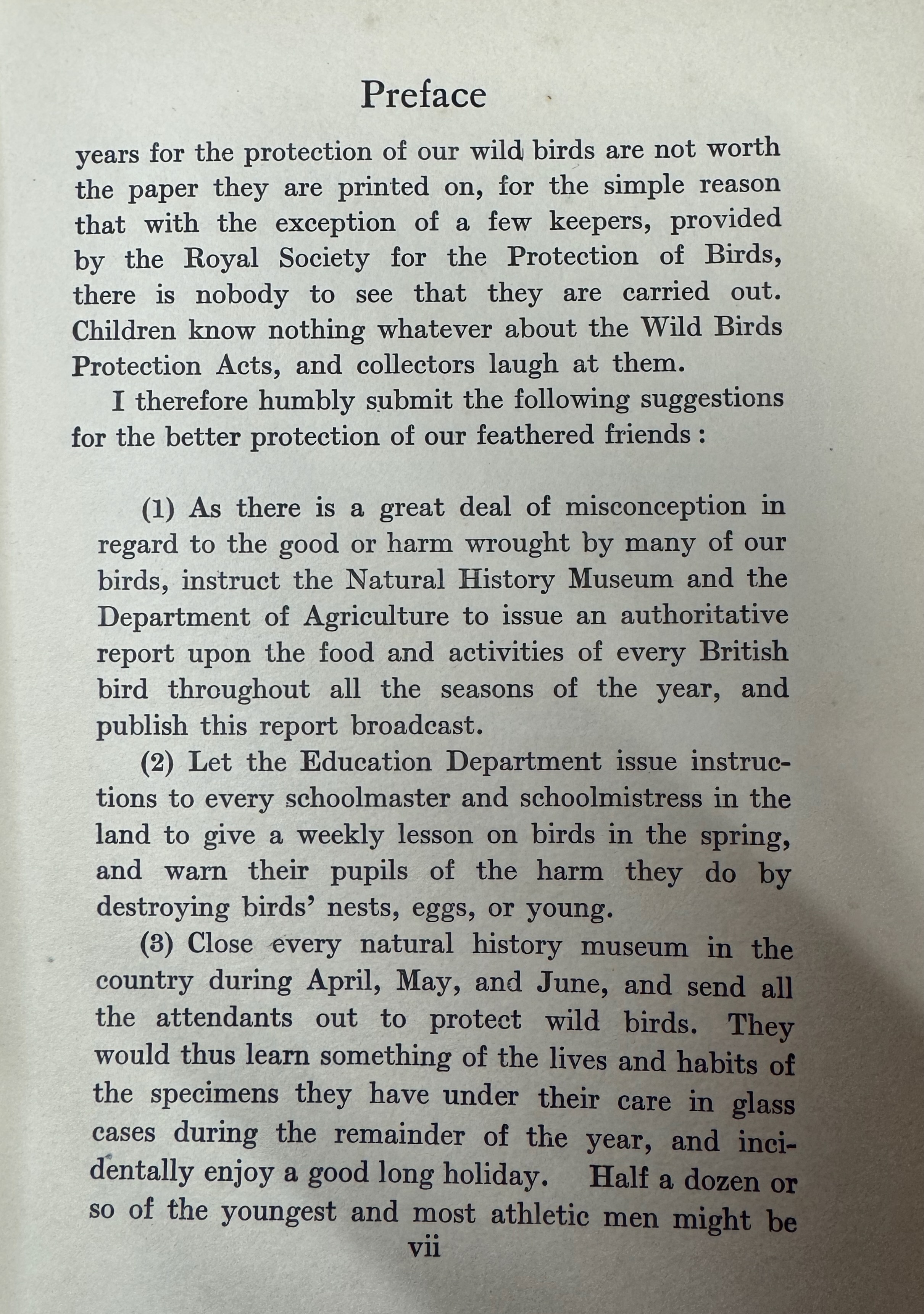
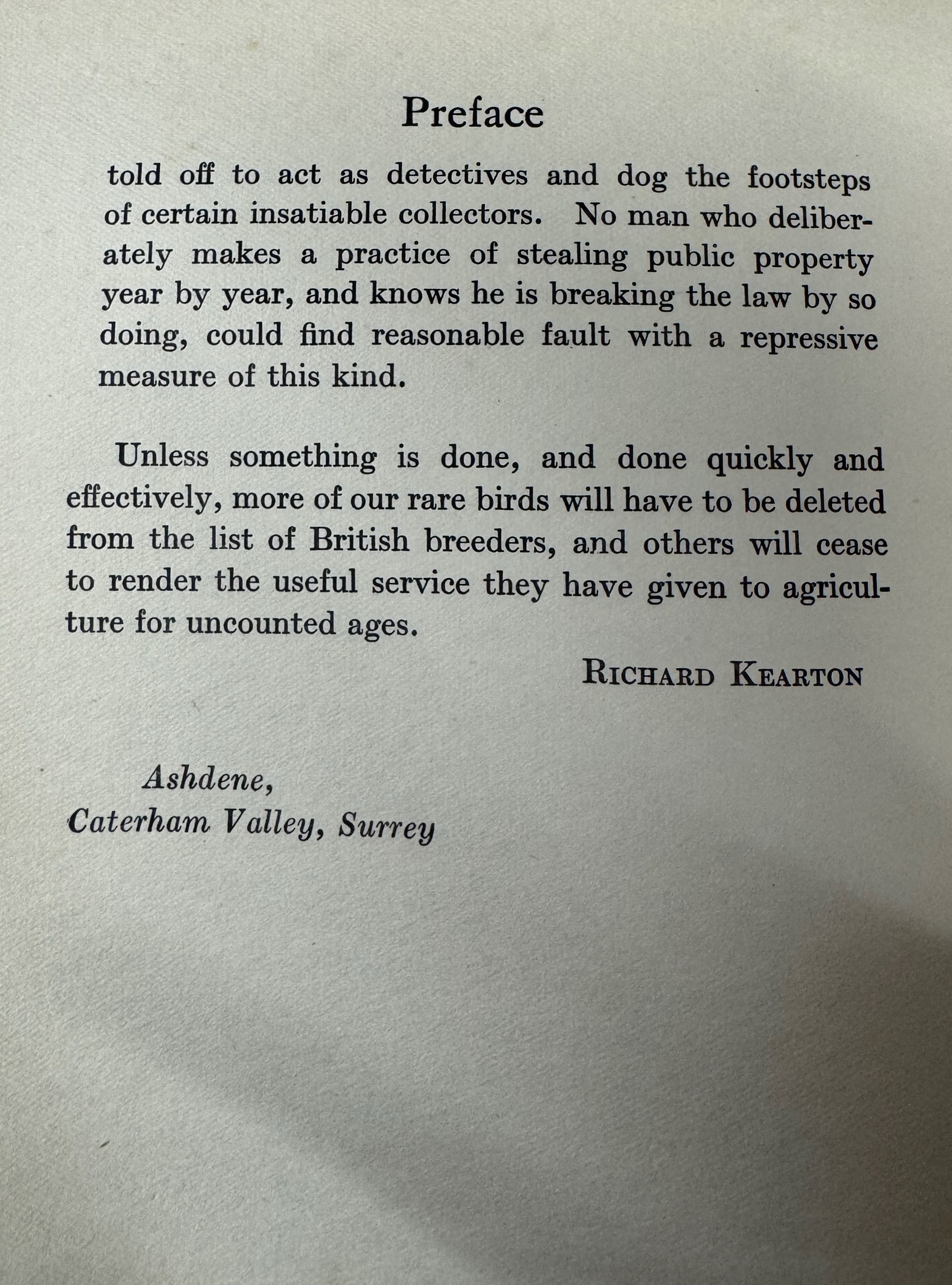
Kearton goes on to say “I have been an observer of bird life all my days, but never remember a time when members of the avian world were so purposefully persecuted as the present. It is no exaggeration to say that not quite ninety per cent of the nests, great and small, built in places accessible to public are wantonly destroyed”. He outlines his proposals to help protect birds in the preface of the book (see photos above).

I also read his thoughts on the rise in sheep farming and how he connected it to the decrease in the number of lapwings, wheatears and other moorland birds. I found a passage in which he also talks about “game-preserving” being a “disastrous business” to hen harriers. Coupled with the recent news of the successful prosecution of a game keeper who killed a hen harrier near Grassington, it is poignant that over a century later we are still encountering the same problems but they are now compounded by other threats to wildlife such as the rise in human populations and tourism, changes in agricultural practises and climate change.
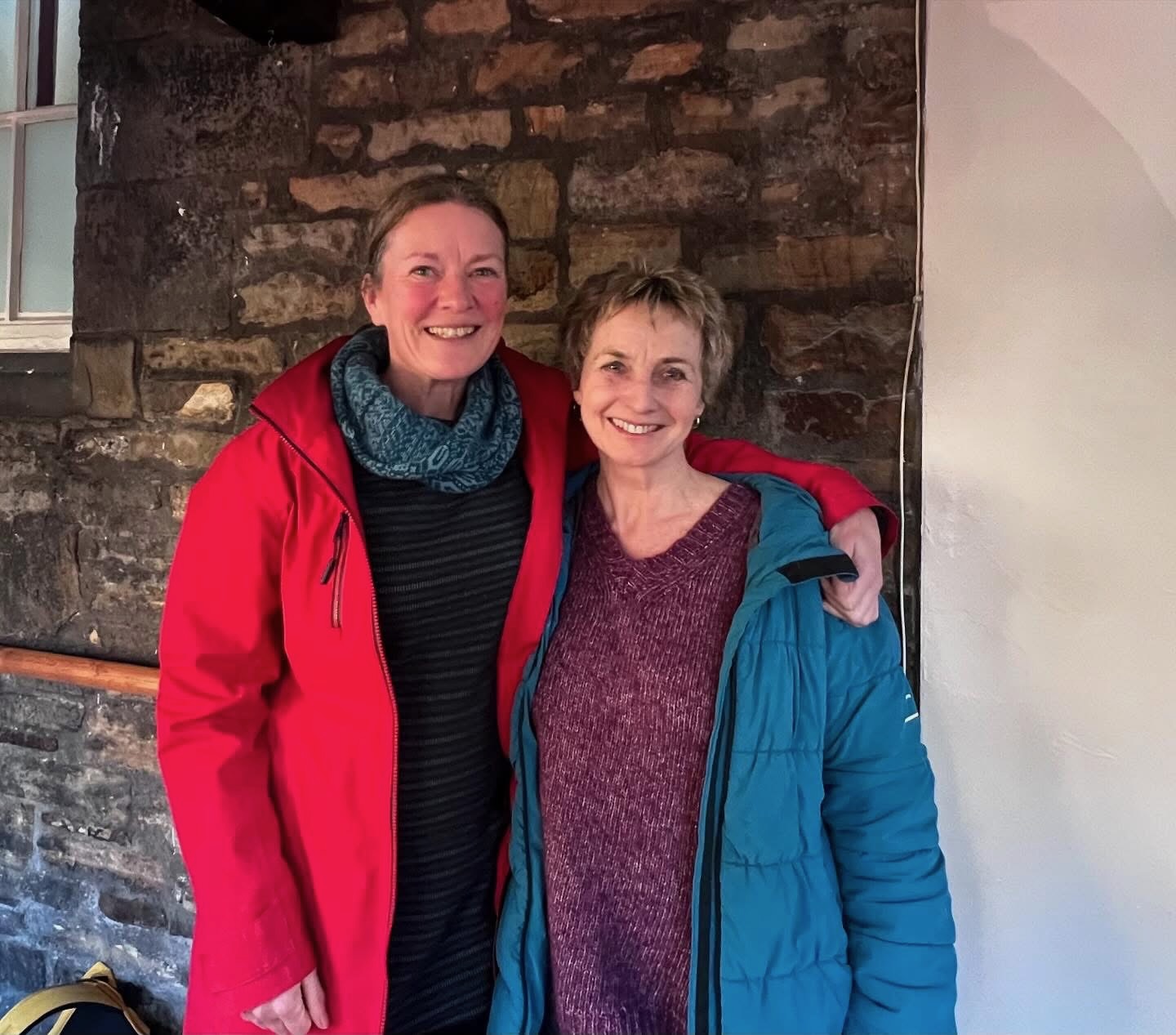
Meeting Mary Colwell, Director of Curlew Action, at the Northern Curlew Skill Share in 2025

There’s a lot to do in order to help our precious wildlife which is why one of the highlights of 2025 for me was my participation in the Northern Curlew Skill Share event organised by Matthew Trevelyan of Nidderdale Natural Landscape. This brought together land owners, farmers, ecologists, artists, writers, poets (to name but a few interested parties) who shared the common goal of trying to pool resources and skills to help find ways to conserve the endangered Curlew. It reminded me of how it isn’t all ‘doom and gloom’ and that I can play a small part by raising awareness via my work. The YDNPA’s Nature Recovery Plan “sets out the Biodiversity Forum‘s aspirations for action between now and 2040, aiming to conserve and enhance the biodiversity within the National Park” and this, combined with the efforts of many individuals and groups across the Yorkshire Dales gives rise to hope that we can make a difference.

Should anybody reading this blog have their own memories of birds in the Yorkshire Dales that they would like to share, please do feel free to comment below or send me a message through my website HERE. I’d love to hear them.
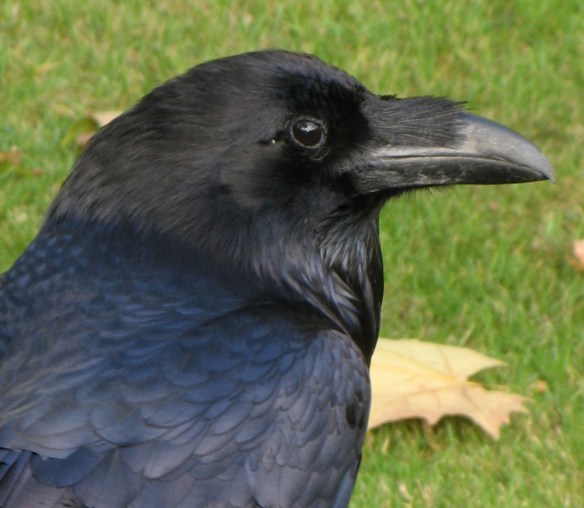
Corbie, bran, cigfran…AKA the Raven!

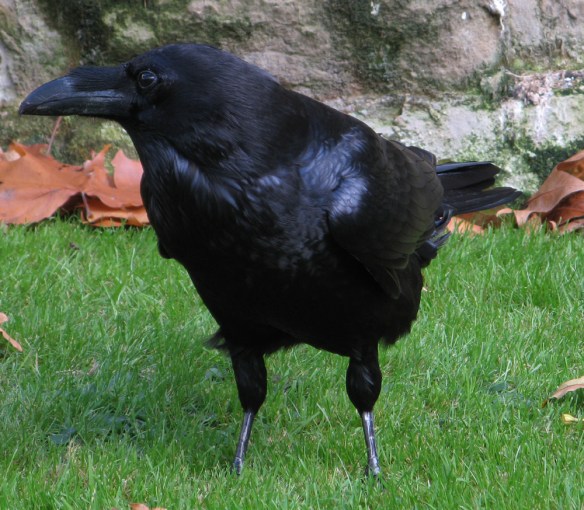
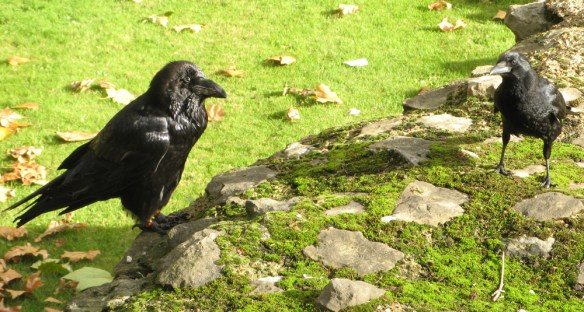
Ravens have captivated me for most of my life and I am fortunate to live in an area where I see them often. When I summit Ingleborough there will invariably be a pair flying around and I see them when I am running over Plover Hill and Pen-y-ghent. These intelligent members of the corvid (crow) family are also the largest and the ones that feature most in the folklore and mythology of cultures from all over the world. (Below are just a few photos I’ve taken over the years, note the difference in size between the raven and the crow in the last photo!).

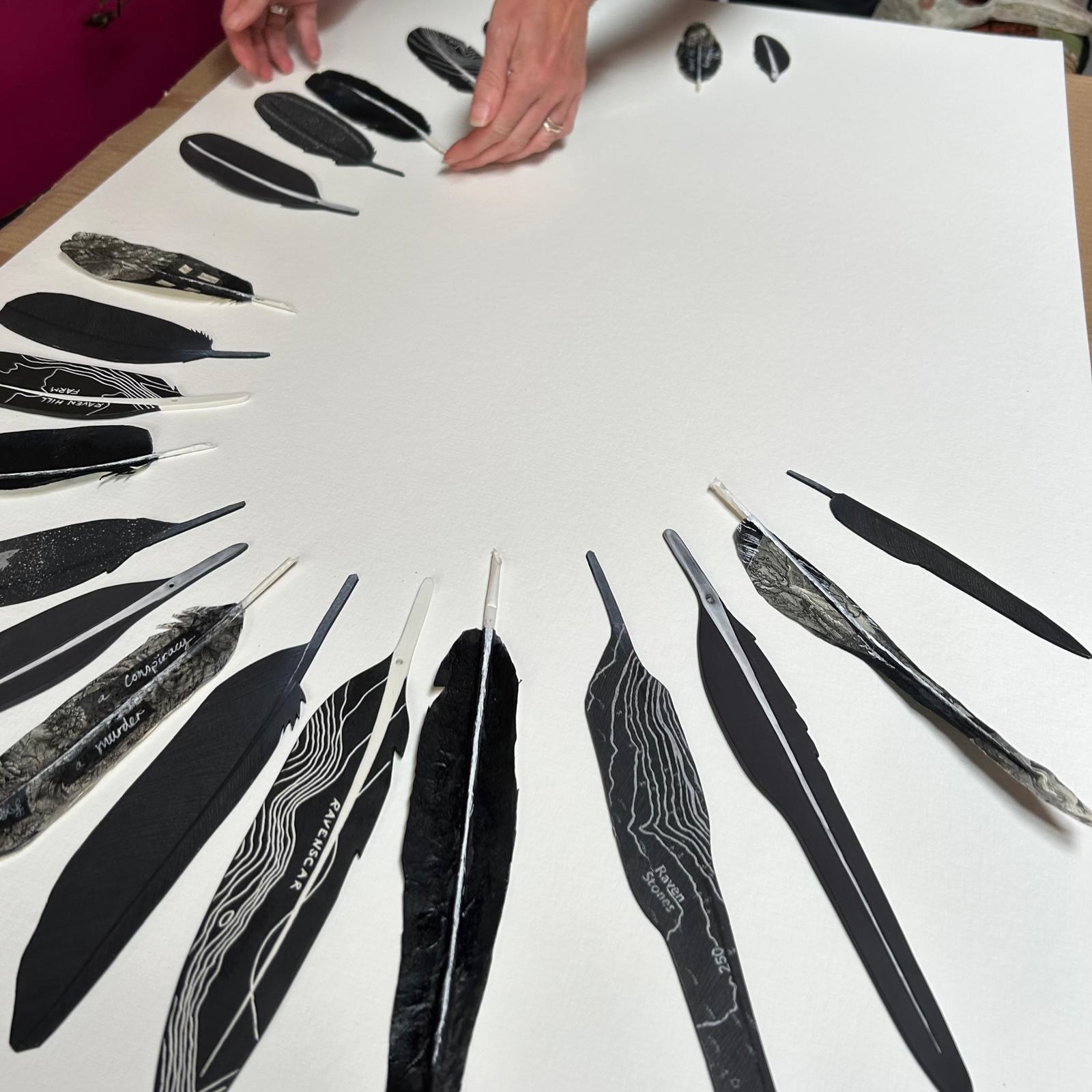
For Charms and Murmurings at Ryedale Folk Museum – my latest Collections exhibition with Josie Beszant & Charlotte Morrison – we are showing work inspired by the folklore, mythology and stories surrounding birds. Ravens feature in many of our pieces including our collaborative work ‘Corvid’. I made a template showing the primary and secondary wing feathers of a raven and we each made fourteen feathers that, when collected together, formed a pair of ‘wings’. I love the distinctive primaries on a raven’s wing that look like fingers stroking the sky.

The three of us at the opening of Charms and Murmurings
(l-r: Charlotte, Josie, me)

My collagraph feathers are inspired by the many places throughout Yorkshire that are named after ravens and also the Norse myth of Odin and his two ravens, Huginn & Muninn (Charlotte’s feathers are ceramic and Josie’s are paper collages).

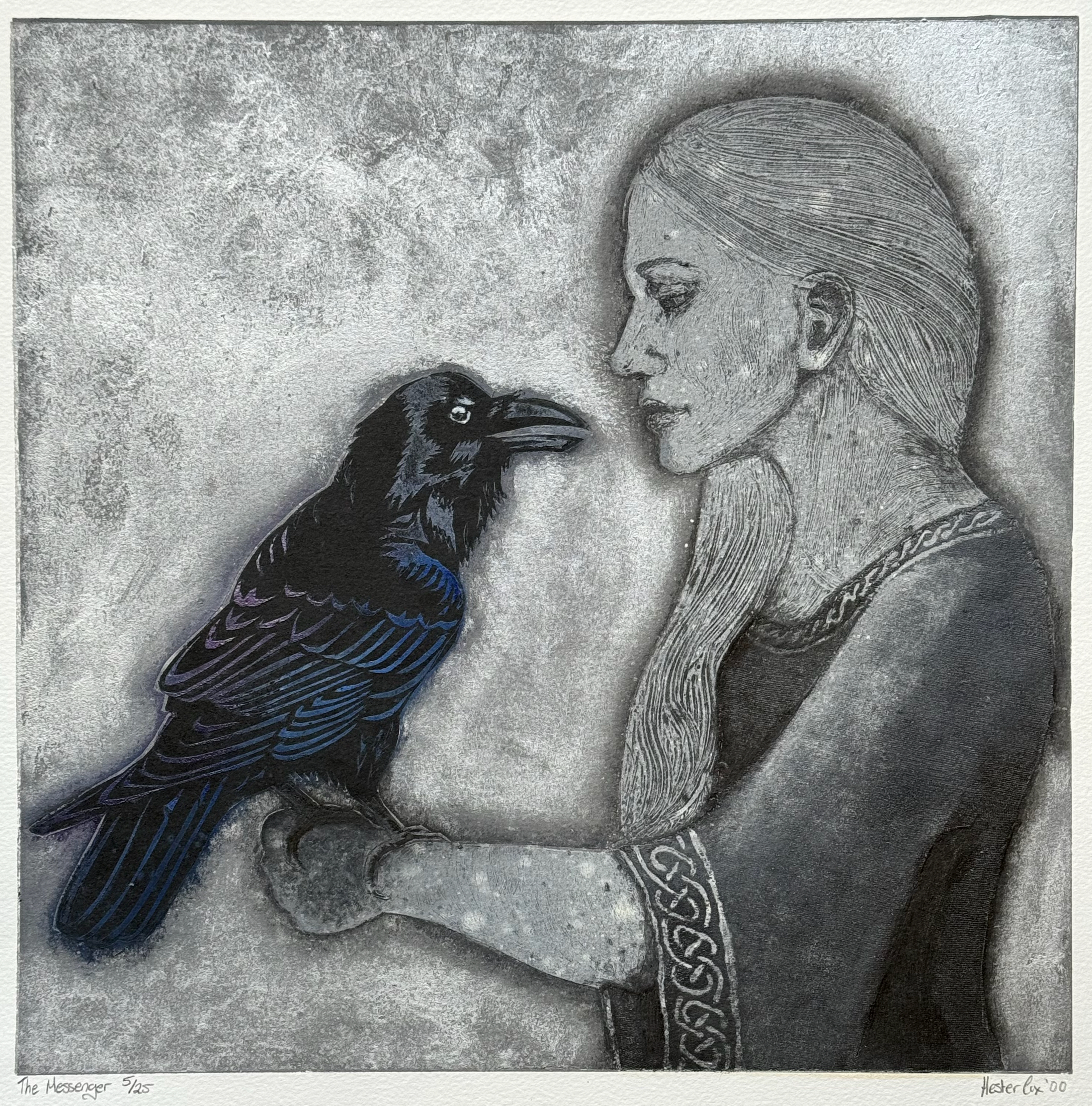
Ravens are carrion eaters and, because of this, they were often associated with death and loss. They are also ‘talking birds’ that are able to mimic human speech and this is thought to be the reason that they appear as messengers in so many myths, often travelling between worlds, to bring news to their human companions. Back in 2000, I created a raven collagraph inspired by Celtic mythology and called The Messenger:

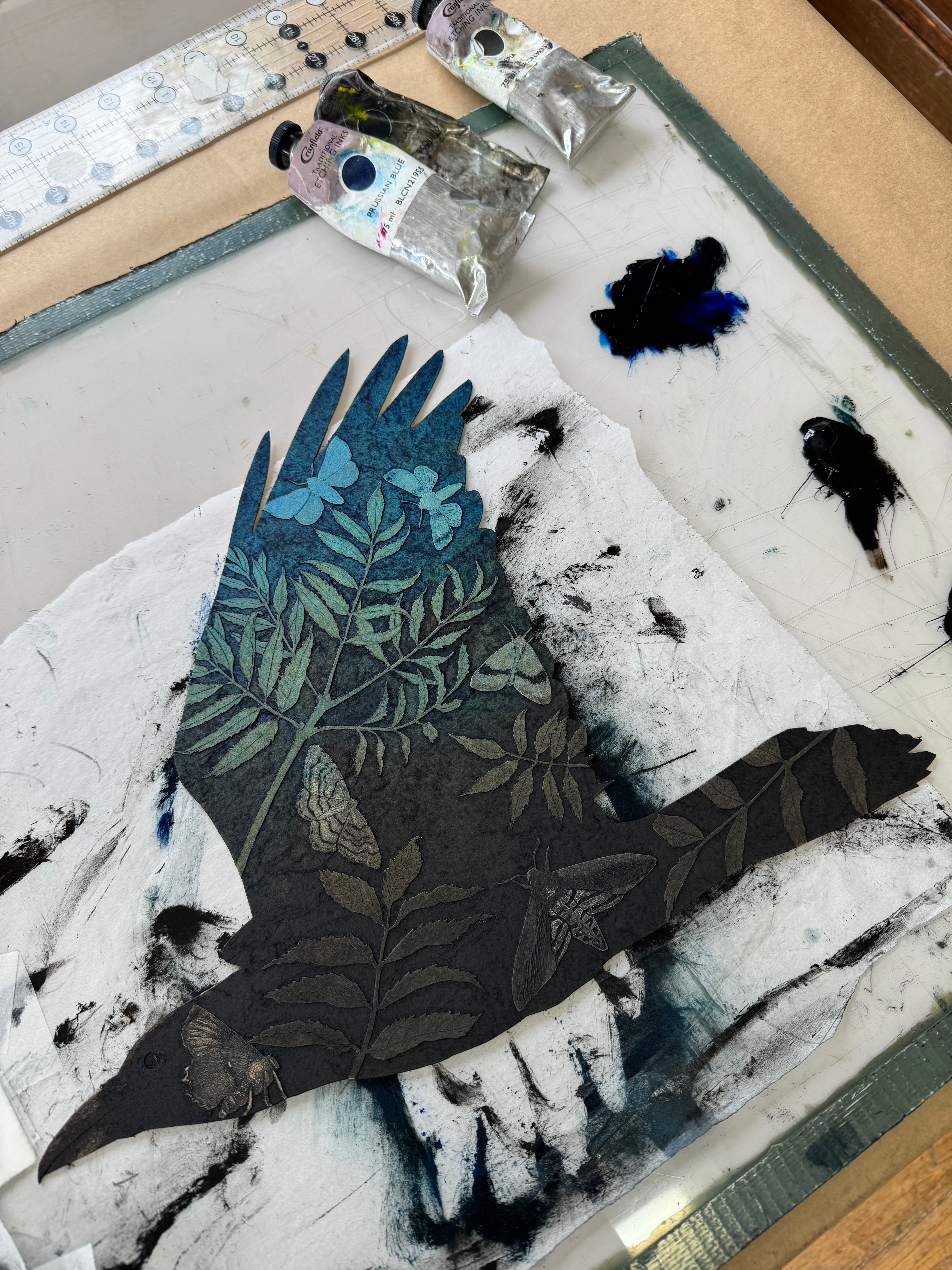
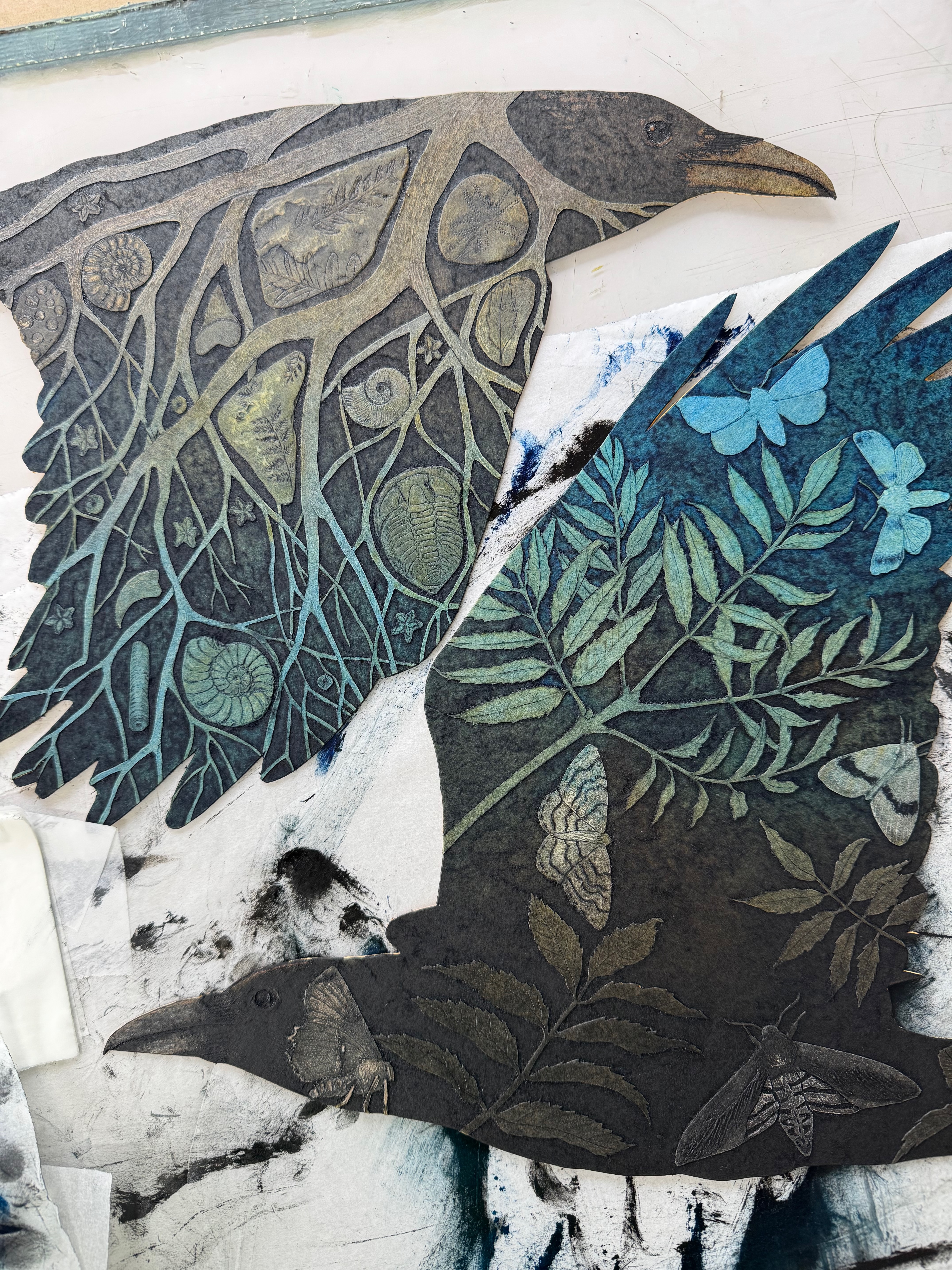
25 years later(!) I have chosen to explore the story of Odin’s ravens and for Charms and Murmurings I have created this piece entitled Thought and Memory:

Huginn (Thought) and Muninn (Mind or Memory) would sit beside Odin – often regarded as the God of Ravens, the dead and warfare – and each morning he sent them out across the world and they would report back on everything they saw and heard. The names of the ravens are difficult to translate but Huginn is thought to represent the intellect/comprehension/perception and Muninn the emotions/memory/urges (to put it very simply). Whilst researching ravens, I came across an article that referenced a quote from the Poetic Edda called Grímnismál (in old Icelandic):

Huginn ok Muninn fljúga hverjan dag Jormungrund yfir;

óumk ek of Hugin, at hann aptr né komit, pó sjámk meirr um Munin.

A translation of this is:

Thought and Memory fly every day the whole world over;

each day I fear that Thought may not return, yet I fear more for Memory.

This really resonated with me and, coming at the idea from an ecological viewpoint, I wanted to depict Thought (Huginn) as living in the natural world that we see and experience physically and I have used the branches of an ash tree which directly links to the sacred ash tree (Yggdrasil) in Norse myth. I’ve created moths to fly among the branches symbolising thoughts and the spirit.

For Memory (Muninn), I depicted the roots of an ash tree with fossils caught amongst them representing the past, our memories and the underworld realm of the dead. The fact that Odin was an elderly man and that he feared losing Muninn more than Huginn made me think about the devastating disease of dementia. Losing our cognitive ability and short-term memories, we become lost in our own world unable to make sense of the here and now and often become physically lost both to our families and friends but also in reality when we can’t find the associations needed to navigate in the world around us. I am not really sure how this collagraph relates to my thoughts but I made it with them whirring around in the background.

NB some people believe that Huginn and Muninn were linked to Odin himself and that through shamanic practices he would send his own thought and mind journeying across the world. Ravens have often been a bird that humans and mythic beings were thought to transform into.

As is usual with my work, there are layers of thought behind it and some I won’t be able to verbalise for a while (there is something about ‘ash dieback’ in there I think!). I often create my prints from ideas that are more instinctive and come from experiences that link to things I feel but haven’t found a way to express in words. This is why I love to meet people at art fairs and discuss my work with them. At the Saltaire Inspired Winter Makers Fair last weekend, I had some wonderful discussions about my new work and found that visitors were providing insights that made me feel like shouting ‘yes, yes, that’s it!’.

Corbie – collagraph print

Finally, this last piece is part of my ‘animal, vegetable, mineral’ series that takes my feather collection as inspiration and links to manmade objects and the plant world. Here I have created collagraphs of a raven feather, a sprig of bog myrtle (sweet gale) and a piece of Viking hack silver which is actually from a former project. Bog Myrtle is thought to be a plant that the vikings used to create a drink which helped them ‘berserk’ before going into battle! There is an interesting article about the varied uses of the plant HERE.

Thank you to everyone that has visited the exhibition and for all of your feedback. I welcome your ideas and experiences about birds, folklore and my work so please do feel free to comment below.

Charms and Murmurings is on at Ryedale Folk Museum until 2nd November.