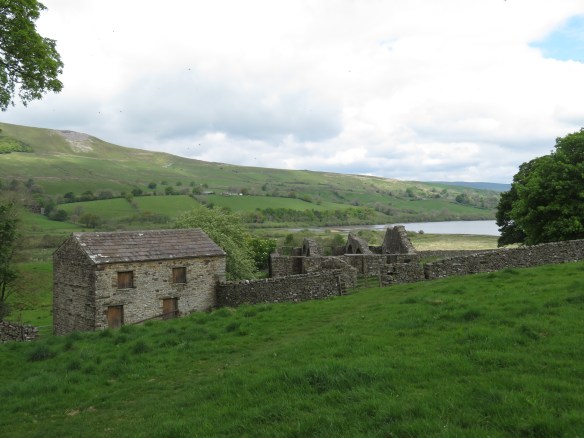
Meadows at Muker

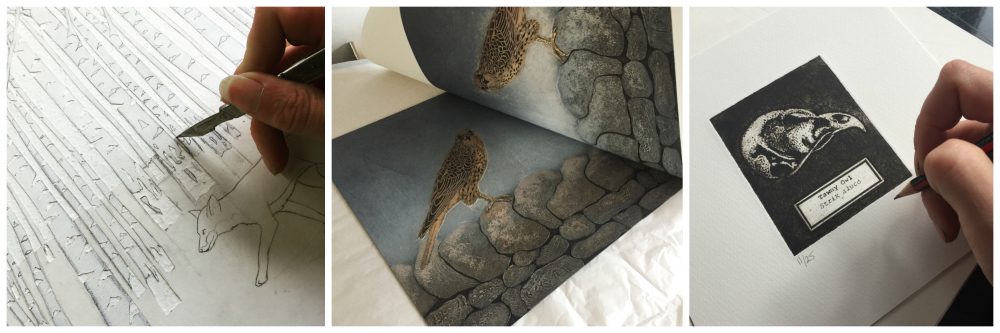
For anyone that is new to my blog, I’m currently working on a project with the Dales Countryside Museum. I’ve been printing up their archive of Marie Hartley MBE’s wood engraving blocks that were used to illustrate her books about Swaledale, Wensleydale and Wharfedale written with Ella Pontefract. I’m now in the next phase of the project which is to carry out research in the form of looking at the archive of her notebooks, diaries and sketchbooks and going out ‘into the field’ to get inspiration for a new body of my own work to be exhibited at the museum gallery in 2020.
IMG_5825

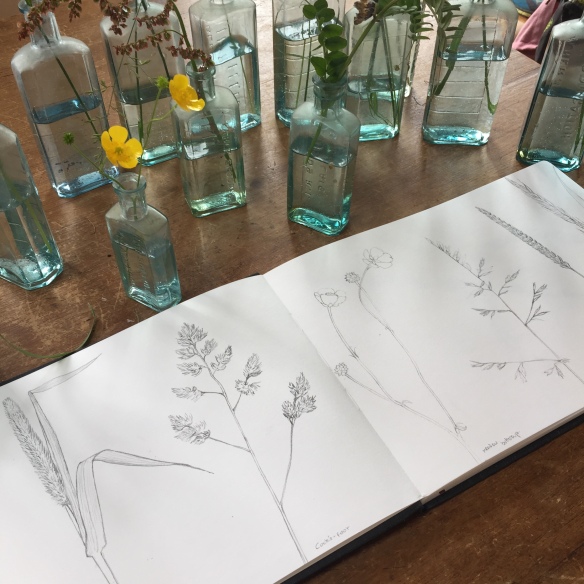
Today I’ve been sketching meadow grasses and flowers for reference for new prints inspired by the glorious upland meadows (of which the Yorkshire Dales National Park has a few). In the 1930s, Marie and Ella wrote about ‘haytime’ in the dales, of a time when whole communities were involved in the cutting and collecting of the hay, machinery was pulled by horses and the hay was then stored in the famous stone barns (often known as cow’us or laithe) ready for feeding the overwintering cattle and sheep.

(A selection of Marie Hartley’s wood engravings depicting aspects of hay making)

“When hay-time comes, generally towards the middle of July, everything else is put aside. All the women help, extra daughters appear miraculously from service. Irishmen are sometimes employed by farmers with small families. In a very wet summer much of the hay has to be left to rot in the fields, and some of the grass is never cut. When hay-time is well and safely over, a wave of relief goes through the upper dale”. (from Swaledale, 1934)

The meadows were not only fragrant, extremely beautiful and a rich source of food they were also very important ecosystems supporting a wide variety of invertebrates which were then fed on by numerous birds and animals. Unfortunately, as agricultural practises have changed and intensified, over the last fifty years 98% of meadows in the UK have been destroyed.
IMG_5782

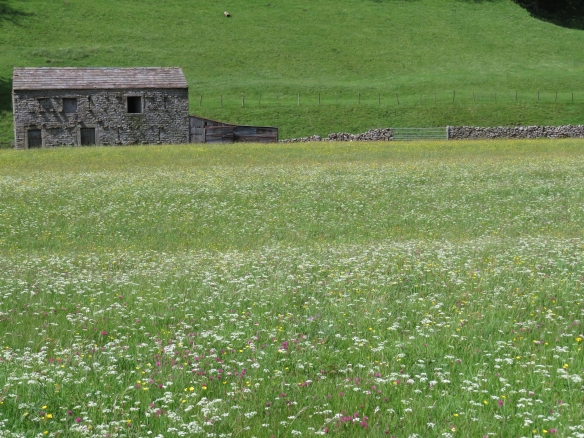
The Yorkshire Dales have also lost a proportion of their traditional meadows but, fortunately, due to the work of the Yorkshire Dales National Park Authority (YDNPA), Yorkshire Dales Millennium Trust (YDMT) and Natural England alongside committed farmers and landowners, the last twenty or so years has seen the conservation and restoration of species-rich meadows. This is a subject that I’ve been interested in since moving to the Yorkshire Dales and further information can be found at the websites of the YDMT & YDNPA. Times are very different now and ecology and economics mean that we’re unlikely to go back to the days of meadow-strewn Dales but what is being created is a network of species-rich meadows that everyone can benefit from and that are being managed with the help of modern machinery alleviating some of the hardships that the farming community of Marie’s time would have suffered. They are not only useful as a fodder crop of animals but attractive to wildlife, the local community and a visitor attraction which helps the local economy.

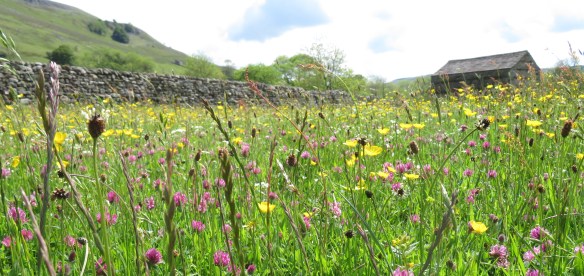
Due to Ella and Marie’s obvious love of the area, I’ve been visiting and revisiting locations around Kisdon fell (I am a fellrunner after all)  which include Muker, Thwaite, Angram and Keld. The meadows at Muker, which have been given Coronation status, are currently at their most stunning.
IMG_5772

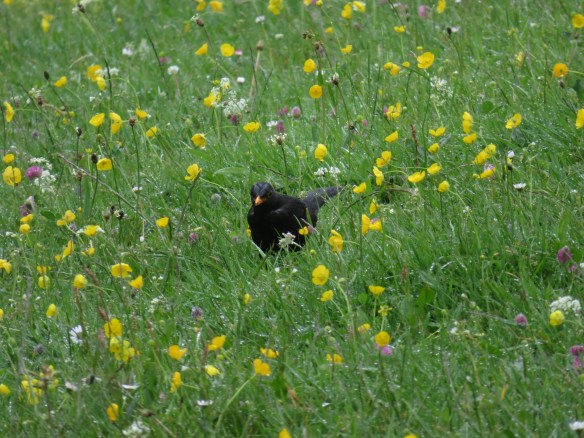
This is the perfect time to visit. They are colourful and smell amazing, swallows and swifts swoop over them to feed on the many insects that they attract and there are so many different plant species. You can see yellow rattle, pignut, red clover, wood crane’s bill, eyebright, rough hawkbit, cat’s ear, meadow buttercups, lady’s mantle, crosswort, speedwell and melancholy thistle to name but a few!
IMG_5669

“In this grave sweet valley of the Swale meadows like the flowery meads of medieval paintings burgeon in early summer. Perhaps nowhere else in the dale does the yellow of buttercups splash the fields more boldly, or the pink of crane’s-bill tinge them more deeply, or wayside bushes shower sprays of pink and white roses more freely than here round Gunnerside and Muker” so says Joan Ingilby and Marie Hartley in their book, The Yorkshire Dales, 1956.
Sketchbooks and Wood Blocks

At the time that I’m writing this, I’ve just printed the last of the Dales Countryside Museum’s collection of wood engraving blocks created by Marie Hartley MBE. I’ve completed ten public sessions at the museum and met some very interesting people connected by a shared love of the legacy created by Marie, Ella and Joan. Artists, farmers, writers, photographers, people that knew her and people that didn’t (but wish they had). Many had stories to share, brought their own prints by Marie to show me and were pleased to have the opportunity to see her exquisite wood engravings close up. I’m now entering the next phase of the project and I will be continuing my research on her life and work by reading her notebooks and looking at her sketchbooks. I’ve read the three ‘Dales books’: Swaledale, Wensleydale and Wharfedale and have also read her beautiful memoire to Ella Pontefract, ‘Yorkshire Heritage’. Other works that I’m finding particularly useful are ‘Forms and Colours’ (about her artwork); ‘A Favoured Land’ (an appreciation of all of the books with essays); Yorkshire Cottage & The Yorkshire Dales. I’ve also started exploring certain areas which I intend to make my own work about.

IMG_3833

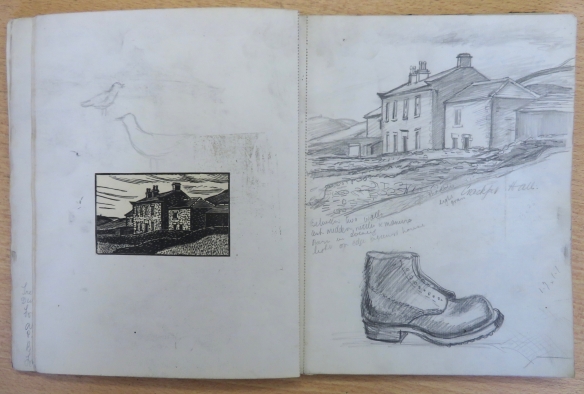
I love this image from Marie’s Swaledale sketchbook. It features a sketch of Crackpot Hall before it became a deserted ruin and the resulting wood engraving. Those combined with the notes, boot and ghostly birds are the distilled essence of the project for me.

I have a full calendar year in which to create my new prints and I intend to make use of that by visiting specific places regularly throughout the year, observing the changes in the landscape and the different flora and fauna. Narrowing down my subject has been extremely difficult and I’m hoping that my research will help with that. I have started by deciding to concentrate on places written about in the three Dales books as these are illustrated by the wood engravings. I’ve then used my research so far to work out places that Marie and Ella repeatedly visited or had a particular love for and I would like to include some locations from each book. As a fellrunner, I am particularly keen for each place to centre around at least one prominent fell. I’m currently visiting:

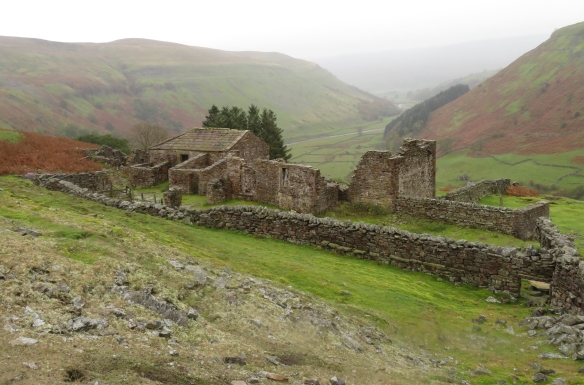
In Swaledale: Kisdon with the surrounding areas of Muker, Keld, Angram, Thwaite and most probably heading up into Birkdale which was a firm favourite for Marie and Ella. There are some fascinating manmade structures within this area that tell the story of its past mining and farming practises and combined with the rich ecological habitats, it really is a gem of a place that I’ve totally fallen in love with.

IMG_1788

Overlooking Crackpot Hall towards Muker with Kisdon on the right (Oct’18)

In Wensleydale:  Addlebrough from Semerwater with Raydale, Cragdale and Bardale and the moors above Stalling Busk. As the second largest natural lake in North Yorkshire (the first being Malham Tarn) being concealed from the main road it is almost a hidden wonder. It is also the source of the river Bain which, at only 2 miles long, is the UK’s shortest river.

IMG_5087

Overlooking the old ruined 18th Century church at Stalling Busk towards Semerwater.

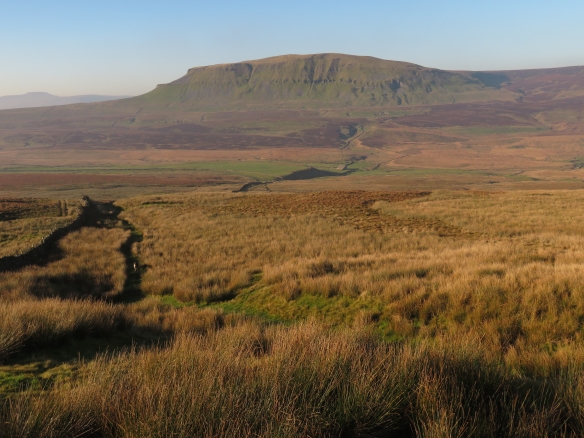
In Wharfedale: Penyghent from Littondale including Foxup. I am delighted that it is included in ‘Wharfedale’ because I have always loved Littondale and Penyghent is my favourite hill which I have explored extensively in all weathers and at all times of day (and night). I can see it from my studio!

IMG_2226

Penyghent viewed on the ascent of Fountains Fell (Nov’18)

I’m also exploring Wether Fell, Dodd Fell & Snaizeholme and I will be settling on more locations as I do more research.

I’m looking for places that have their own special character making them distinctly different from other areas. The fells within each area often rise as singular hills which are easily recognisable from all directions. I also want to look at areas that are noted for their special scientific interest in terms of their flora and fauna. It seems apparent to me that the Yorkshire Dales has changed dramatically since the time that Ella and Marie wrote the books. They captured and recorded a way of life that was on the cusp of changing forever being affected by the technological advances in agriculture, the increased use of cars and tourism. However, what hasn’t changed is the geography of the area and combined with natural processes and human influences, the Yorkshire Dales National Park is home to some of the most diverse wildlife habitats in the UK. I want to explore those and to see how their history is written on the landscape.

In future posts I will be writing about these places and my experiences when working in them, more about Marie and her life and the things that I discover as I continue my research.