Join Us for Bird Lore and Meet the Artist Events

Since 2015, I have been working with artist Josie Beszant and ceramicist Charlotte Morrison on a project called Collections. We have been exploring the human urge to collect—why we gather, what we choose to preserve, and how objects can hold memory, meaning, and emotion. We have been developing our work through a series of exhibitions and residencies, including partnerships with museums and galleries. Eight years after our first collaboration with Ryedale Folk Museum, we were delighted to be invited back with an exhibition of new work called Charms and Murmurings.

The exhibition opens this weekend with two events at the museum – Bird Lore with Sally Coultard and Friends takes place from 11.30 – 12.30 when Josie and I will be chatting to the best selling local author and newly appointed patron of the museum about her latest book and our exhibition, both of which explore the fascinating folklore of birds. For more information and to book a place, click HERE

In the afternoon, Charlotte, Josie and I will be at the museum gallery from 2-4pm in a Meet the Artist event. We will be chatting to visitors and answering questions about our new work.

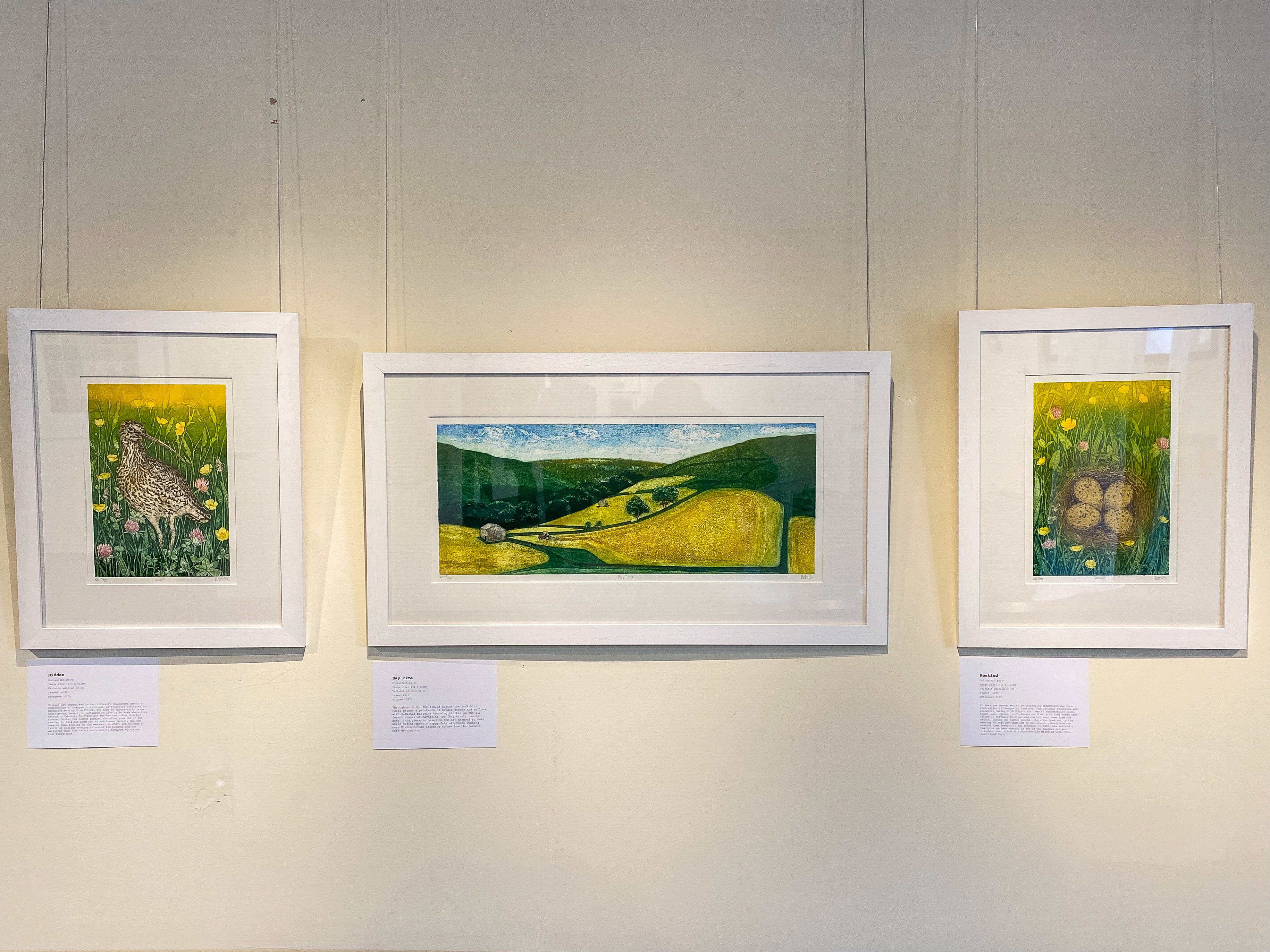
The exhibition continues until 2 November 2025 and over the coming weeks I will be writing about the collagraphs that I have made and the stories behind them. I hope you will join me in exploring the different birds that are loved and feared in our folktales and embedded in our language, place names, and traditions. 

Celebrating Meadows and Curlews! Two exhibitions to enjoy this summer.

It has been a long time since I wrote anything but I have plans for ‘short and sweet’ in future so that maybe, just maybe I’ll write more often than once every year! This post is just to let everyone know that I have two exhibitions on at the moment.

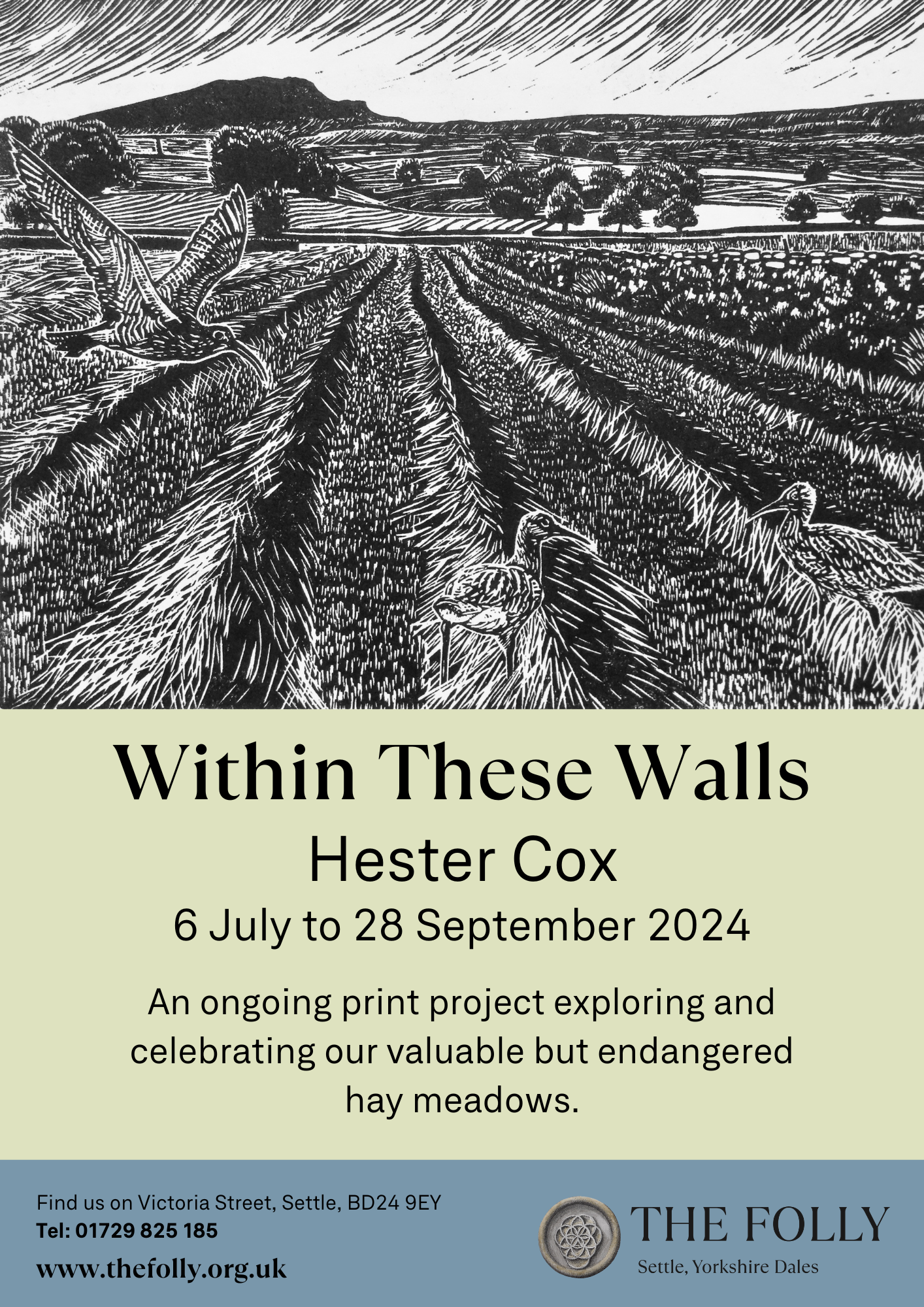
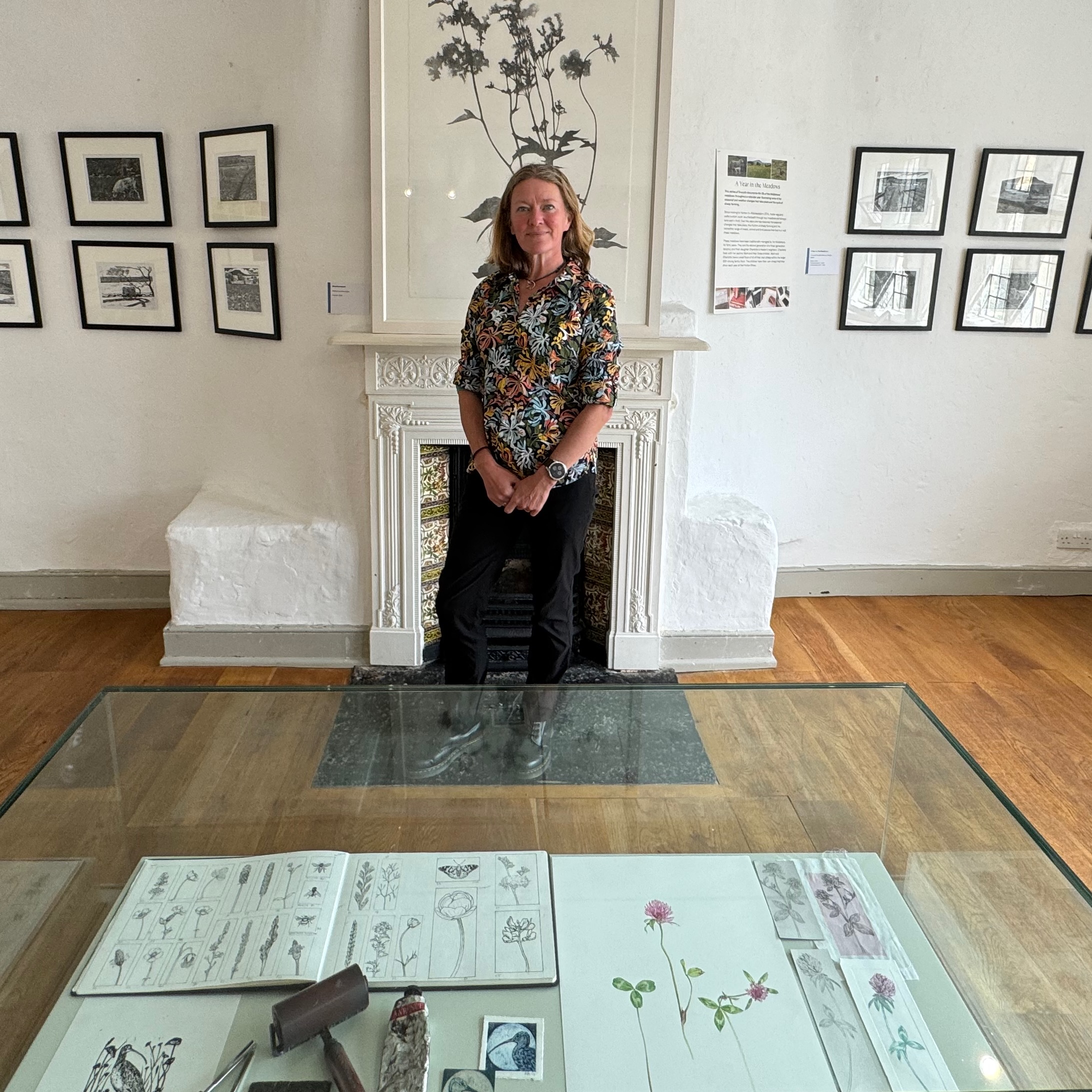
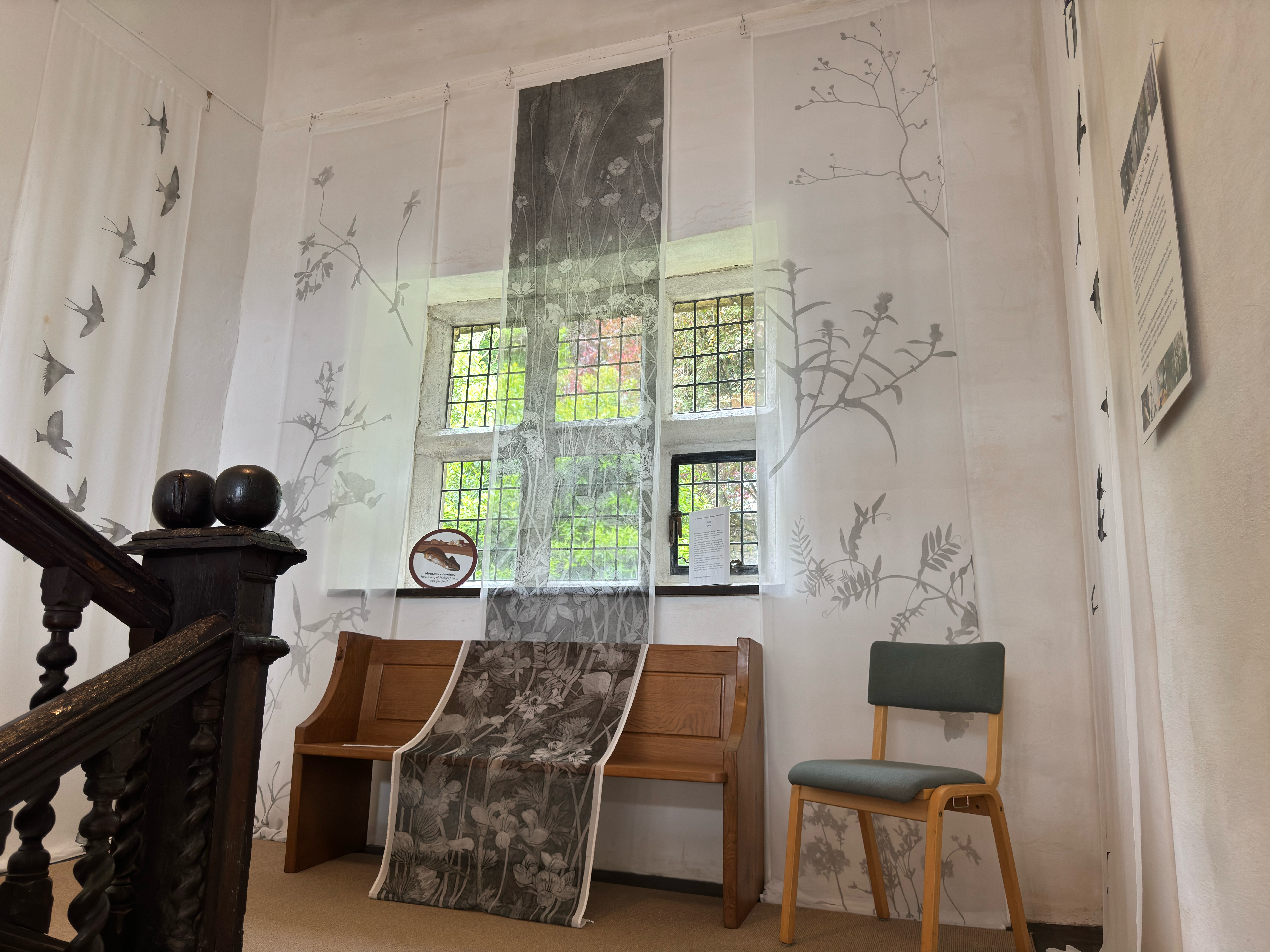
I’m absolutely delighted that Within These Walls has a new venue. The Folly is an old and fascinating building housing the Museum of North Craven Life and also the award-winning The Folly Coffee House! My hangings are gracing the upper stair well and the rest of my project is exhibited in the top floor gallery space. The museum is at Victoria Street, Settle, North Yorkshire, BD24 9EY and is open:
Tuesday – Saturday and bank holiday Mondays, 11:00am to 4:00pm (last admission 3:30pm)
The Folly Coffee House is open:
Monday-Saturday 10:00am to 4:00pm

The other exhibition is a fabulous project called Cry of the Curlew coordinated by Paco Valera and Barbara Murray whose photos and poetry document the plight of the iconic curlews of the Yorkshire Dales. As a longterm curlew admirer and campaigner, I am delighted to exhibit my collagraphs and Migration series prints in this important exhibition that has been previously been shown at the Dales Countryside Museum.

Here’s what Kendal Museum has to say:

The beauty and fragility of Curlews is highlighted through the stunning photography of Paco Valera and insightful prose-poetry by Barbara Murray. Inspiring artwork is on display by Sally Zaranko, Hester Cox, Judith Bromley, and Robert Nicholls, alongside the wire sculptures of Stephanie Smith. Swedish artists Emily Berry Mennerdahl and Jonas Böttern of Hillside Projects present work symbolising ecological collapse. A video and soundscape by June Gersten-Roberts features interviews with farmers on sustainability, along with Alastair McIntosh’s poem, Extinction set to the music of Loriana Pauli. A new watercolour work by Dr William Titley of In-Situ beautifully maps ‘The Curlew Way,’ as part of his Walking with Landscape project. A wonderful display by Curlew Recovery South Lakes will demonstrate the vital work they are doing to protect nests and support the delicate local population of these beautiful birds, as well as sharing ways you can get involved.

I’ll be taking a well-earned break in Scotland in August but when I return in September I will be starting new work celebrating some of our priority bird species of the Yorkshire Dales National Park.

Within These Walls: Hay Time in the Dales

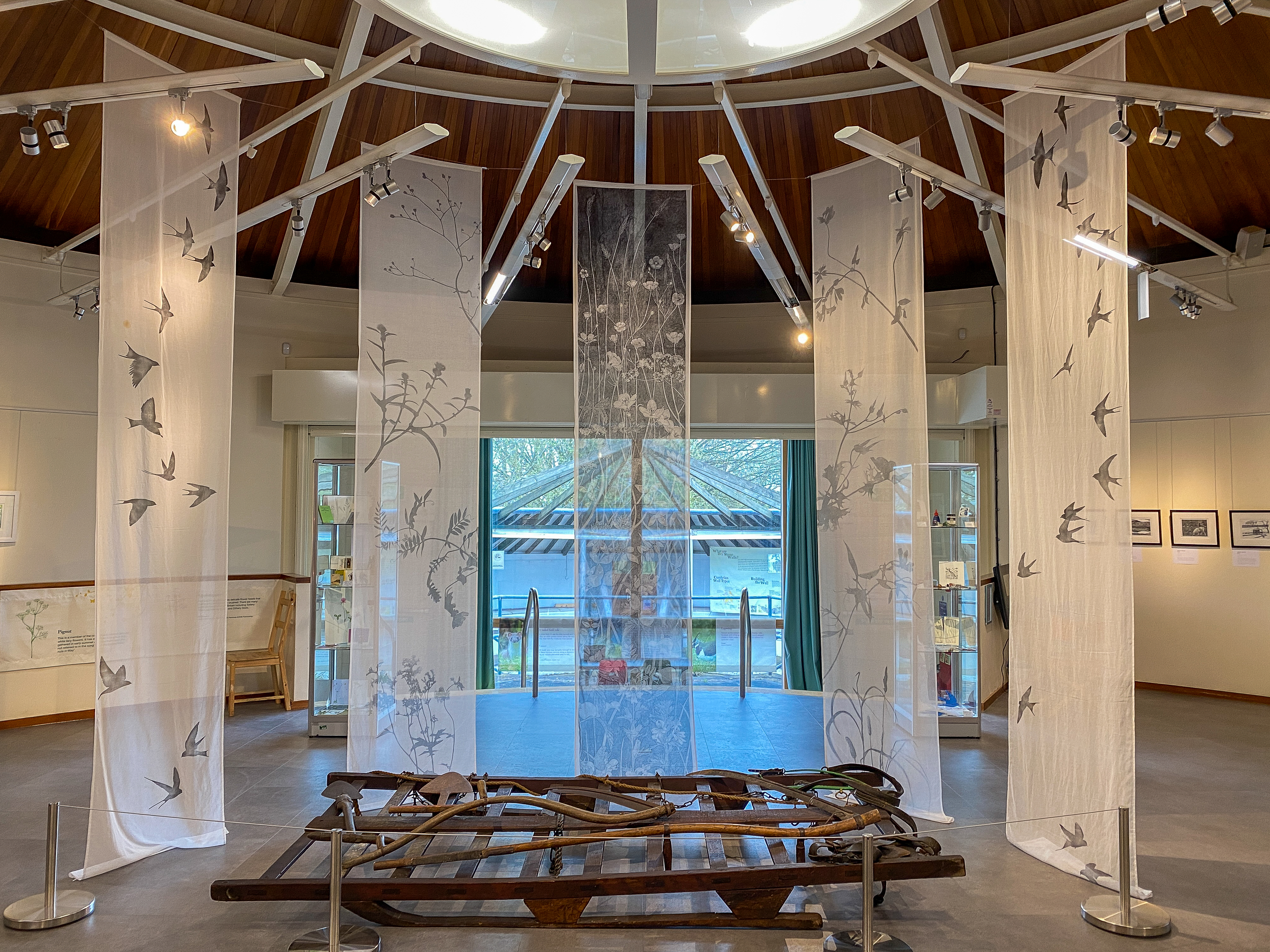
My print installation, Within These Walls, created for a field barn at Grassington Festival in 2017 displayed with a hay sled.

After seven and half months of intensive work on my calendar linocuts, five new monotypes and a new collagraph, my exhibition at the Dales Countryside Museum is open and I’m delighted with how it looks. Fiona and her team have chosen an array of artefacts that were used for haymaking in the Yorkshire Dales along with a wonderful archive of oral histories and photographs of the Irish workers that came over to Yorkshire each year to help with Hay Time.

You can watch two films at the exhibition: one is an introduction to my studio with a collagraph printing demonstration and the other is the 2 minute film Paul Harris created of my installation in the barn.

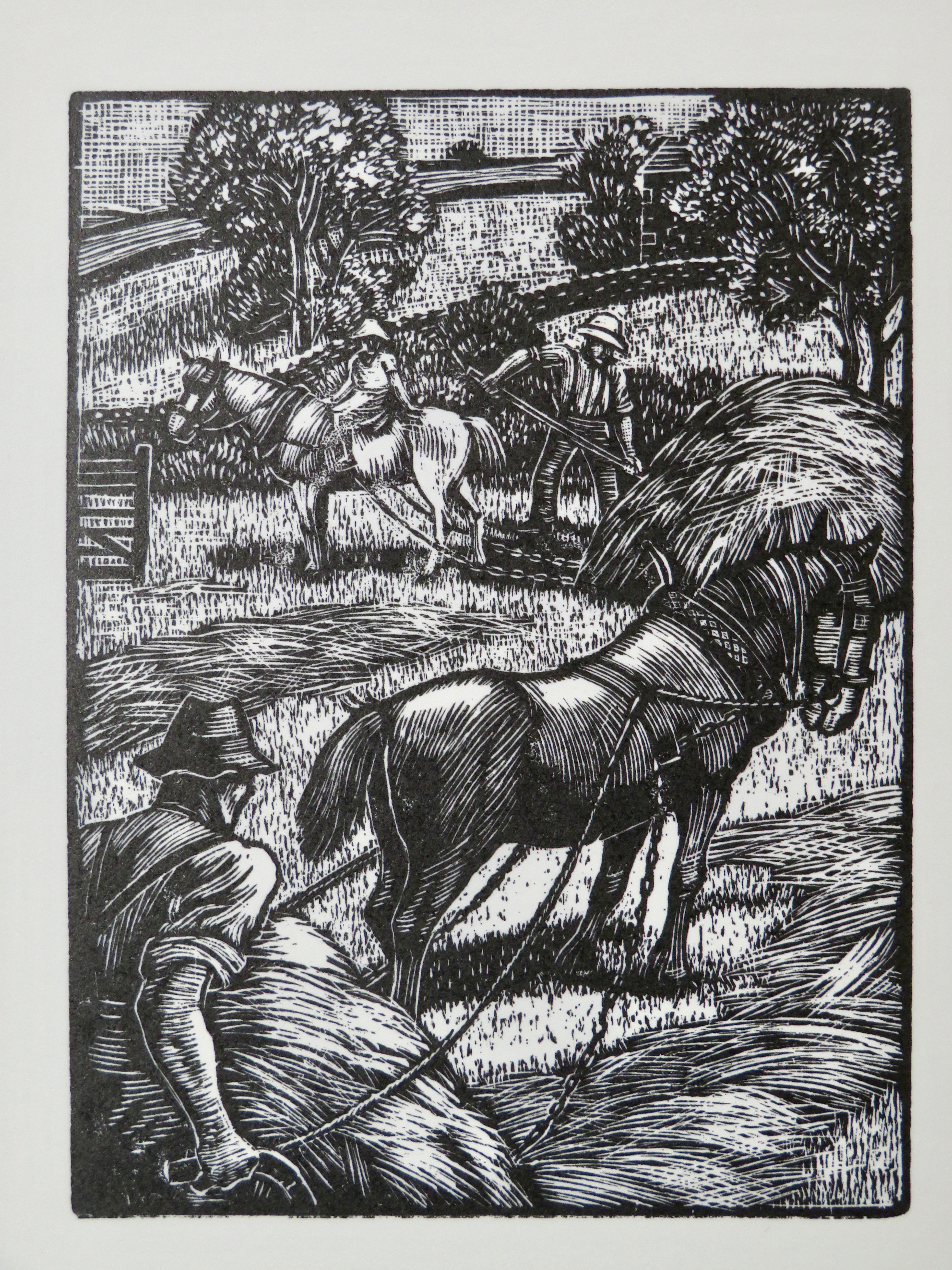
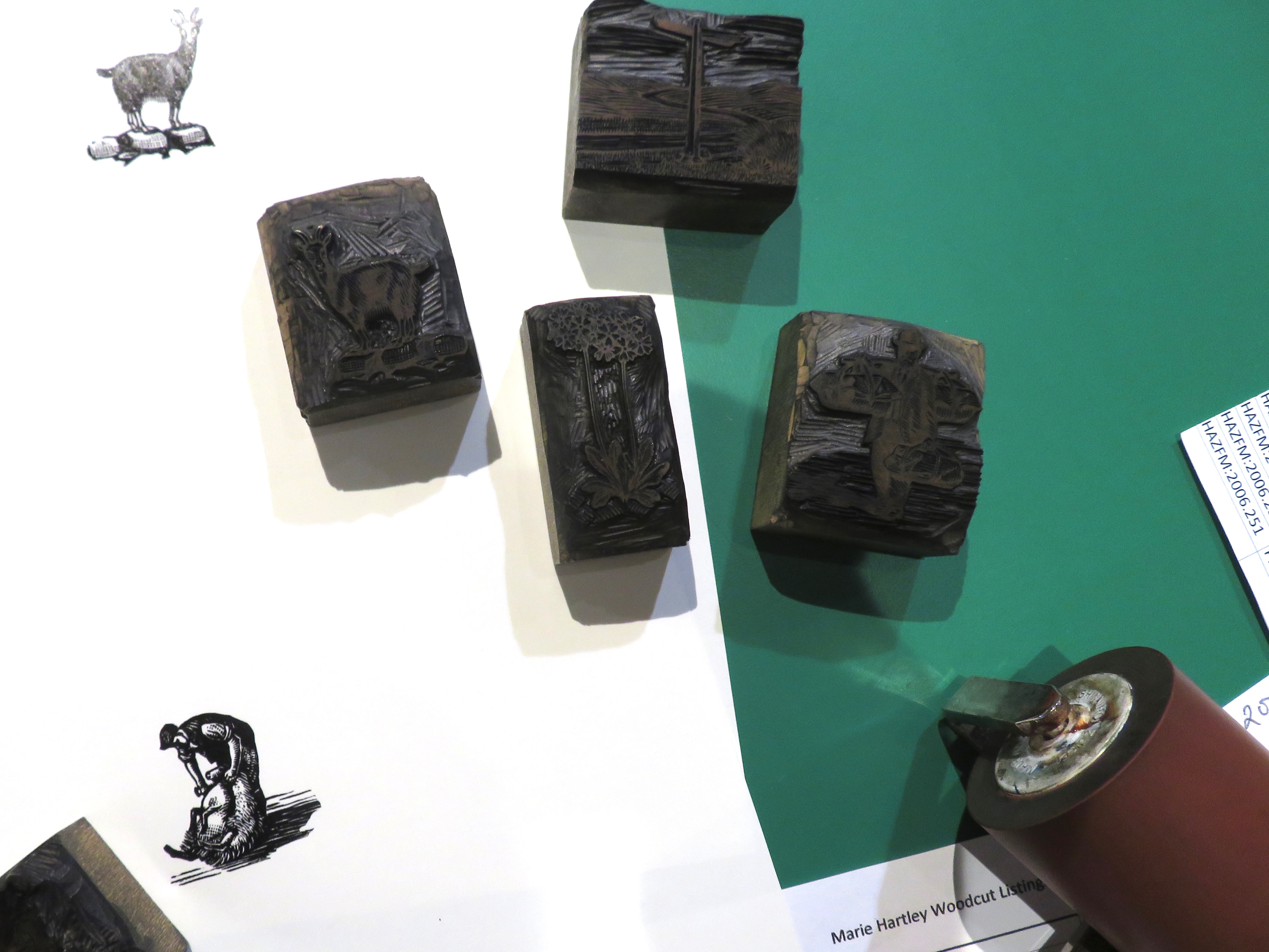
There are also cabinets with some of Marie Hartley’s original wood engraving blocks, and the prints that I made from them, showing scenes from hay making in the 1930s. I started this project back in 2014 when I moved to Horton-in-Ribblesdale and began walking a footpath through and past three local meadows. Throughout the year I observed the rhythm of sheep farming, the change of the seasons and accompanying weather conditions in the meadows. I was able to observe the many different species of plant that grew and the visiting wildlife to the meadows. It became apparent that they were really good examples of species-rich traditionally managed meadows and I began drawing the plants and making prints of the wildlife that came to them.

Over the years, I’ve become familiar with the meadows across the Yorkshire Dales and interested in ‘nature friendly farming’. This exhibition celebrates the ecological diversity of healthy hay meadows as well as their agricultural and cultural history with the hope that visitors can enjoy and understand the contemporary importance of these wonderful landscapes.

The exhibition runs until the 17th September 2023 and is open daily, 10am – 5pm. Entry to the exhibition is included in the museum admission fee:

  • Adults £4.90
  • Concessions (60s and over): £4.40
  • Under 16s: FREE
  • Carers: FREE

You can buy tickets on entry or plan your visit by clicking to book online HERE

A Year in a Meadow in Linocuts

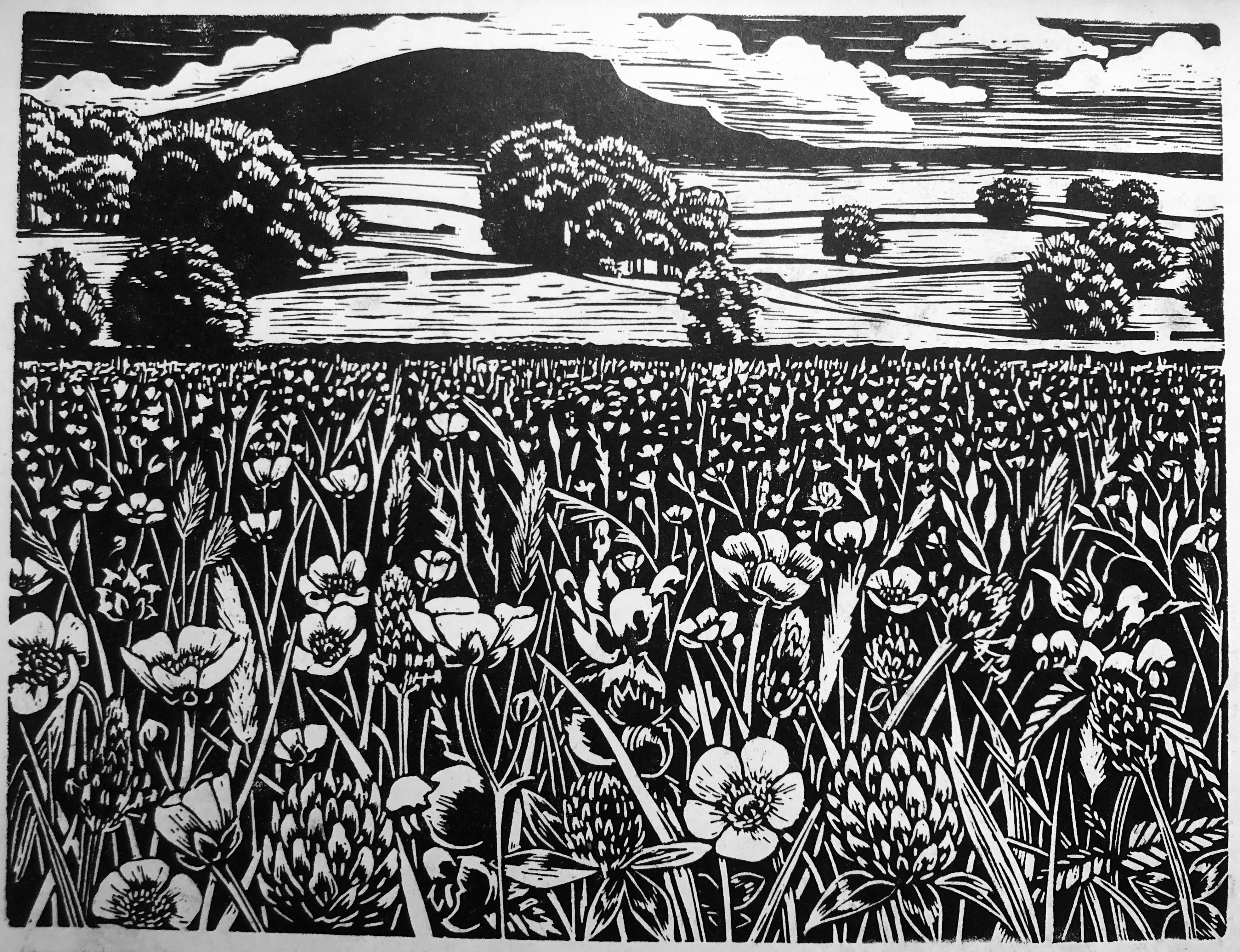
I’ve been beavering away on my meadow project and it’s time for a bit of an update. When I undertook my project with the Dales Countryside Museum back in 2019, I had always intended to create a series of linocuts as a homage to Marie Hartley’s gorgeous wood engravings but, as is often the case, I ran out of time and ended up sticking to collagraph. With this new opportunity to show my project at the museum I’ve been given another chance to achieve this goal. I decided that I will create 12 black and white linocuts that will illustrate life in a meadow over a calendar year. I have been taking note of everything that happens in our local meadows for the last eight years and have a wealth of photos, drawings and ideas. My neighbour that farms these meadows follows the traditional methods which means that she intermittantly grazes the meadows with a flock of ewes from September keeping the grass low enough to allow meadow plant seeds to germinate. In late October/November she introduces a tup to the ewes and he swaggers about the fields looking macho in his harness (it’s usually a texel and a friend rightly likened him to a nightclub bouncer). Then the ewes are back in with their lambs from early March through to the end of April. The fields receive a bit of farm ‘muck’ for fertilising at some point and then from May through to August, the meadows are empty of livestock and it is fantastic to see the speed at which the plants grow and the different species that are dominant at different times. The hay gets cut around mid-July and this year we were fortunate to witness the successful fledging of four curlew chicks.

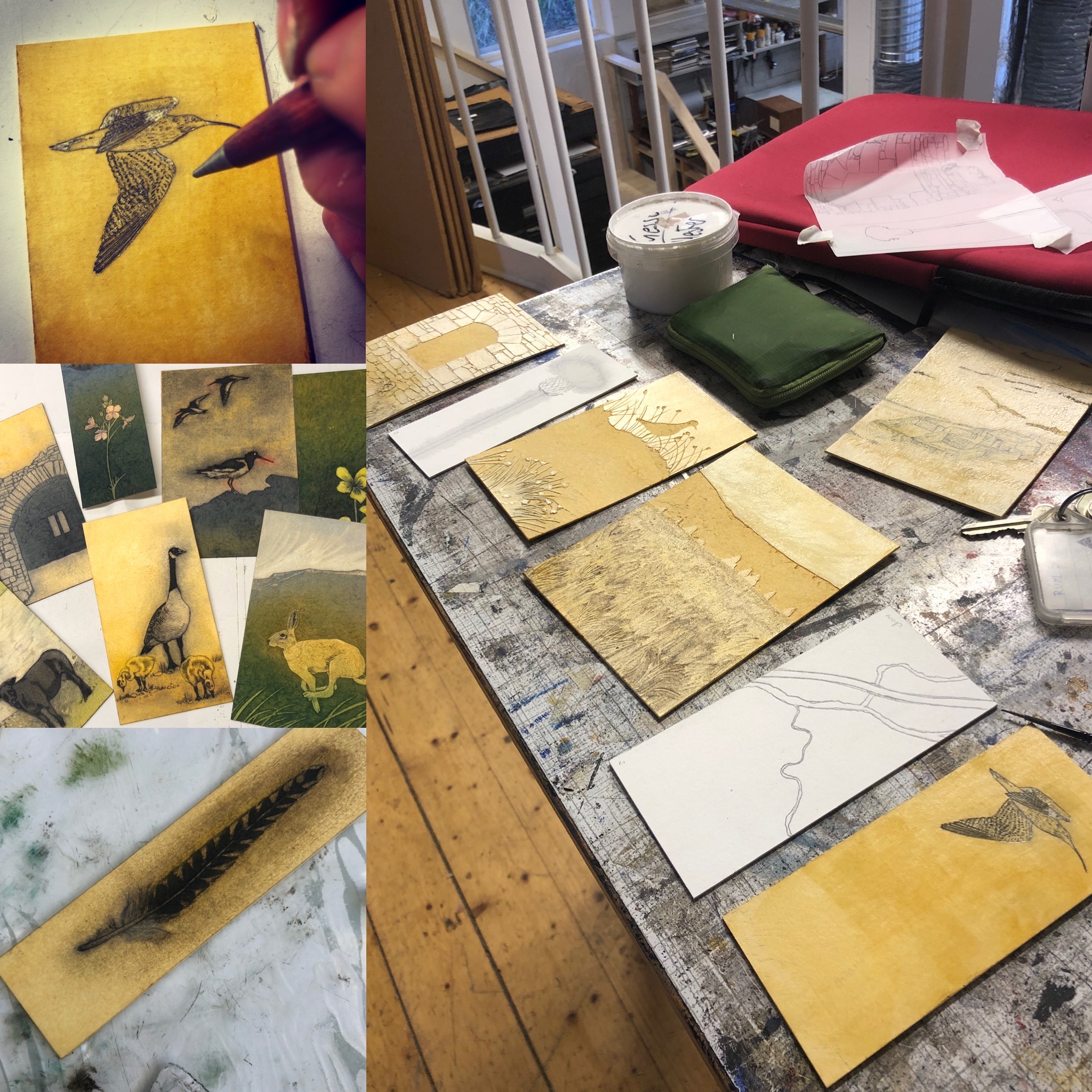
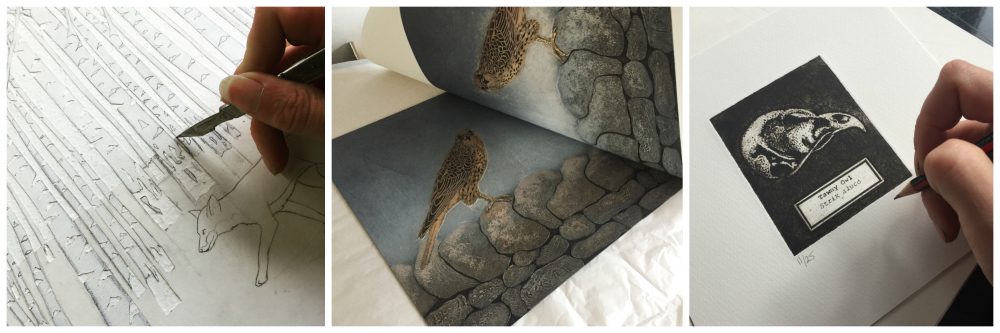
Marie Hartley’s wood engravings show some of the stages in the haymaking methods of the 1930s & 40s and my aim is to show contemporary methods with my images. I’m not an adept wood engraver (maybe one day!) but I am pretty competent at linocut, having done it on and off since I left college, and the look of it and way of working share some similarities with wood engraving. They are both relief print methods and so you are printing the raised surface of the block. The image is created by the removal of that surface with sharp tools. In effect, you are creating white areas that don’t print plus the block is a mirror image of the final print so it does require a bit of brain power to design in that way. I sometimes think that printmakers have very specific kind of brains in order not to feel befuddled all of the time!

In the above images, you can see the linoleum (made from a mix of linseed oil, cork dust, resin and gum pressed onto a jute backing). It is normally grey but I’ve stained the surface with printing ink so that it is easier to see the cuts that I’ve made. I also use a white gel pen to draw on some more complicated areas so that I don’t make mistakes when cutting. You can’t easily put back what you’ve cut away so it is important to keep track of what you’re doing.

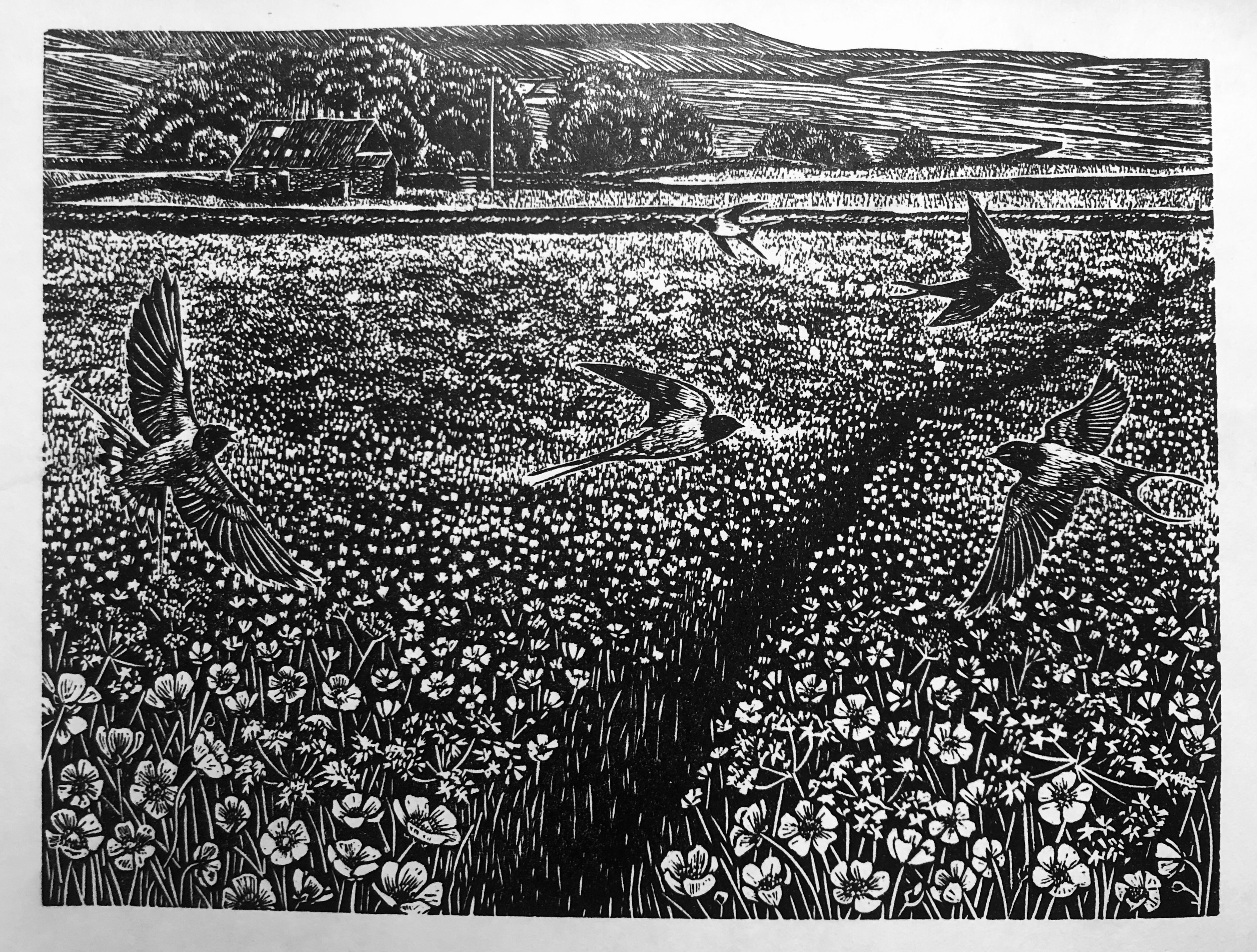
I’ve taken some time to look at the work of other artists known for wood engraving and linocut and the research has been really enjoyable. Having printed all of Marie Hartley’s blocks, I’m very familiar with her work but I also looked at the engravings of artists such as Charles Tunnicliffe, Clare Leighton, Howard Phipps & Clifford Webb. It is interesting to see how they handle different skies, how much detail they choose to put in and what kind of stylisation they employ. I’ve chosen to keep mine quite illustrational and very much about a specific place so you’ll see Penyghent cropping up in a few. Here’s the first proofs for May & June, I may ‘tweak’ them a bit before I edition them next year:

I’m also making a series of smaller square linocuts that will depict some of the diverse wildlife species that rely on the meadows, and the plants/trees growing on the fringes, for their food and shelter. There is a delicate balance at work with certain insects only eating specific plants and then birds and animals relying on feeding from the seeds of certain plants or eating the insects of the meadows and further up the chain you have birds such as barn owls looking for the shrews and voles that live in and on the edges of the meadows and birds such as curlews relying on sheltered places to nest and raise their chicks. I hope that this print series will help to communicate the ecological importance of these traditional meadows.

Studying the Meadows

Looking across Ashes Pasture to a farmer cutting hay beyond.

For the majority of this year I have been working on what I call my ‘Meadows Project’. This is a continuation of the work that I started back in 2017 with my installation Within These Walls’ and continued with a couple new prints inspired by haytime in the Yorkshire Dales as part of ‘View from the Fells: In the Footsteps of Marie Hartley’. As a result of a conversation with Fiona Rosher at the Dales Countryside Museum last summer, I’m delighted to say that I’ll be showing all the work created so far and a lot of new prints at the museum in the summer of 2023. It will be a joint exhibition with the DCM exhibiting their information and artefacts associated with hay making in the Yorkshire Dales.

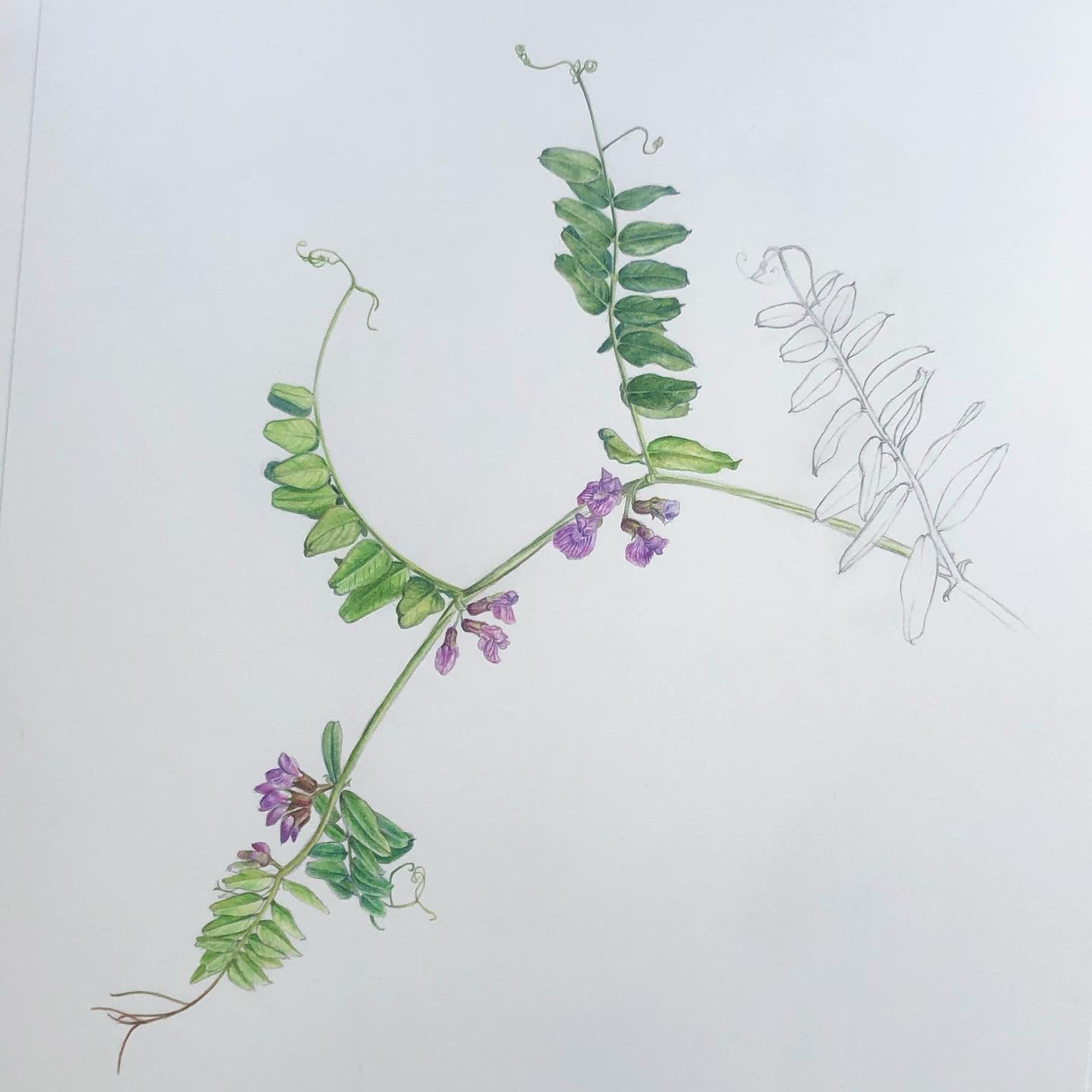
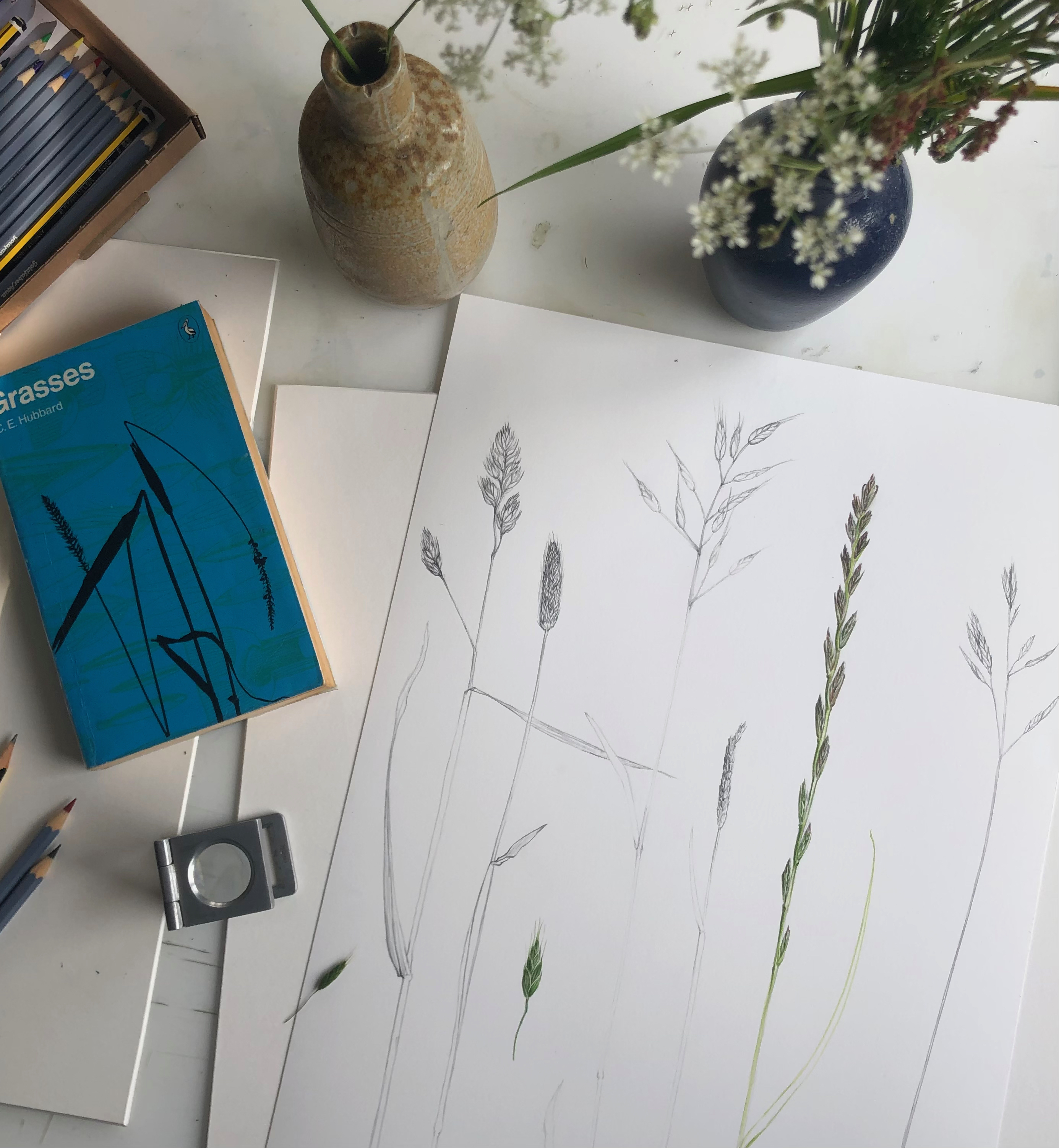
I’m fortunate to have a number of excellent upland meadows very close to my home and I’ve been visiting a couple of them almost daily. To date, I’ve identified over 50 grass and wildflower species and numerous invertebrates. I’ve spent some lovely meditative days sketching some of the plants from life using Faber Castell Aquafaber pencils.

These drawings will be reference for new prints and I have the germ of an idea for a new installation piece. I’m also planning a series of black and white linocuts that tell the story of a contemporary dales meadows in a similar way that the gorgeous wood engravings created in the 1930s and 40s by Marie Hartley MBE showed us how haytime was done in the last century. Now that the hay has been cut, I will concentrate on developing some of the new work and plan to share that with you over the coming months.

My local meadows. We call them ‘Charlotte’s meadows’ after our neighbour as it is her family that farm them.

Back in the Meadows

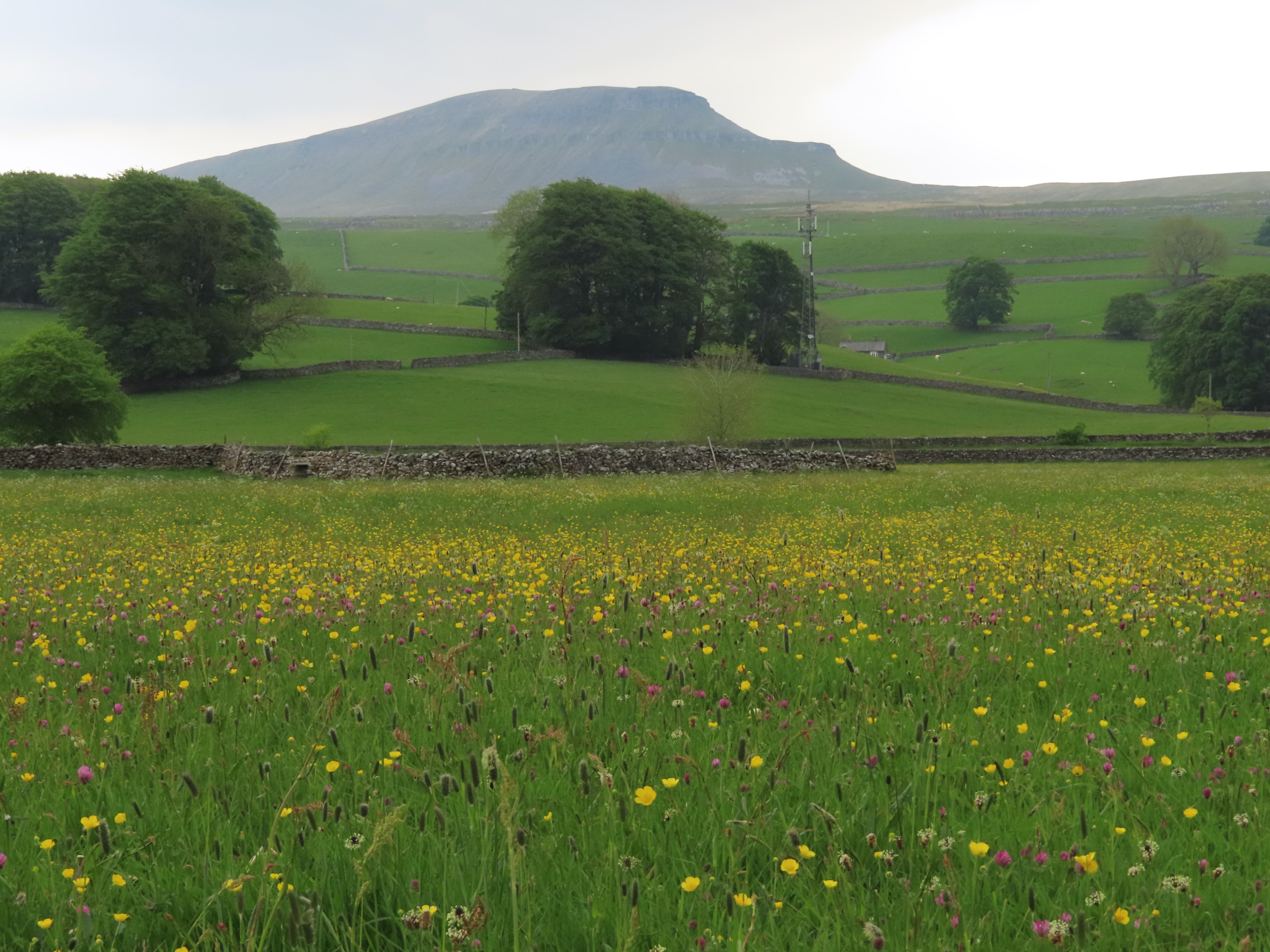
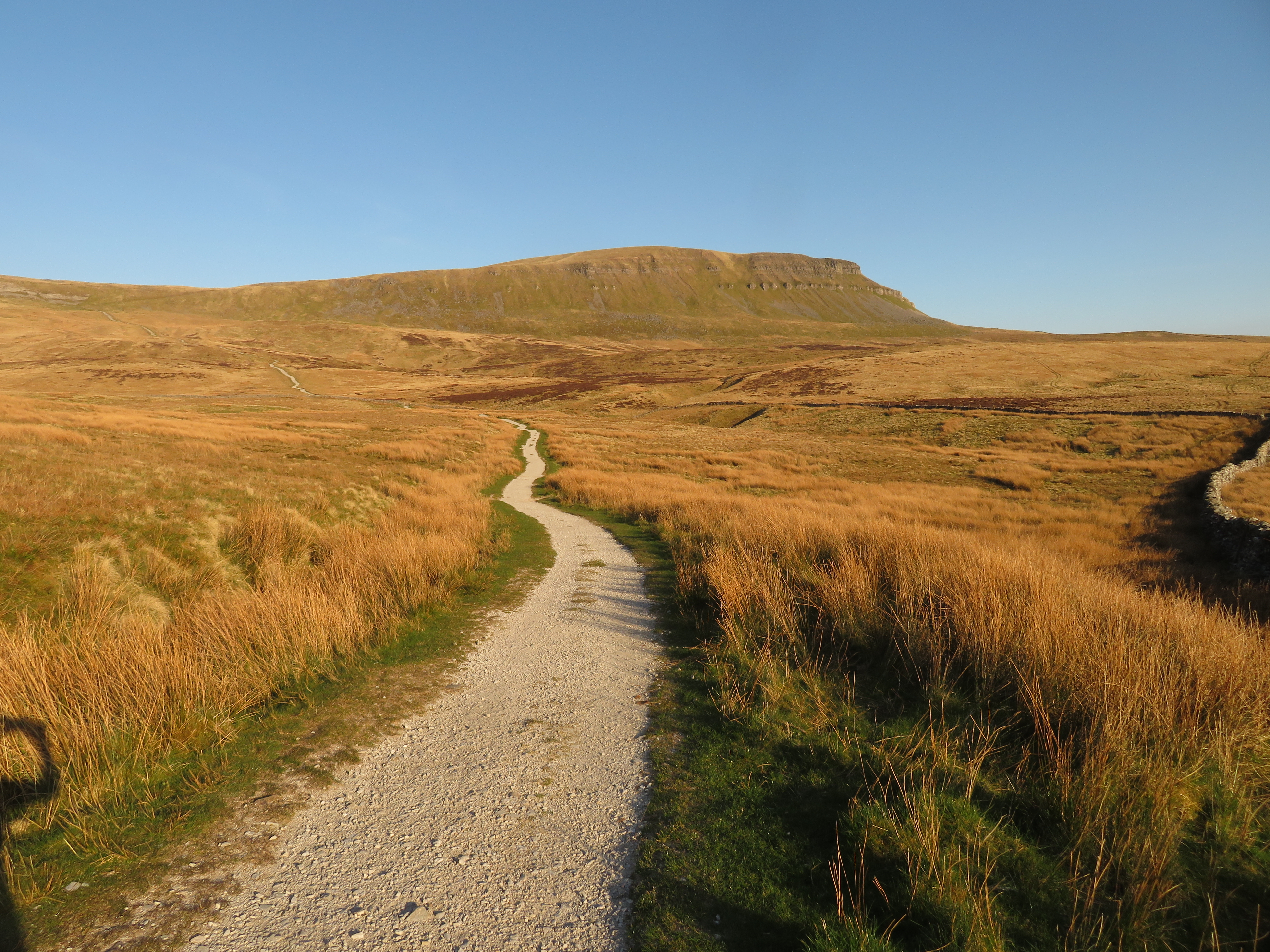
Pen-y-ghent seen from one of the beautiful local meadows on my daily walk.

I cannot believe that my last post was in 2020! I’ve been so immersed in all the myriad of things that I do as a professional artist that I haven’t given myself the time to sit down and write. I’ve decided that perhaps ‘little and often’ would be preferable to not at all. Over the next few months I intend to write about some of the projects that I’ve been involved in lately but my main topic will be ‘Within These Walls’, my ongoing work concerned with the upland meadows of the Yorkshire Dales.

There will be an exhibition next year in collaboration with the Dales Countryside Museum. They will be exhibiting their wonderful artefacts and information about Haytime in the Yorkshire Dales and I will be showing all of the print works that I’ve created for the project so far. So…watch this space and I’ll be back shortly.

Marie’s List

As lockdown restrictions have eased, I’ve been able to revisit a few of the sites for my project and have enjoyed getting back to Keld, Muker, Birkdale and Semerwater. It has been interesting to see how the whole situation with Covid has impacted my work for the project. With the exception of teaching workshops, gallery deliveries, art fairs and exhibitions, I mainly work from home in my studio. As my work calendar quickly went from full to totally empty I found myself with plenty of time to myself and few distractions from other projects. At times, making new prints for my exhibition has been a struggle but at others, it has been a solace – something to become absorbed in allowing me to forget what was happening in the wider world. What I have noticed is that my focus shifted from making landscape pieces or larger single prints to much smaller work inspired by words and details.
CE143313-F4B8-4198-A375-533033B3A18E

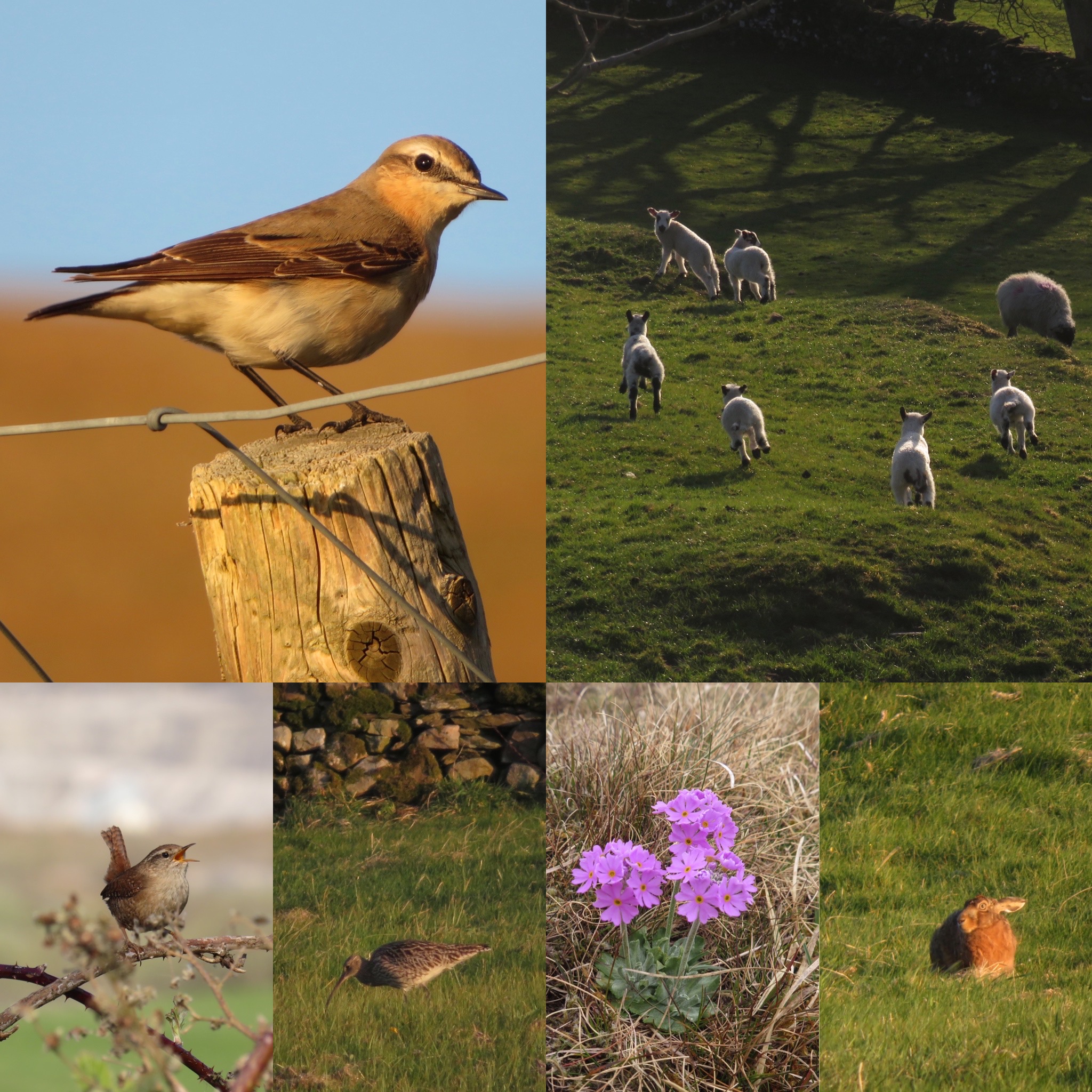
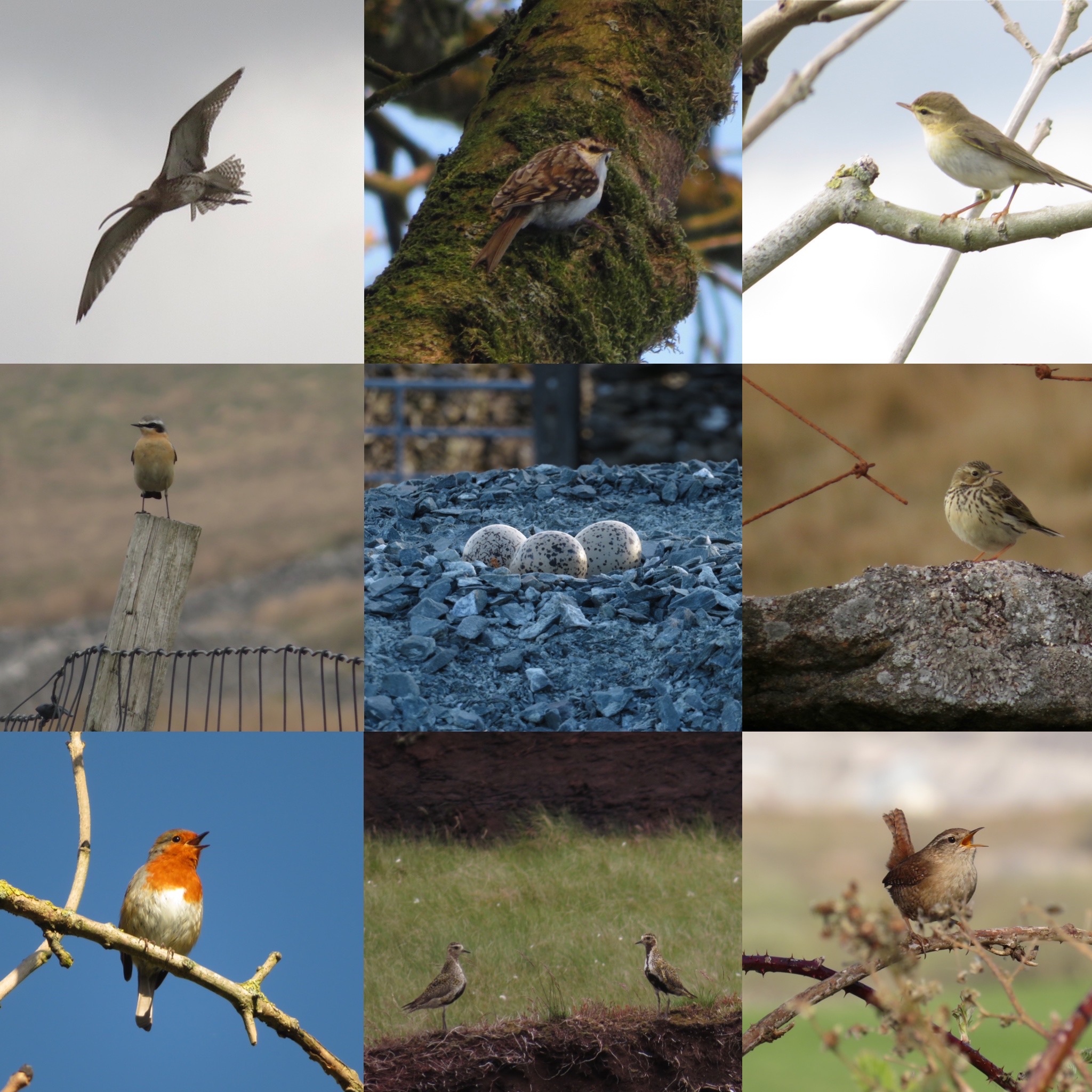
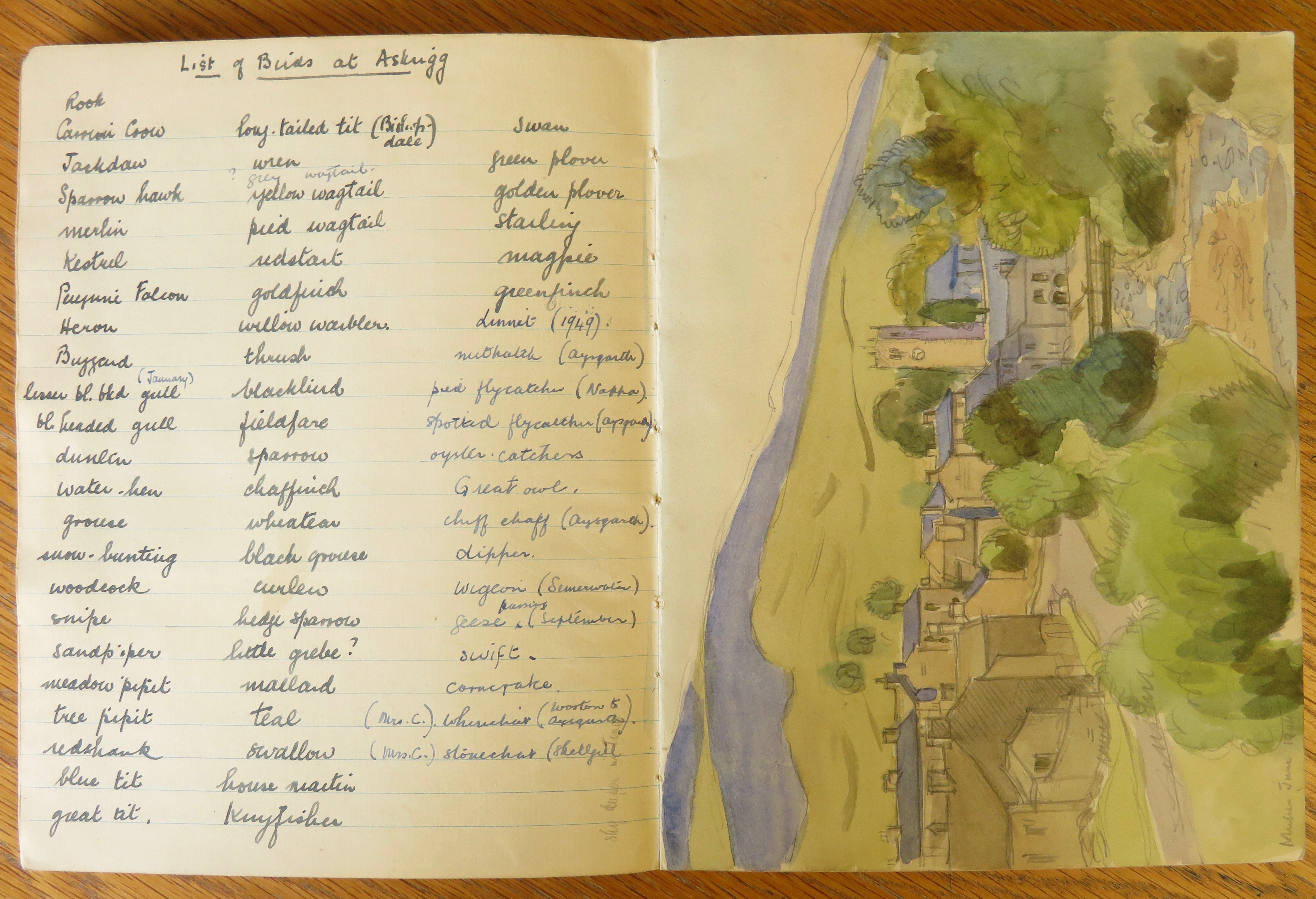
As for many people, nature has become an even bigger inspiration during this time. The birds becoming active and migrants returning as spring arrived became of huge interest to me as I went out for my daily exercise. The songs seemed louder and the species more varied. I saw linnets in the lane, curlews in the field, oystercatchers nesting by the road, ring ouzels right next to the footpath on Penyghent and, with the absence of traffic and people, they all seemed bolder and more at ease. Meeting a local farmer on one of my walks, we stood across the lane from each other and discussed how we felt that the Yorkshire Dales was probably as quiet as it would have been a hundred years ago. I began listing all of the birds that I’d seen within my local area and I compared that with a list that I’d found in Marie Hartley’s diary (from 1943-47).
IMG_6152

I’d already noticed the appearance of the corncrake on that list, a bird no longer seen in the Yorkshire Dales, and I started to make a note of all the birds on both our lists that have been classed as ‘birds of conservation concern’ by the BTO (British Trust for Ornithology) & RSPB (Royal Society for the Protection of Birds). “The assessment is based on the most up-to-date evidence available and criteria include conservation status at global and European levels and, within the UK: historical decline, trends in population and range, rarity, localised distribution and international importance” (BTO). The ‘Red List’ currently has 67 species of birds found in the UK that have been assessed as being at risk. Marie’s list of 66 birds includes: 1 that is now completely absent from the Yorkshire Dales, 14 that are on the red list, 23 on the amber list and only 28 are classed as being ‘green status’ in that they are plentiful and breeding well within the UK. I have a list of 68 species that I’ve seen and have been able to positively identify within the Yorkshire Three Peaks region. I can only guess at how much more abundant many of the species were in the early 1940s, a time just before agriculture was about to undergo major changes in intensification and mechanisation.
IMG_6136

Wood engraving by Marie Hartley showing haymaking in the Yorkshire Dales.

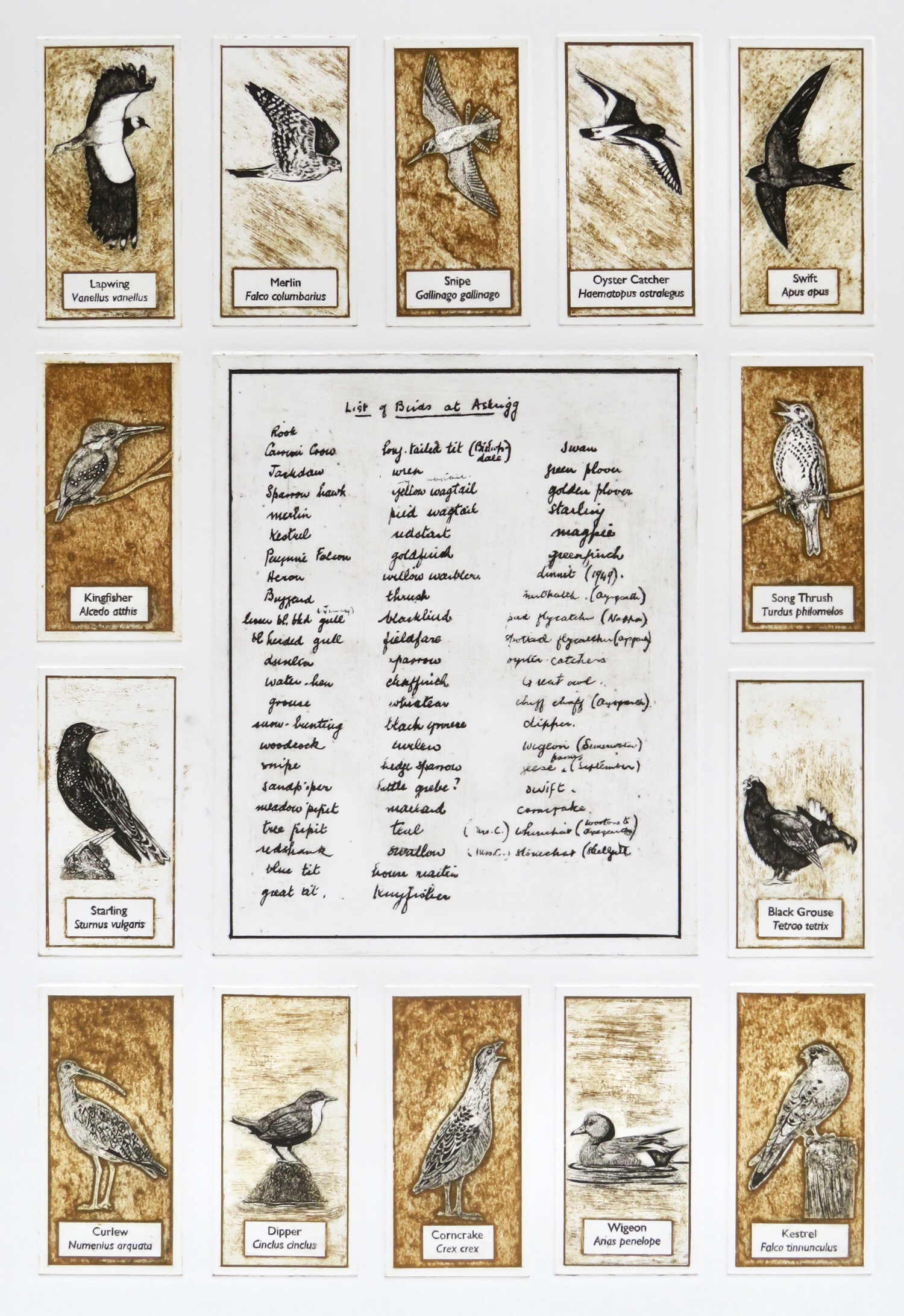
I’m not an ornithologist and everything I know about birds has been learned from my mum (a retired ecologist) and my own research but I find the subject fascinating: worrying but also inspiring. On the one hand, it is of great concern that there are so many bird species now in decline but on the other hand, heartening to know that the Yorkshire Dales is home to so many of them. I decided to make a piece of work taking Marie’s List as a starting point. I wanted it to celebrate what we have in the Yorkshire Dales and also perhaps provoke discussion and interest in bird conservation and the reasons why so many birds are in decline.
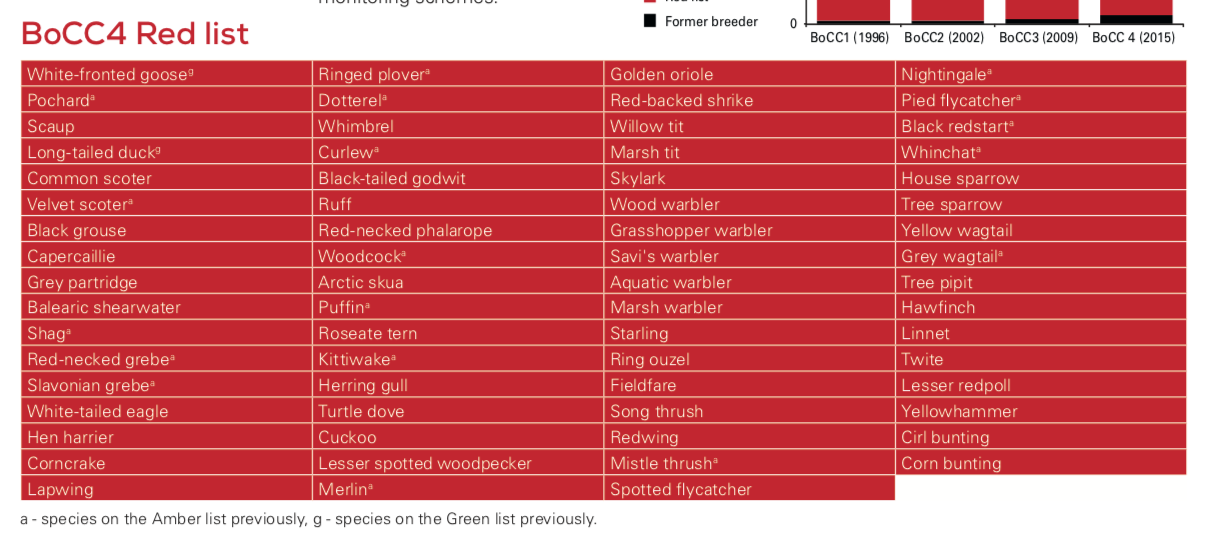
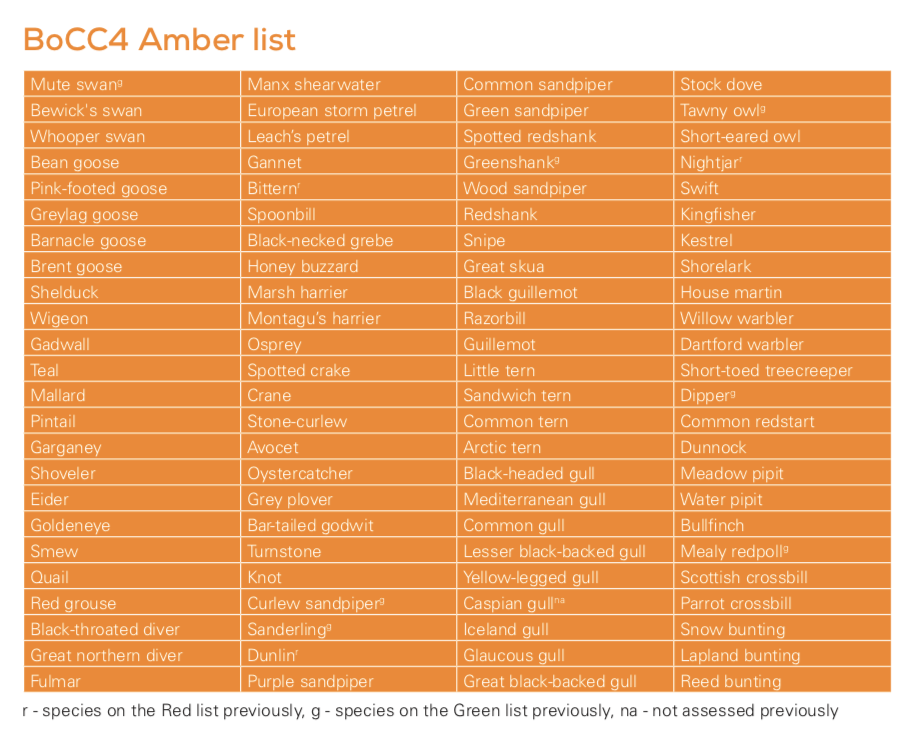
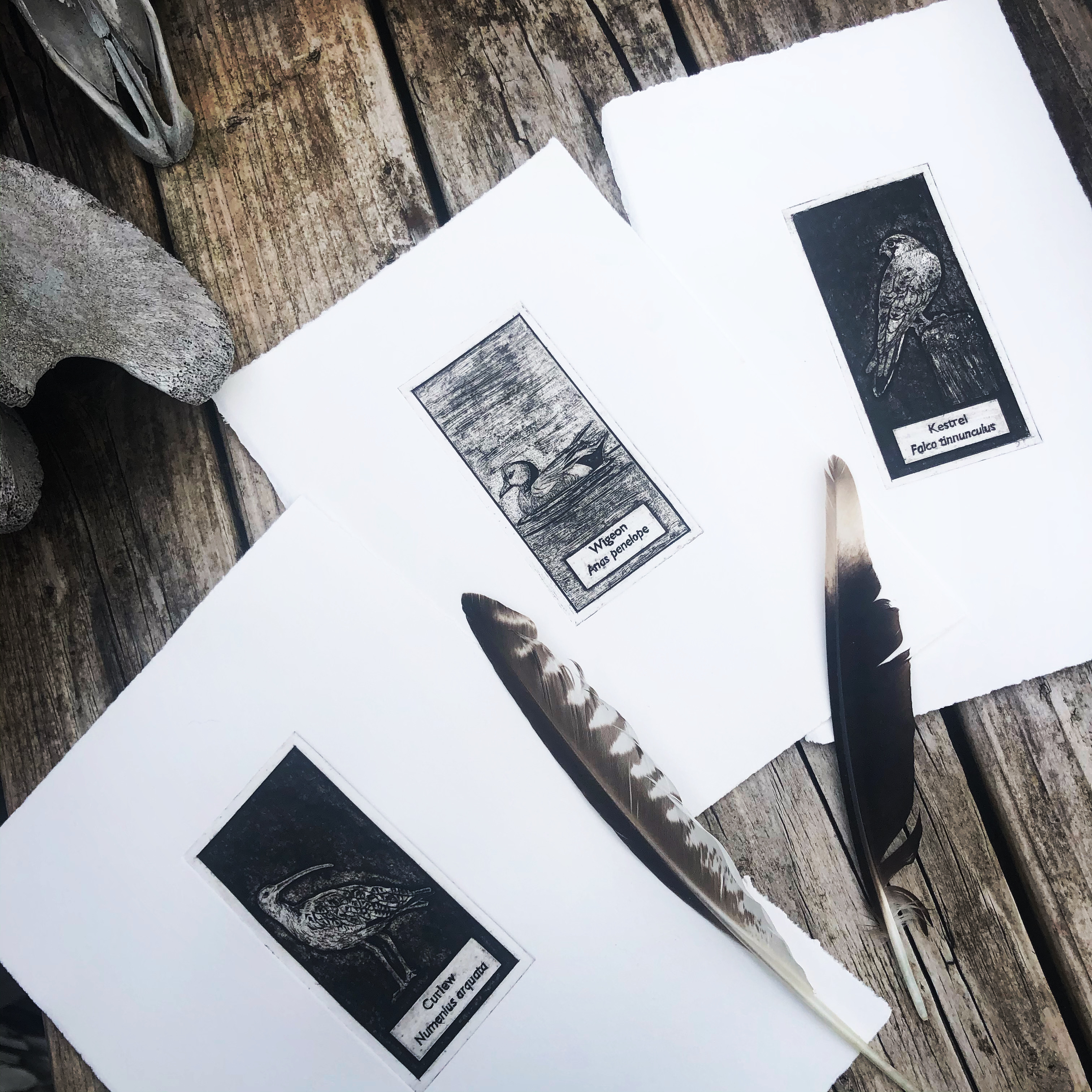
Screenshot 2020-06-29 at 16.32.58Screenshot 2020-06-29 at 16.33.06 As with all of my work, I started with an idea and that developed and changed as I made various decisions about what to include, where to focus and how to physically create the work. I selected 14 birds from Marie’s list that were either red or amber status. I decided to create an individual printing plate for each with her actual list reproduced in the middle. As I started to work out the overall design, I thought about whether I’d label the birds or not and once I decided that I would, I realised that the plates were starting to resemble the old cigarette cards that people used to collect. I have a few John Players ‘Bird of the British Isles’ cards and I love the size and detail of them. I made each little collagraph card using cutting techniques combined with gesso, acrylic medium & wood glue for texture. The labels were made by reversing text on my computer, printing it out, varnishing it and scratching the letters out to create areas of drypoint. I used a font that resembled letterpress type from the 40s.
B467E7F5-384F-40CC-83C1-E0C70CC44CA7

Proof prints of some of the bird collagraphs with curlew and oystercatcher feathers that I found on a run.

I also like the link between these and the tiny wood engravings of individual birds that Marie created as end pieces for chapters in the Dales books. In fact I included three of the birds she depicted: Dipper, Curlew and Snipe.

I wanted to recreate Marie’s handwriting so that the list would look as she’d written it. Normally I would use a photograph of the list and take it to a printmaking studio where I could use specialist equipment to make a printing plate such as a silkscreen or a photopolymer plate. This could then be combined with my collagraph cards to create the overall work. Unfortunately, during lockdown all the studios were closed and I wouldn’t have been able to justify travelling to them anyway (there are none that are within an hours drive). I considered ordering a photopolymer printing plate from a company but was put off by the expense and the lack of control over the quality. So I decided to go down the route of creating a drypoint using a reversed photographic printout from one of my photos of the page of Marie’s diary. It is a laborious way of working but very effective and probably exactly the thing to be doing when you feel out of sorts with the world around you. It took me two and half days to scratch out all of the letters but at the end of that, I had an intaglio printing plate that I could use alongside my little bird collagraphs.

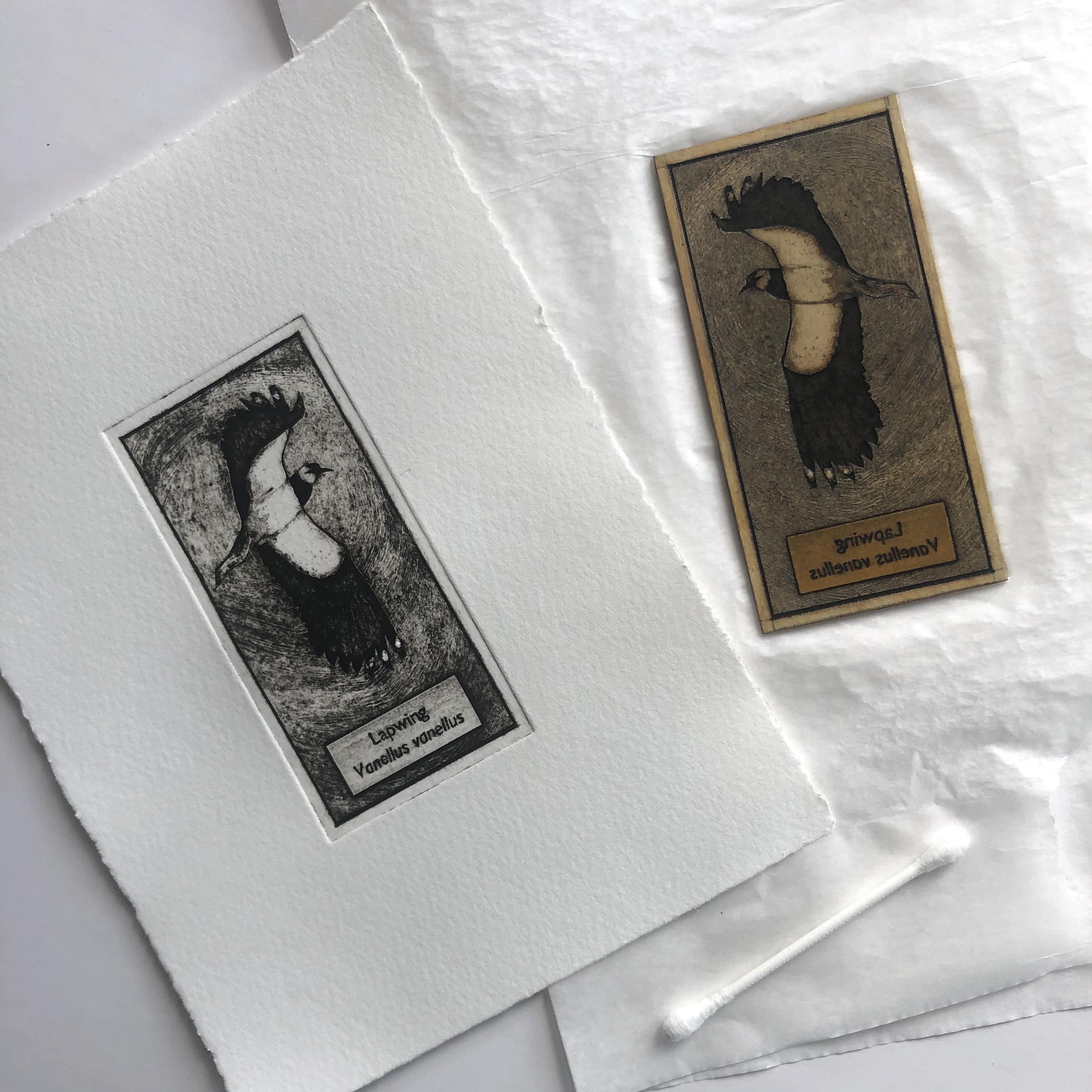
Now to the printing part. I’d been ‘proofing’ each bird plate as I went along in order to check whether they worked and also because the pattern of light and dark backgrounds was quite important to the overall look of the print. I spent a great deal of time arranging and rearranging the cards to make the overall design aesthetically pleasing. Once I had proofed everything, it was time to make a ‘registration paper’ so that the spacing of the individual plates would be perfect every time I printed. It’s pretty straightforward, you mark on a piece of paper where each plate will go and draw out the rectangles. I then taped that to my press bed with a clean piece of tissue paper over the top. I could see the lines through the tissue but could take it off when it got dirty. The first print went quite well but after that, each time I laid the damp paper over the top the plates kept moving so that I’d end up with a wonky prints. To ink and wipe all of the plates for one print took up to 2 hours so after the second crooked print, I gave up and decided to work on the solution to the moving plates before I had another go.
IMG_0954

I needed something to hold them in place that wouldn’t damage the plates and also wouldn’t create a ‘hotspot’ of added depth because that would make that area of the print darker due to extra pressure. Brian (my husband) suggested that I stick them to the tissue with smears of honey. Whilst I initially thought this would be really messy and unlikely to work, it did lead me to realise that I could try a small dab of bookbinder’s pva in place of the honey. It is a glue that is archival but that can also can be removed with water after it has dried. I put a tiny dab on the back of each plate which held it in place and then, after printing, I was able to wash the glue and tissue from the back of them without causing any damage to the plates. This is a bit of a revelation because I like using lots of plates to create a single image but the movement issue has often put me off.
Hester Cox, Marie's List

So after a few weeks of work, the print is finished and ready to frame for whenever the exhibition goes ahead. We are now waiting to find out when the museum will reopen and what would be the best course of action regarding the dates for the show. I will let everyone know as soon as we have a definite decision.
Carrying on!

Well, so much has changed since I last posted and the world feels like a very different place. I’ve decided not to write too much about the current situation with COVID-19 because I think we all need a bit of escape from the constant bombardment and I doubt that my ‘two penneth’ will help. There’s some wonderful writers and philosophers out there that will have plenty to say and do it in a far more profound way so I’ll just say that  I hope that people stay safe, well and can remain positive.

I’m currently in the ‘making’ stage of my project with the Dales Countryside Museum and I’m working on a series of prints which have been inspired by areas of the Dales that Marie Hartley and Ella Pontefract wrote about in their three books: ‘Swaledale’, ‘Wensleydale’ & ‘Wharfedale’. Fortunately, I have already spent over a year visiting a few areas repeatedly and have collected plenty of reference material so, despite being confined to my immediate area (no hardship, it is a beautiful part of the Yorkshire Dales), I am able to continue to work on the show. My husband is also working from home and our dogs are delighted to have us around all day! It isn’t always easy to concentrate, stay motivated and get into the right headspace when there is something so much bigger than all of us happening and we are preoccupied by thoughts of our family and friends. For my own sanity and the benefit of my work, I’m avoiding the radio, spending much less time on social media and am immersing myself in audio books (I am currently working through Ann Cleeves’ ‘Inspector Vera Stanhope’ series).

IMG_1655

What has struck me the most about my immediate environment is the change in the countryside. The landscape is normally full of walkers, cyclists and runners tackling one or all three of the Yorkshire Three Peaks and now the hills are virtually empty of people. Brian and I are both fellrunners and our daily exercise takes the form of a run with the dogs and we can go for miles without seeing a single person except perhaps a farmer on a quad bike. It would be tempting to wax lyrical about the peace and quiet except that the hills are ringing with the bleating of lambs and the most exceptional bird song. There are pairs of curlews poking about in the earth, hares running around and I don’t think I’ve ever seen so many meadow pipits, skylarks and wheatears. I’ve even seen ring ouzels on Penyghent a few times. I was talking to a neighbour who has farmed here for many years and he said that this is how it used to be when he was young which makes me wonder if this is what it was also like when Marie and Ella were researching their books (minus the quad bikes!).

5C39890B-3668-4D60-9ECC-39E3A550C0A6

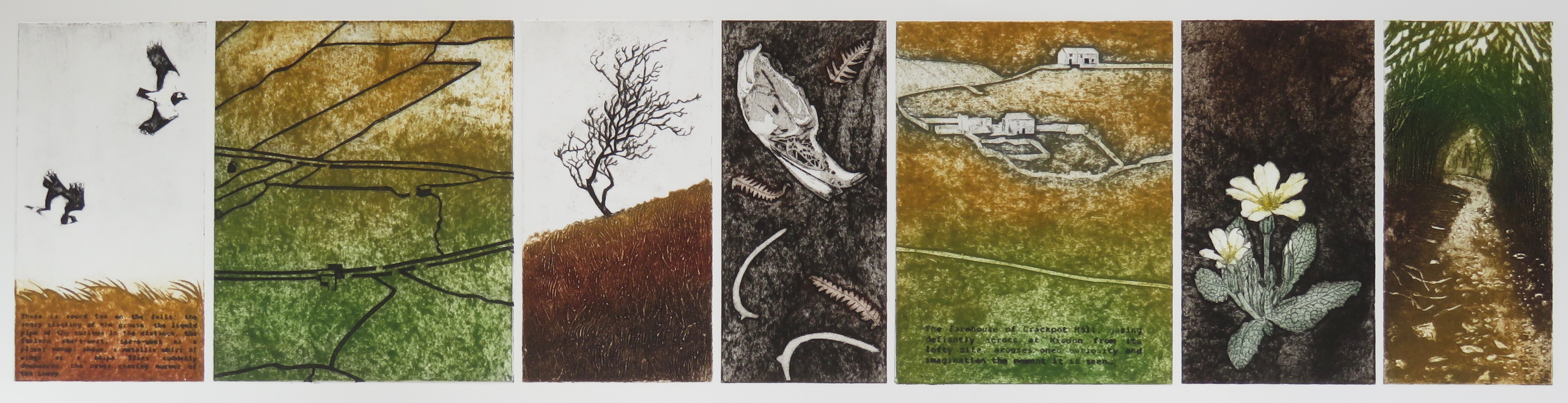
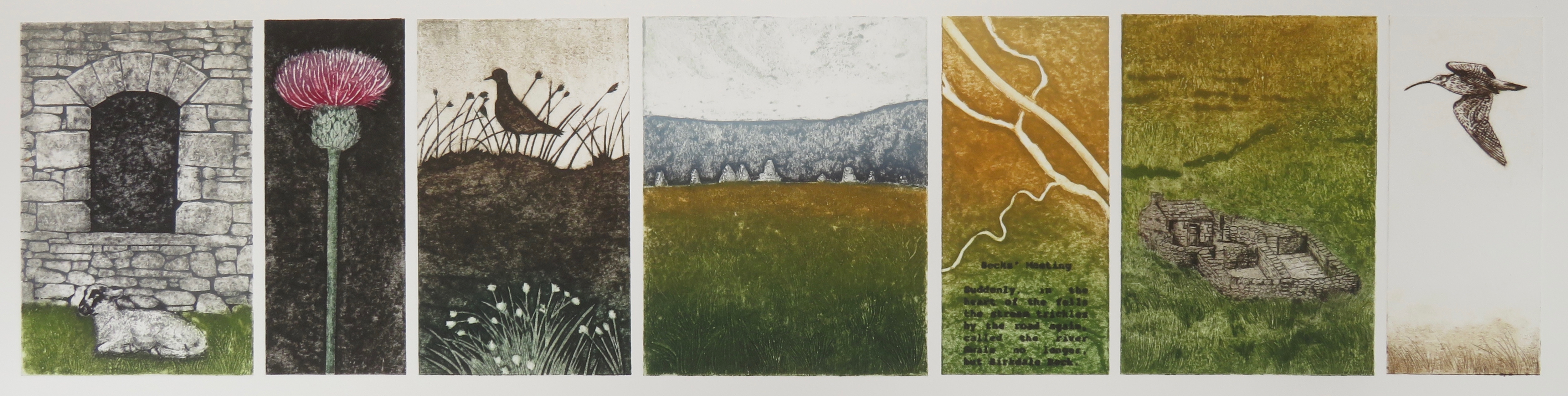
Before everywhere went into ‘lock down’, I went to Ã…lgÃ¥rden studios in Sweden to spend a couple weeks working intensively on the project. I took large pieces of card to Sweden thinking that I’d create some big collagraph prints and what I ended up making were four panoramic pieces each formed from seven smaller images that illustrate ‘journeys’ that I’ve taken. In fact, at the end of the fortnight, all of the printing plates could be wrapped up carefully and put in my pocket!

268E3A99-182F-41FF-A2EB-5F522006313F

I’m working on various scales for the exhibition but I really like this link with Marie Hartley’s illustrations. Her wood engravings were small, intricate little blocks and appeared throughout the books illustrating the places, people and wildlife that Ella wrote about. Each of my ‘Waymark’ prints tells the story of a particular time that I ran a route inspired by their writing. Two of the pieces actually include quotes from the relevant books. Here is ‘Waymarks: Kisdon’:

IMG_1627

and ‘Waymarks: Birkdale’:

IMG_1624

The images are inspired by things that I’ve seen along the routes and that help to tell the story and indicate the seasons. There are currently two more in the series and I’m now working on a fifth that is specifically about the stretch of the river Swale from Muker to Keld.

I travelled back on my birthday, 12th March, after which we quickly went into a very different existence. Before I went away, I’d spent weeks working on another piece which consists of 95 tiny prints collected together to form a larger work. The plates were sat in a box in my studio waiting to be printed and that proved to be the perfect project to tackle whilst coming to terms with our new circumstances. My next post will be all about that piece. Thanks for reading and I hope everyone can find some positives to keep them going.

In the Footsteps of Marie Hartley MBE

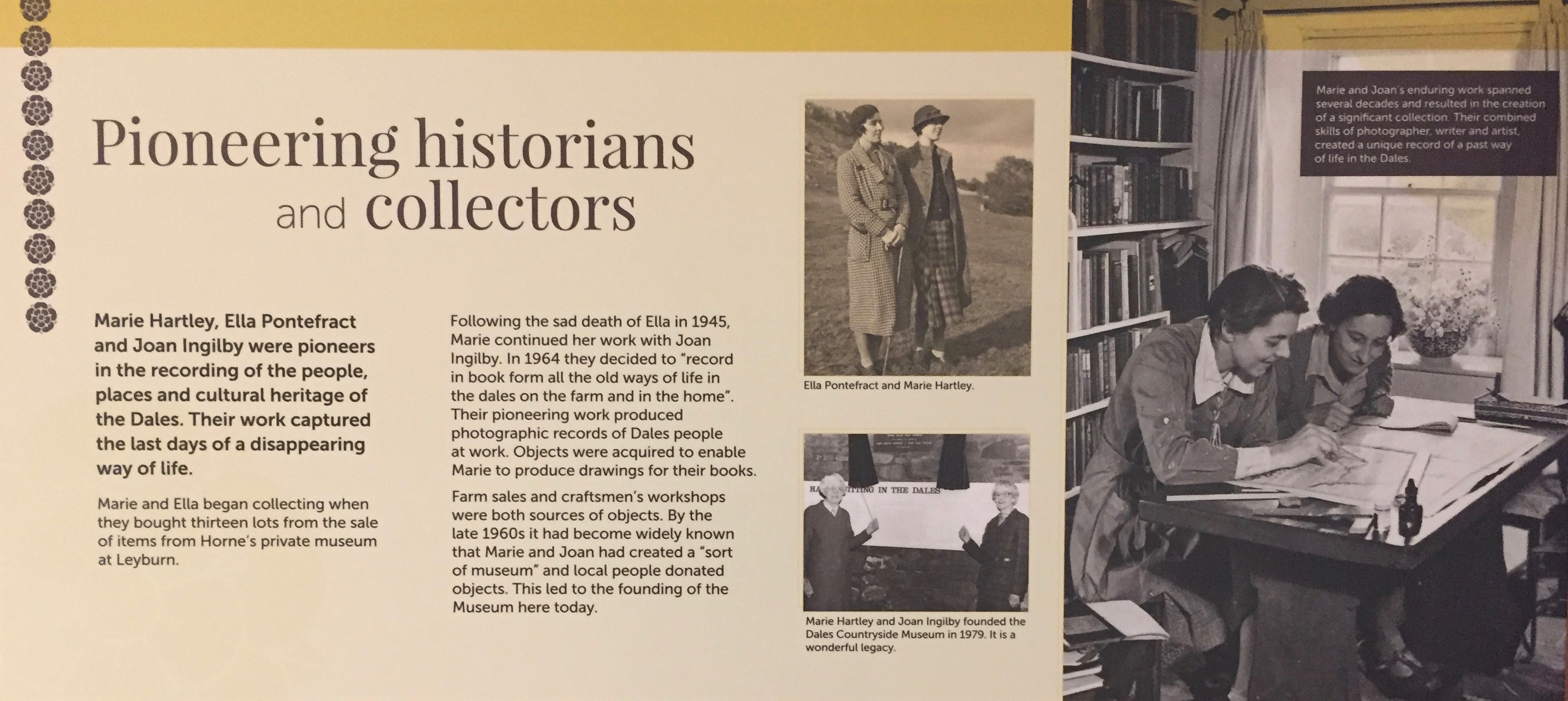
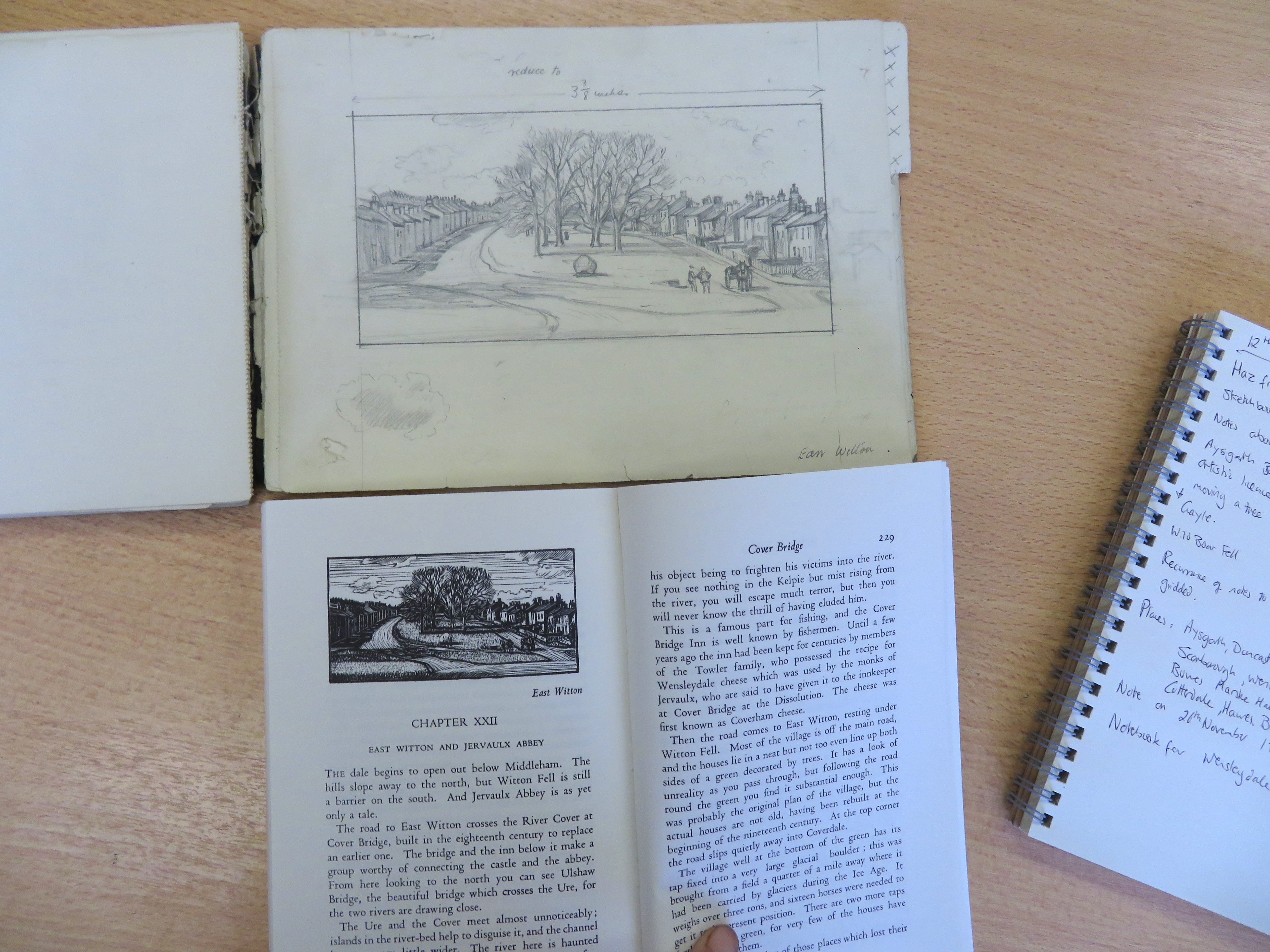
Back at the beginning of 2018 I was contacted by Fiona Rosher, Museum Manager at the Dales Countryside Museum in Hawes. The Museum was celebrating the 50th Anniversary of the book ‘Life and Tradition in the Yorkshire Dales’ which was written and illustrated by Marie Hartley and Joan Ingilby who founded the Museum. Within their archives was a collection of 130 wood engraving blocks created by Marie Hartley MBE and Fiona wanted to know if I would be interested in printing them so that they could have a set of prints for use within the museum. This sounded intriguing and what followed was a series of meetings with Fiona where we discussed the possibilities of the project. It soon expanded and developed into one that would culminate in an exhibition of my own work in the summer of 2020. We agreed that I would begin the project by printing the blocks in the museum so that visitors could watch and I could talk to them about their memories of Marie, their experience of the Yorkshire Dales and about printmaking. I would then carry out research about Marie Hartley which would take the form of reading all of her books written in collaboration with Ella Pontefract and Joan Ingleby and I would be given access to the archive of sketchbooks, notebooks and diaries that the museum owned. This would help to form a picture of the woman herself and help me to find an angle for my own work. I would then go out ‘into the field’ to draw, print and develop ideas for a series of brand new works. In other words, a dream of a job!

IMG_5429 (1)

Anyone that knows me will know that I work very hard to make a full-time living as an artist and I am often so embroiled in various exhibitions, shows, teaching workshops, running art groups and the accompanying admin that’s involved in doing those things that I often feel that there is very little time and headspace for making new work. It is one of the reasons that I disappear off to Ã…lgÃ¥rden Studios for a few weeks every year so that I can have uninterrupted time to develop my printmaking. With that in mind, we realised that I’d need some funding to allow me to take a bit of a step back from other commitments for a while and really make the most of this opportunity. Fiona was brilliant in campaigning for the project and we are so fortunate that the Yorkshire Dales National Park Authority and the Friends of the Dales Countryside Museum have provided the necessary support needed. In return, I am printing the blocks within the museum to allow the public to see the process, will be giving a talk to the FoDCM and will be running a number of printmaking workshops at the museum in 2020. I’m also updating the archive records for the wood engravings as I progress through the printing, making notes of any damage and any links to preparatory drawings that I discover in Marie’s sketchbooks.

IMG_3801

Most of the wood engravings that have been published were created for three books that Marie wrote with Ella Pontefract: Wensleydale, Swaledale & Wharfedale. I’ve decided that I will concentrate my own research on those areas of the Yorkshire Dales. I’m a keen fellrunner and my plan is to run some of the routes described in these books, get to know the places and then I will identify particular points of interest that I would like to return to for sketching and printing. I’ve got a tentative plan to take my campervan on some of my excursions and set up my portable press so I can actually print directly in the landscape. I like to feel that it would be in keeping with Marie and Ella’s explorations of Wensleydale carried out in their little caravan that they christened ‘The Green Plover’ (see a sketch of Marie’s now held at the Leeds University Art Collections by clicking here)

IMG_3859

I shall be writing regularly about the project and sharing snippets of research, images printed, anecdotes from the people that I meet and anything else that I find interesting. In the mean time, if you would like to see me printing some of the wood engravings, I will be at the Dales Countryside Museum in Hawes from 12-4pm on consecutive Tuesdays up to and including the 7th May 2019 (excluding Tuesday 16th April when I’ll be there on the previous Sunday 14th April, 12-4pm). Do come and see how exquisite Marie’s work is and I’d love to hear anecdotes from those that knew her and stories from your experiences of the Yorkshire Dales (please note, museum admission charges apply).

The Installation of ‘Within These Walls’

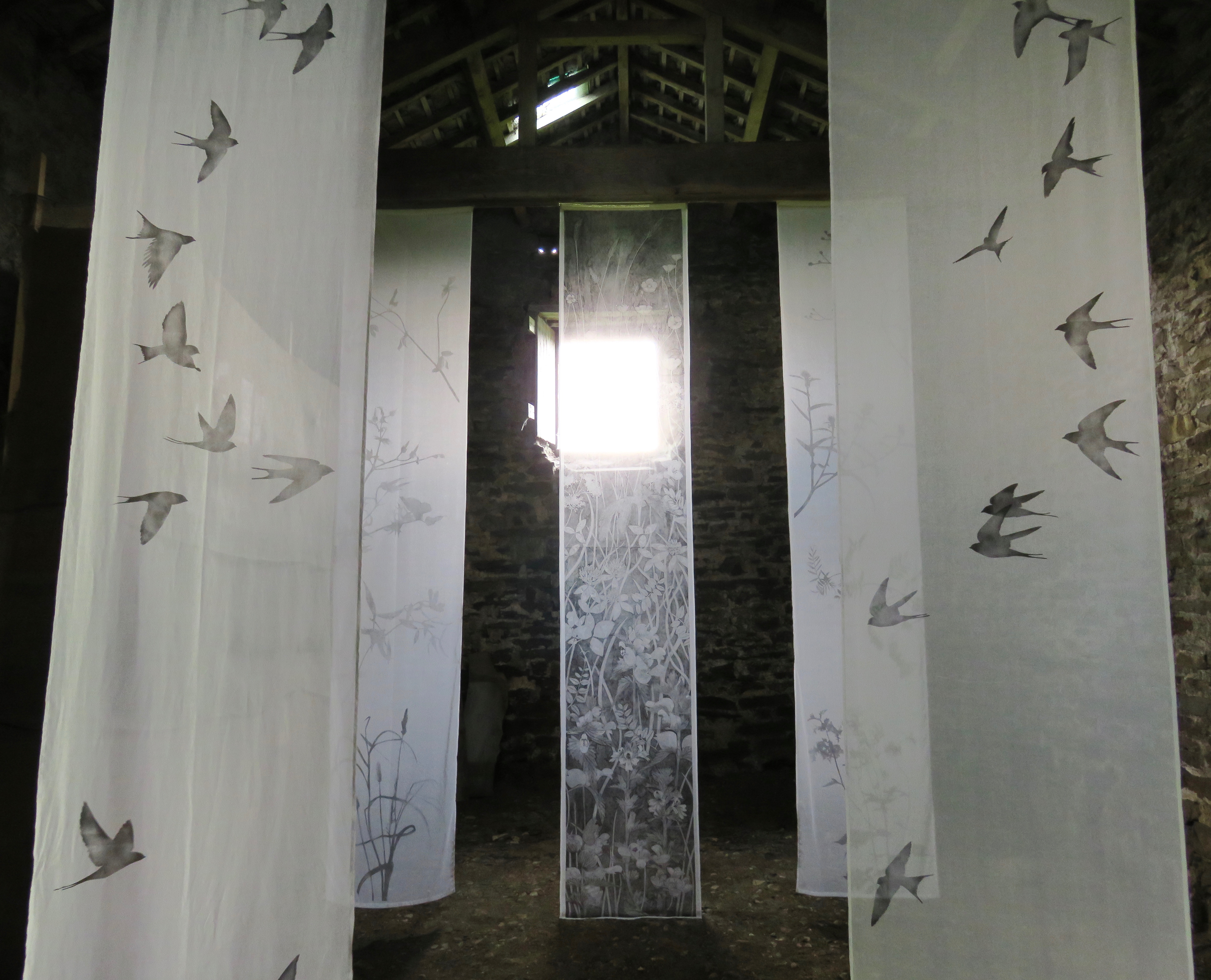
So now I had five hangings printed, sewn and perspex rods ready to be inserted (thanks Ian Whyte for drilling the fittings!). Ian Harland, the owner of the barn, had worked really hard to clear it and get it ready for the installation. I’d been up there to sweep up, do a risk assessment and cover the shelving with hessian (I bought a 42 metre roll!). Now there was just the small matter of reaching the beams, which are 4 metres from the floor, to fit the screw eyes and tie the rods in. Ian managed to borrow a builder’s ladder and I was going to give it a go myself but I have to admit, despite being a fellrunner and (briefly) a potholer, I was feeling nervous. I really don’t like being up ladders. Its not a fear of heights because I love standing at the top of a mountain, I think its a fear of precariousness! I have been known to get cragfast on rocky ledges when the wind is up.
Fortunately, I got a text from my friend Matt, an arboriculturist and former tree climber extraordinaire, offering to give me a hand. This actually meant he came along and did the whole thing. My mum and her partner Ian were up for the week so they came up too and kept an eye on Matt’s little boy and wrangled his gangly pointer puppy. I was in charge of passing him the pristine white voile hangings and was responsible for making sure that nobody trod on them or got tangled up!

It was a bit fiddly and we’ve come up with all sorts of ideas to make it easier next time I hang them but essentially, the rods and line did the job and Matt made it look very easy. In the meantime, Ian Harland was mowing the grass and making everything look lovely. He has been cultivating two meadows close to the barn and they are glorious. Ian Whyte then pinned up the rest of the hessian which helped to minimise the distraction of the rack of shelving.

IMG_2098

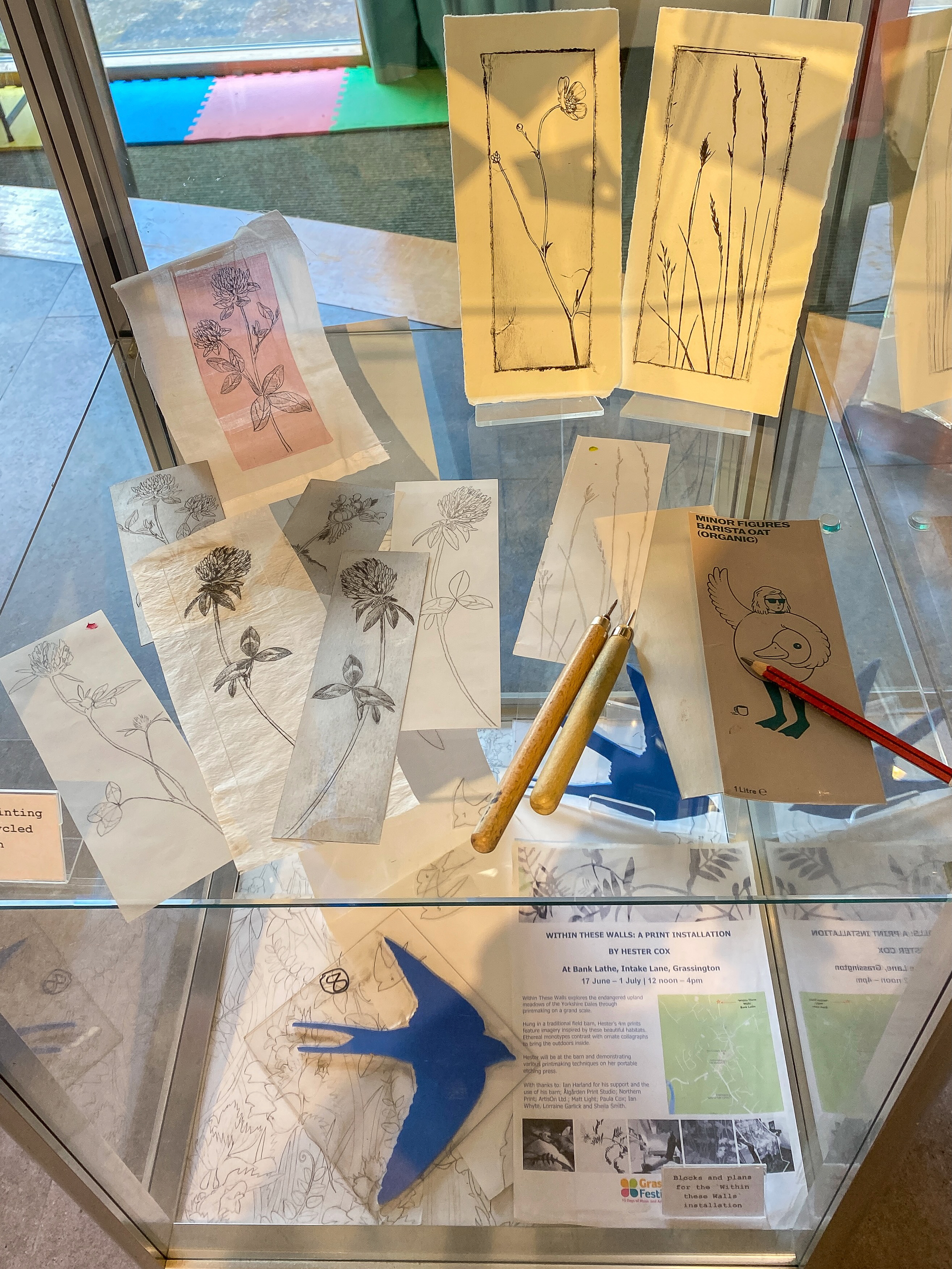
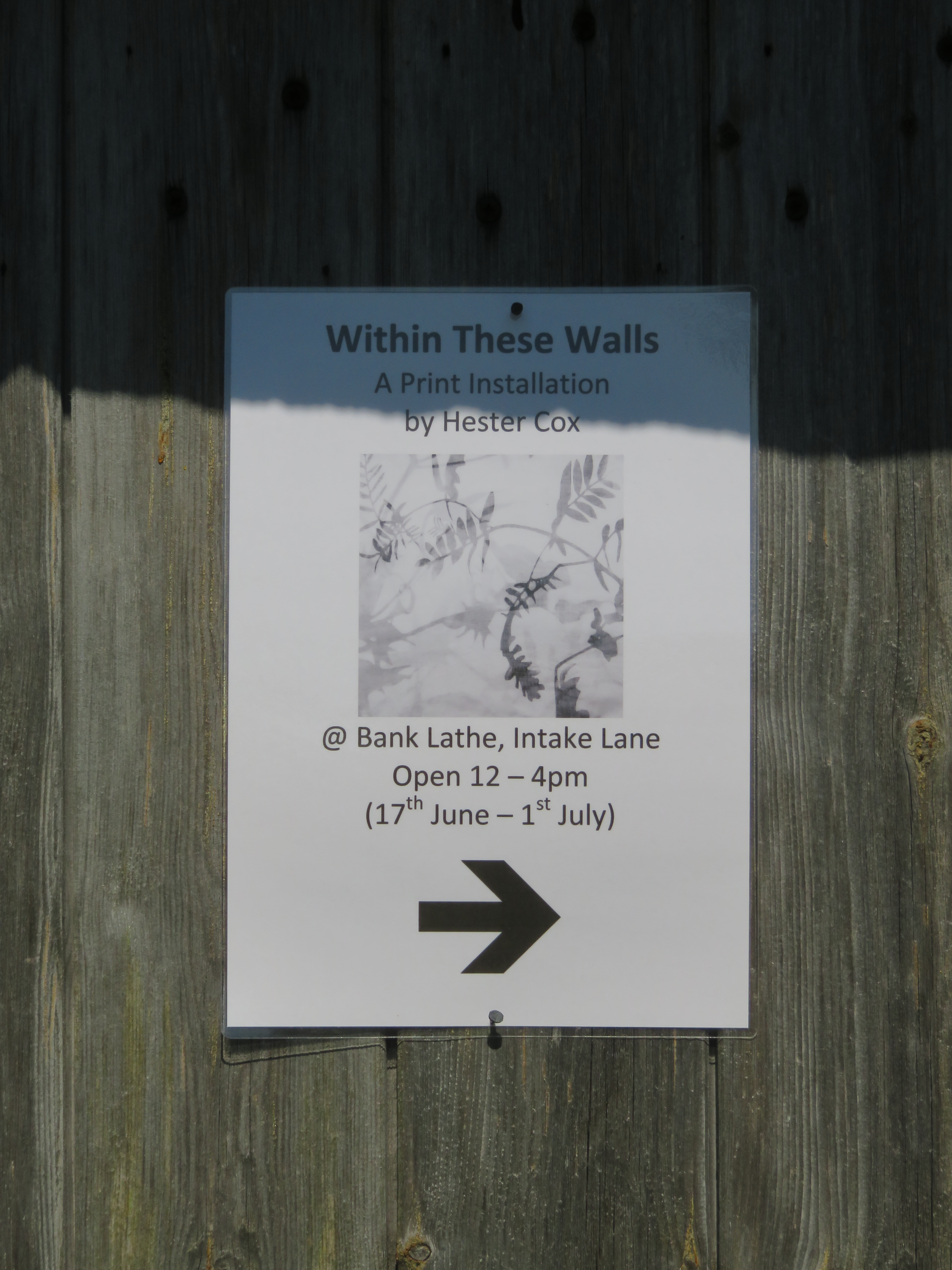
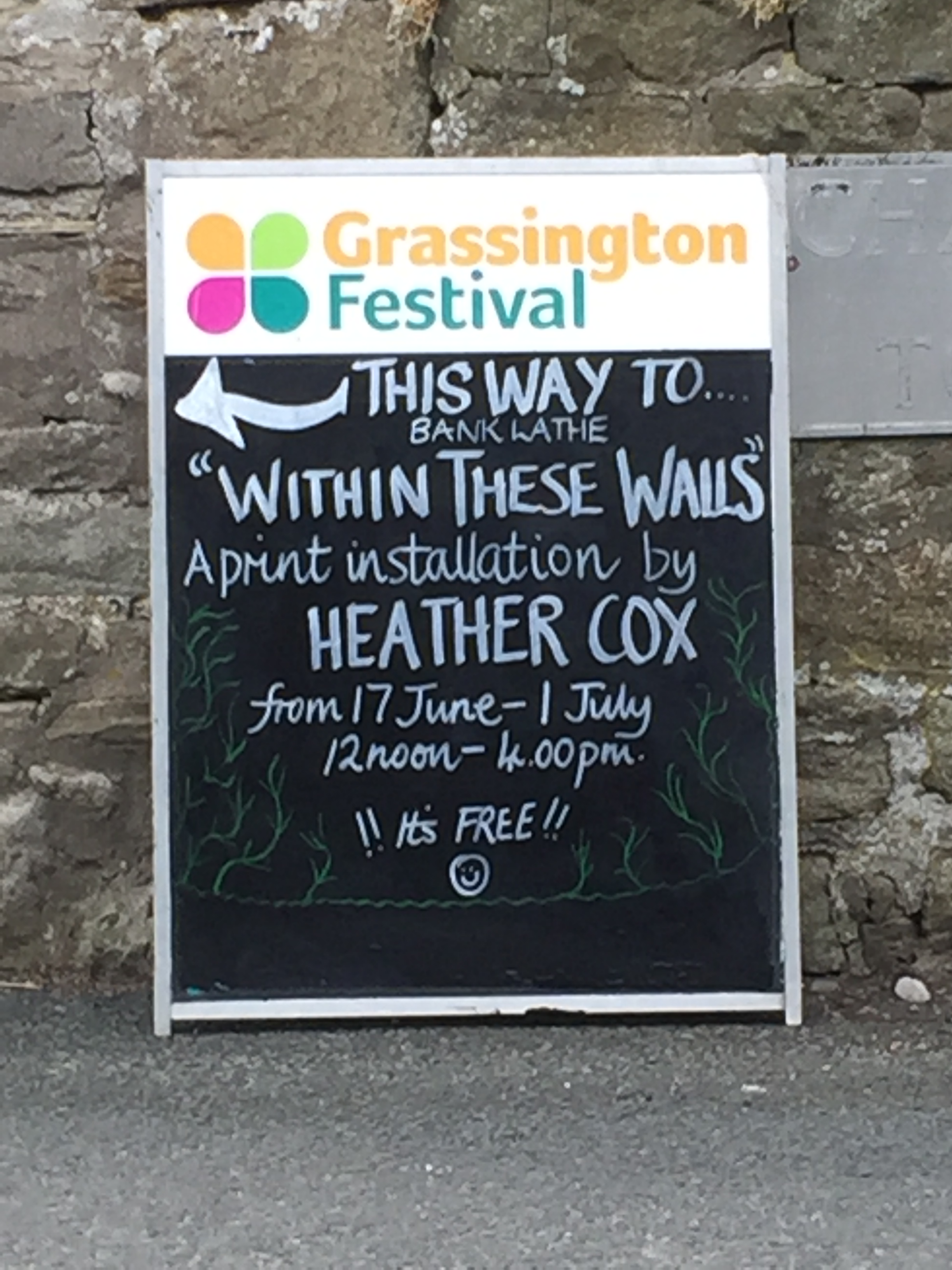
After installing Within These Walls, I distributed the flyers I’d had printed and put direction signs up. I’d also had postcards of four of the plant monotypes printed. Selling them at 50p each not only gives people something to remind them of the installation but also helps recoup my petrol costs for being up at the barn each day. The Grassington Festival team made me a lovely A-board to direct people up the lane and I’m turning a blind-eye to the fact that I’ve been renamed ‘Heather Cox’ 😀

IMG_1979

So that’s the logistics and the installation has now been up for over a week and open for 6 days. I’ve had 138 human visitors so far and 14 dogs! In my next post I will talk more about my personal feelings about the installation now its finished and some of the visitors’ reactions to it but I think its fair to say that I’m not only relieved to have pulled this off, I’m totally delighted with just how well the prints work in the space.

NB thanks to Paula Cox and Ian Whyte for taking photos of the installing part!

IMG_2017