Extreme Printmaking!

It’s been a busy few weeks. Last week was an exciting mix of workshops and meetings and culminated in the Connections North Seminar at Harrogate Studio Theatre. This concentrated on the artists residency opportunities available to artists in North Yorkshire . Arts Connections had invited me to speak about my experience of doing my printmaking residency at Ålgården in Sweden. Others giving presentations were representatives from the Finnish, Scottish and Swedish centres as well as Sarah Smith, a fellow artist who did a stone carving residency in Sweden, and a representative from the Arts Council of England. It was an exciting and inspiring day and I was especially pleased to see Christina Lindberg and Anna Mattsson again.

This week I have been mainly outdoors!

A few months ago Paul Mosley, Hackfall Officer for the Woodland Trust, asked me if I would be interested in running an Inset day for teachers at Hackfall Woods with the emphasis on printmaking outdoors. Always up for a challenge and with Hackfall  being a favourite place of mine, I agreed. 27th March seemed a long way away and I was sure that on the day I would be leading a group of teachers happily making prints in the sunshine as the birds sang. Suffice to say that, as the snow fell and then fell again, I have been worrying about the workshop for some weeks!

I’m a bit of a perfectionist and tend to be meticulous in my lesson planning so I knew that the only way to ensure success was to do a dry run of the workshop the day before it took place. That way I could ensure that everything would work in the current weather conditions. So I can actually say that I spent two days printmaking in the snow 🙂

Using ArtisOn as a base, Paul and I met our 12 teachers along with Hackfall volunteer Sue Cockcroft, who was invaluable as a printmaking assistant. We then set off to Hackfall in the minibus. Paul had explained the idea of story sticks and a couple of the teachers decided to have a go. Story sticks are a way to engage a child’s attention right from the start of the visit by getting them to look for found objects to attach to their stick using rubber bands throughout their walk. This provides a visual record of their journey through the woods. Apparently it stems from an aboriginal practise.

Image

I then discussed the Geoartcache project that I was commissioned to do by Chrysalis Arts for North Yorkshire Open Studios last year. I’ve created a trail in the woods that combines printmaking, book art, wildlife and folklore. Further details are on the Geoartcache website. Originally the trail consisted of 10 caches and the book cache but it has been adapted to allow for the caches that have gone AWOL due to flooding, storms and skulduggery! There are now six stamp caches and the book cache so do go and have a look if you are in the area.

Image

Slipping about a bit, we headed down the hill for a spot of bark rubbing and the chance to ‘meet a tree’ before heading to the ‘beach’ to do sun printing (ha!). I love sunprinting and it has so much scope as an educational tool. It is based on the principles of cyanotype which was discovered in the nineteenth century and became popular with engineers as a low cost way of reproducing their designs as ‘blue prints’. Anna Atkins used it to record her extensive plant and seaweed collection and these were collected together in what is generally considered to be the first book published with photographic illustrations. She is also considered by some to be the first female photographer although that is open to speculation with Constance Talbot (Henry Fox Talbot’s wife) often being cited as the first (amongst others). Anyway, the process is great for combining science and art and I soon had my teachers creating photograms by looking for interesting found objects such as leaves, twigs, feathers and sand to create images with. They then laid the objects on the light sensitive paper and placed a piece of perspex over the top to hold them in place whilst we waited for the weak sun to do its work.

Image

Fortunately, you can sunprint even when its cloudy so within ten minutes the exposed parts of the blue paper had turned a very pale bluey white and the paper was ready to be developed in my little tub of river water,

Image

The chemical in the parts of the paper that have not been exposed to UV light are water soluble and wash away leaving the paper white whereas the UV exposed parts turn a dark blue. The blue deepens as the paper dries to become a beautiful cyan blue (a clue is in the name).

Image

I layered all the developed prints carefully in small sheets of blotting paper to dry and we headed along the muddiest path in Hackfall to check out one of my geoartcaches, ‘Waterdog’. I retold the story of St.Cuthbert and the otters and demonstrated the stamp and then we headed to my favourite folly, Fisher’s Hall, for a spot of monoprinting. I love this folly. Its a magical and meditative spot where you can sit and watch the river whilst listening to the birds. Here it is earlier in the year.Image

I had to use oil-based water soluble relief printing ink from Lawrence Art Supplies as my speedball inks didn’t perform very well the day before because of the cold.

???????????????????????????????????????????????????????????????????????????

Everyone managed to make some lovely monotypes despite cold fingers but we decided that plasticine printmaking at the pond might just tip some of the less hardier members of the group into hypothermia so, instead, we headed up to the banqueting house to admire the view across the valley and in the other direction, to Mowbray Castle.

002

Chris was waiting with his minibus at the car park to take us back to ArtisOn for lunch. Sue Palin spoilt us with three delicious soups and bread followed by scones and two kinds of cake 🙂 Full up and a bit rosy cheeked from the snow, I then set about showing the teachers how to make prints and stamps from funfoam, how to explore textures of found objects by printing from plasticine and the amazing things you can do with relief collagraph techniques. None of which need a press or any expensive materials. Here’s one of my collagraph sample boards:

101

The teachers getting stuck in to making stamps.

011

All in all it was an excellent day and proved that the weather should be no obstacle to having a good time! In fact I distinctly recall the first workshop that I ever did for the Woodland Trust which involved me leading a group of printmakers around Hackfall in the pouring rain to gather inspiration for two days of collagraph printmaking. The results were amazing and reflected the weather.

Melanie Blades 1

So, if anybody is now keen to come printmaking in the woods, Paul is running a Family Day at Hackfall on the 10th April, 11am – 4pm. There will be pond dipping and I will be based in the Rustic Temple doing printmaking. Adults and children are welcome to come and have a go. For more information visit the Hackfall website. Booking not required. Hope to see some of you there and perhaps we will have some sunshine! 🙂
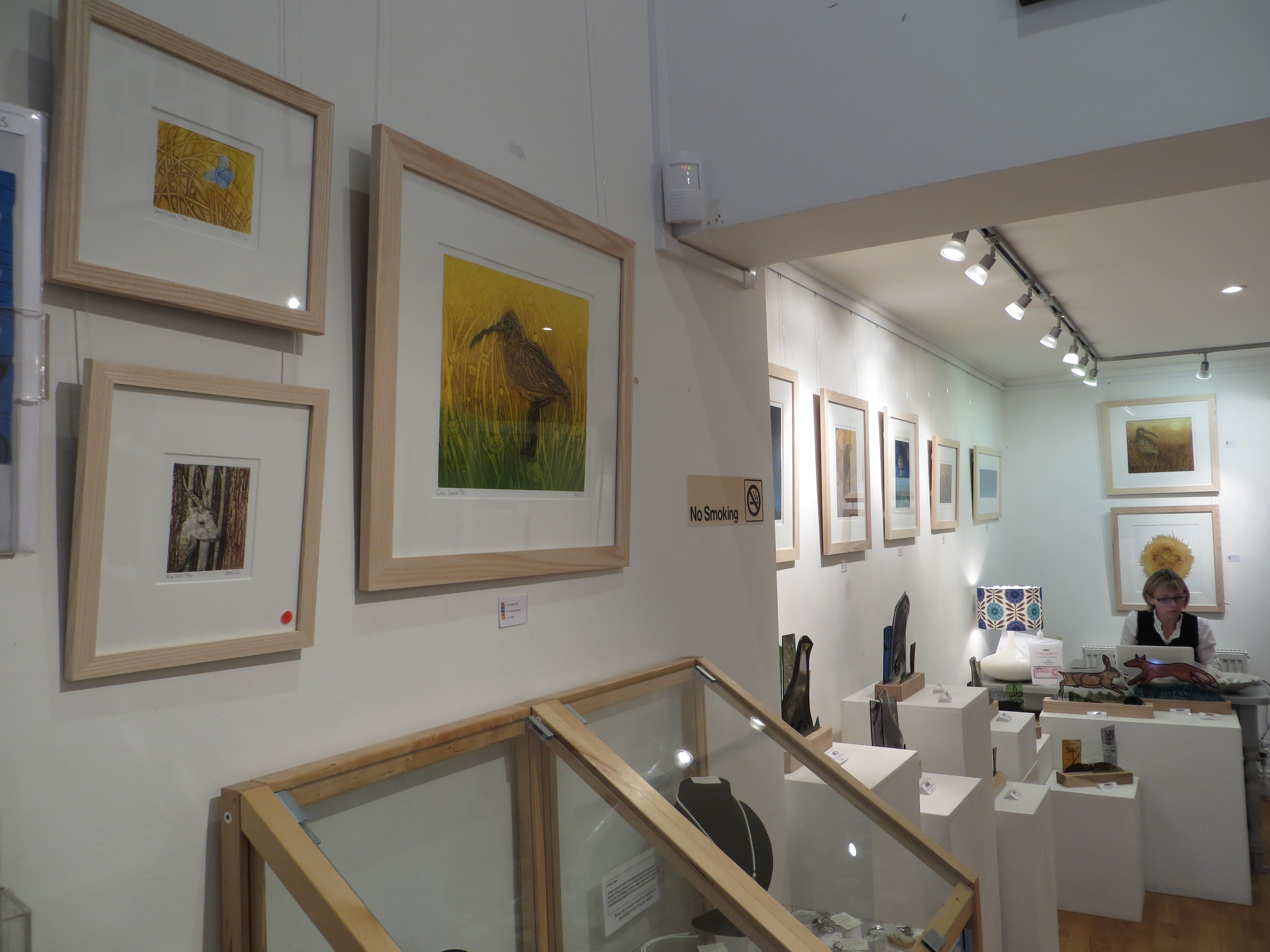
 

Telling Tails

I’ve just had a little flurry of activity with regards to exhibitions and I now have my prints on display at Feathered Friends, Cambridge Contemporary Art & Bird’s Eye View, Leeds Craft Centre and Design Gallery.

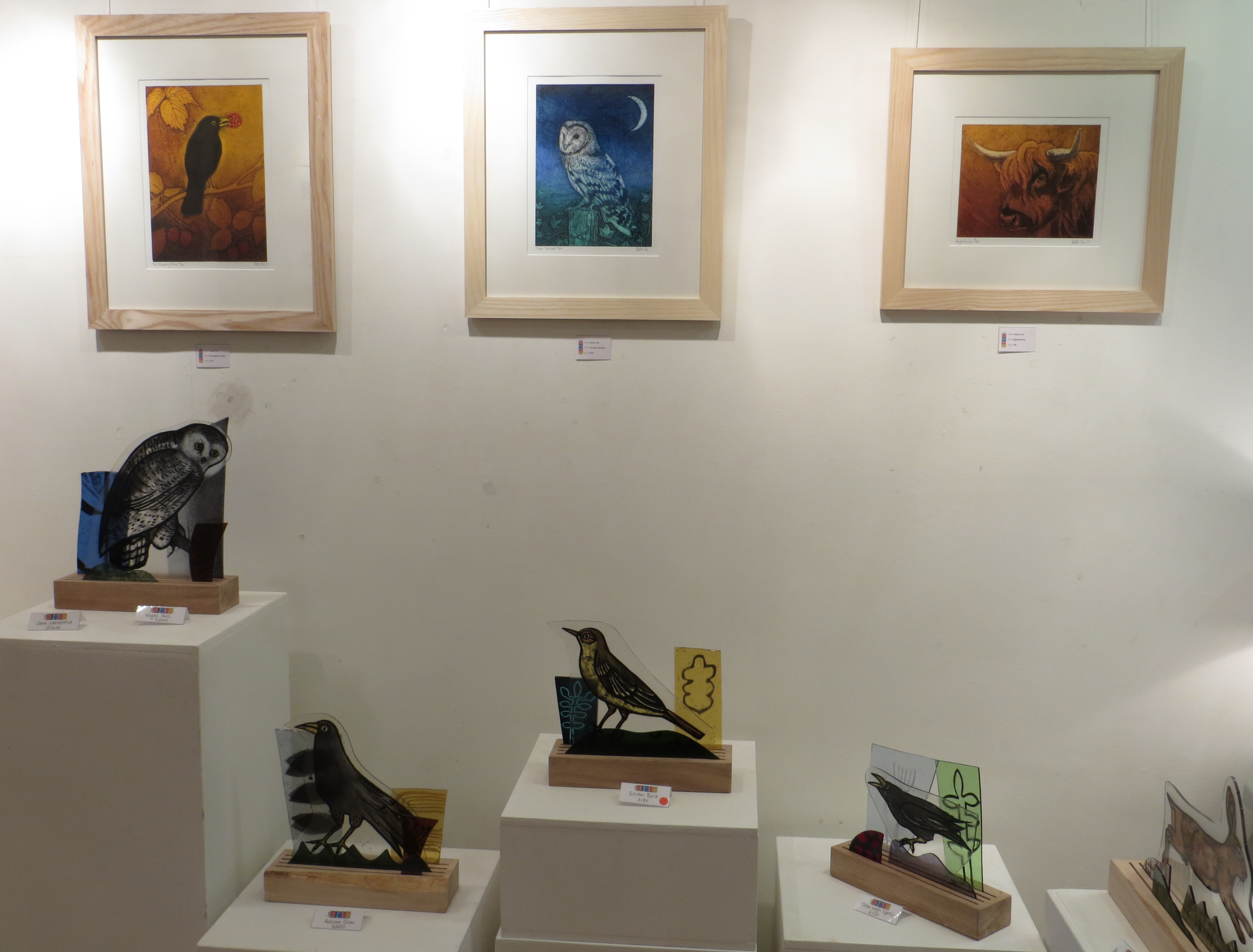
On Wednesday last week, glass artist Jane Littlefield, gallery manager, Alison Holt, and I hung the Telling Tails exhibition at Rural Arts in Thirsk. In the beginning it was quite a conundrum to work out how to display Jane’s beautiful three dimensional glass pieces and my prints together but with the use of plinths for Jane’s work, the walls for mine and the rearrangement of all the lovely ceramics, textiles and jewellery in the gallery, I think we came up with a very pleasing exhibition.

003 006 017 022

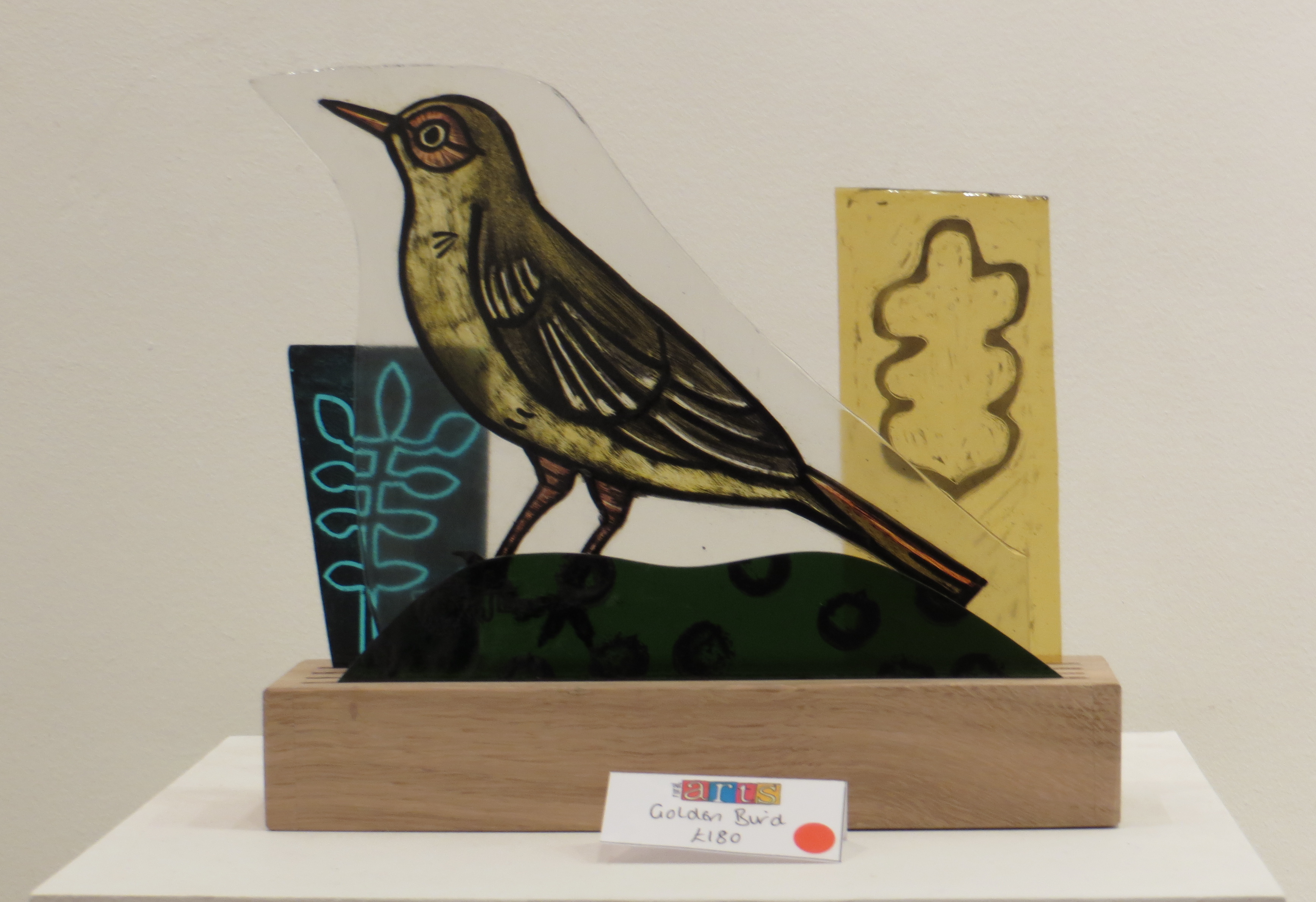
Jane has developed a really interesting way of working with her pieces consisting of multi-layered painted glass images that create a three-dimensional collage. The glass is hand painted using traditional stained glass paints and translucent enamels that are fired in the kiln. The work refers to Jane’s experience of the Peak District in which she lives and works. 

010 020 023

026

Both of us are inspired by nature and stories and we often depict the same birds and animals such as crows, hares and owls. I am very fortunate to live in a rural place and I see lots of wild animals and interesting birds but it is the ones that appear throughout history in poetry, folklore and myth that tend to grab my attention most and are likely to make it into my collagraph prints.

We held the preview for the exhibition on Friday night and I’m pleased to say that plenty of people came and we now have a couple red spots! 🙂

This little roe deer collagraph was the first print of mine to sell:

Roe Deer

By coincidence, this year’s North Yorkshire Open Studios meeting (to distribute promotional materials and discuss the event) was held at Rural Arts on Friday and I have collected my brochures ready to send out to anyone that would like to visit me in my studio. I love taking part in North Yorkshire Open Studios because it is a chance to meet people that like my work and also to show how the prints are made. I will write about that in more detail nearer the time (it is over two weekends in June) but in the meantime you can visit NYOS’13 at their website and facebook page and if you would like me to send you a catalogue, you can send me a message with your postal address via the contact page of my website and I will happily send one out to you.

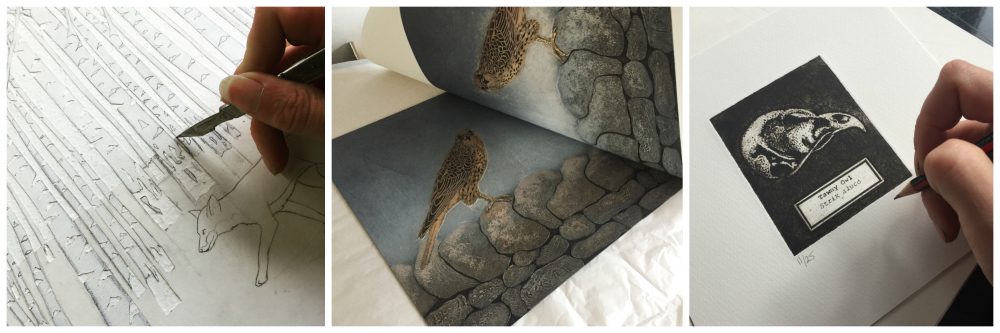
I am now off to continue making a very detailed collagraph plate of a fox in a birch forest. It is inspired by the beautiful forests that I saw in Sweden. If it goes well, I’ll write about it soon!

March Hares and Feathered Friends

As usual, blog posts from me tend to be a bit few and far between but I can report that I’ve been steadily getting back up to speed after my slow January and I’ve delivered work for two exhibitions that have just started. Both are bird themed shows. The first is at The Craft Centre and Design Gallery in Leeds and features my prints along with those of Janis Goodman, Pam Grimmond and Mike Smith. It is on until the 29th June 2013 so there is plenty of time to visit.

The second exhibition is at Cambridge Contemporary Art and is a group show with prints from Janis and Pam again and also Carry Ackroyd, Jane Ormes, Simon Griffiths and Fiona Watson to name but a few. ‘Feathered Friends’ continues until 1st April 2013 but both galleries have my work permanently in the browsers for anyone that misses these shows. I’m now finishing the preparations for my exhibition ‘Telling Tails’ with glass artist Jane Littlefield at Rural Arts in Thirsk. We both share a love of the natural landscape and  the stories and folklore that surround the wildlife that inhabit it. Jane creates beautiful three dimensional glass pieces such as this hare:

hare

The exhibition runs until the 31st May 2013. Incidentally, if anyone would like to attend the preview it is from 7-9pm at The Old Courthouse, Rural Arts in Thirsk, RSVP by email to hannah@ruralarts.org. I will have some brand new prints on display as well as a selection of recent collagraphs.

This is my new barn owl, ‘The Silent Sentinel’:

The Silent Sentinel

The exhibitions and events that I’m doing are mounting up for 2013 and will include North Yorkshire Open Studios, group shows at The Found Gallery in Dunbar and The Blue Tree Gallery in York, Art in the Pen at Skipton, The Harrogate Art Show and The Simplicity of Colour at The Gallery in Masham. I’ll post details as each show comes up.

My workshops are now coming up thick and fast. I’ve just finished my collagraph course at Number Six in Pateley Bridge (we’re already planning more for the autumn) and have started the beginners collagraph course at ArtisOn in Masham where I am also teaching ‘Printing without a Press’ next week on the 8th March and ‘Natural Forms in Linocut Printmaking’ on the 23rd March. Phew…that will do for now!

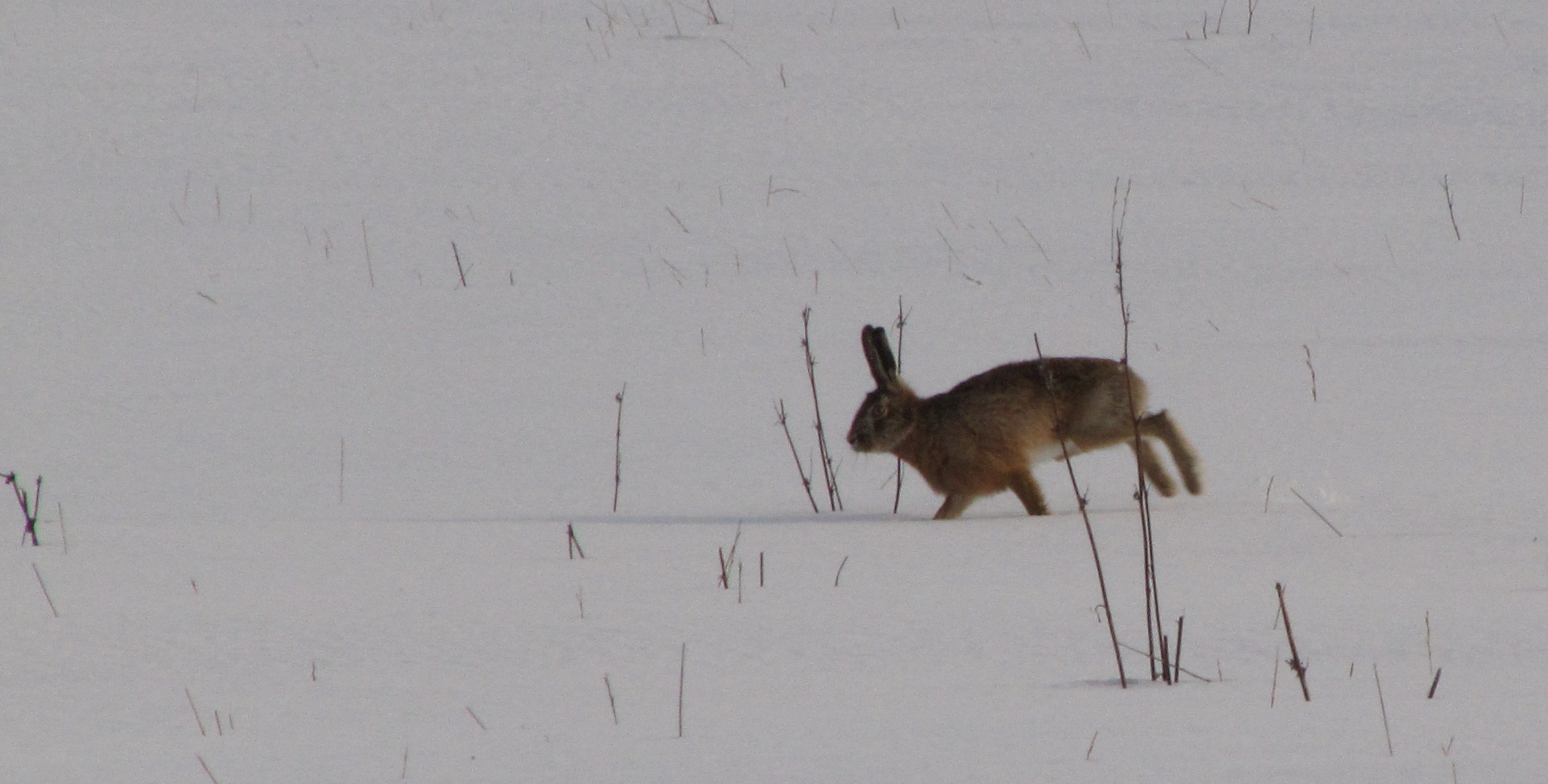
On an entirely different note, I’ve been doing some more hare watching when I’ve been out fell running. We’ve had plenty of snow and this is a lovely brown hare that I managed to find by following its footprints.

hare

The most exciting was my first ever sighting of mountain hares in their winter coats! I’ve just this weekend successfully completed the High Peak Marathon with my team mates ‘The High Peak Scuttlers’ and we ran a fabulous route from Edale which traverses the Derwent watershed. I’d been told that there were mountain hares living in the area and sure enough, I got my first glimpse of them at Bleak Low on a recce run a couple weeks ago.

winter hare

Amazingly, we actually saw lots of them and on the race itself, we were crossing Bleak Low again as the sun came up and we got a fleeting glimpse of a couple. In the space of just a couple weeks the hares are beginning to lose their white coats and are looking browner.

For all those intrigued by what I get up to when not in the studio, here is a photo that my boyfriend and fellow team member at The High Peak Marathon took. It was taken just after we had safely navigated the frozen bogs in moonlight and picked up the Pennine Way to the Snake Road crossing. It was as cold as it looked but the hot tea at the checkpoint soon revived us.

I’m off to continue work on my altered book for The Library of Lost Books now. More on that another day!

Hibernation!

It’s January, the snow is thick on the ground and the studio is rather chilly but it has been so good to have a month where I don’t have masses of commitments and can take stock a bit.

029

I started to run an evening class at Number Six in Pateley Bridge but, with only four students coming to the first session, we decided (with NYCC Adult Learning Services permission) to run the remainder of the course as three fortnightly 6 hour workshops. The course looks like it will soon be full and I have my Monday nights back without the prospect of having to drive over the moors in snow and ice every week so we’re all winners there! I taught a monotype workshop to the Northallerton Art Club last weekend and that was very enjoyable with seven creative people making some beautiful prints using direct drawn,  reductive & collage methods. Now I have the rest of the month and much of February free to make some new prints for my exhibitions in March, to work on my bookmaking for Joan Newall’s course and to slowly develop some of my ideas started in Sweden.

I was lucky enough to run into Heather and David Cook, both painter/printmakers, in Malham the other day and they kindly showed me some of their latest work and David discussed his brilliant exposure unit that he has made to make his Imagon plates. I’m hoping to make something similar so that I can continue my photopolymer experiments. So there are lots of plans afoot. The only problem is that it is winter! I actually quite like this time of year especially when we have sharp frosts or snow. As a fellrunner, I like nothing more than running through virgin snow and marvelling at the purity of the landscape but the downside is that during the rest of the time, I seem to slow right down!

039

I always look forward to January and February and the chance to work on some new projects and I imagine how much I’ll get achieved and how I’ll spend everyday making lots of exciting new things but the reality is that during the darkness hours, I’m sleepy and just feel like curling up with a book, some poetry or a good film. I’ve got a lovely stack of books to work through including two from Robert MacFarlane (The Old Ways & Mountains of the Mind), ‘Man with a Blue Scarf’ which is Martin Gayford’s diary of sitting for Lucien Freud, Memory Wall by Anthony Doerr, The Snow Tourist by Charlie English and I’m just part way through ‘If Nobody Speaks of Remarkable Things’. Added to that is regular dipping into the poetry of Kathleen Jamie and Norman MacCaig and random admiration of the prints in Carry Ackroyd’s ‘Nature Powers and Spells’ and you can see that I have plenty to keep me occupied!

Despite slowing down, I am still working on a new collagraph, taking a fox, the snow and the birch forests as inspiration, which will be for my exhibition ‘Telling Tales’ with Jane Littlefield at Rural Arts in March. I’ll be making a couple new bird prints too. I’m so used to working every hour available that it feels a bit lazy not to! I read in a fellow artist’s blog that she felt that when she made the shift to being a full-time artist, she was suddenly doing something that she had crammed into her spare time all of the time and she found it hard to know what to do with her leisure time. I feel like that. Art is what I do and I rarely switch off from it because I love it and everything around me is part of it. I am also totally self-supported so I have a strong drive to use all my available time to create the work that will keep me clothed, housed and fed!

However, I have decided to stop worrying about not burning the candle at both ends and enjoy this chance to recharge and take stock before the frenetic activity that will no doubt ensue in the coming months. I’m dividing my weeks into days for working on my prints from Sweden and researching what I need to get started with my photopolymer printing and make my exposure unit, days to make some new collagraphs for my exhibitions in March and the rest of the time to get somewhere with my bookmaking and do my admin. Joan taught us how to make lined boxes with lids in our last class and it has given me an idea for this year’s final project. The photo shows my box covered in my handmade paper. Our theme this year is ‘worn surfaces’ and I’m using ‘A Tale’ by Edward Thomas as my starting point. More on that in another post.

001

January also brings the dreaded tax return! Self-assessment online makes it a bit easier but the whole process is one that I don’t relish. I try and make it slightly more interesting by totting up which galleries have sold the most prints over the year and which prints have sold the best for me. This has the added benefit of reminding me which galleries I need to keep a special eye on. The ones that sell the best obviously need to have their stocks replenished regularly and sometimes if the managers are too busy to send out requests, the onus is on me to offer to deliver more work. The ones that aren’t selling need a phone call to find out if the prints are still on display and if anything needs returning or swapped.

In 2011/12, Cambridge Contemporary Art was my top selling gallery, hotly followed by The Gallery in Masham (Josie has been selling my prints consistently for 19 years and is invariably one of my best selling galleries!), then ArtsBank at Saltburn. All three galleries have a few things in common that I think make them not only successful, but a pleasure to work with. Firstly, I always know I will be paid for the prints that I’ve sold on or around a certain date of the following month, the paperwork is always thorough and I trust the people that I am dealing with. The gallery owners have very proactive publicity campaigns and are constantly updating their websites, sending out newsletters and using social media to promote exhibitions and their artists. I also get regular emails or phone calls to let me know if customers are interested in prints that are not currently in the galleries, to order more work from me and to offer me exhibiting opportunities. In return, I try really hard to promote the galleries when they put on exhibitions of my prints, always send detailed and clear paperwork with my deliveries and try and deliver any orders as soon as I can. The relationship is like any successful partnership, it requires trust and plenty of attention on both sides.

My list of gallery sales also shows me where some of the outlets aren’t performing very well and then I can decide what to do about it. This could be for all sorts of good reasons but ultimately, every print that sits unsold is a potential sale elsewhere and at one gallery, five of the unsold prints were the last in the editions so I was pretty keen to get them back and into one of my more successful outlets. It is quite hard when you sell your work across the UK because keeping an eye on it can be tricky and when I’m busy, I’m not always very good at keeping on top of this kind of thing so now is the time for doing any chasing up that needs doing. Some of the galleries only sell a handful of prints each year but so long as there are a few sales and I have a good relationship with the owner, I am happy to have my prints there. You never know who might see them and it is better to have them on a gallery wall than sat at home in my studio.

My top selling prints for 2011/12 were The Return (only one left):

The Return

A Flight of Swallows (still available):

a flight of swallows

and in joint third, Rookery (which has sold out):

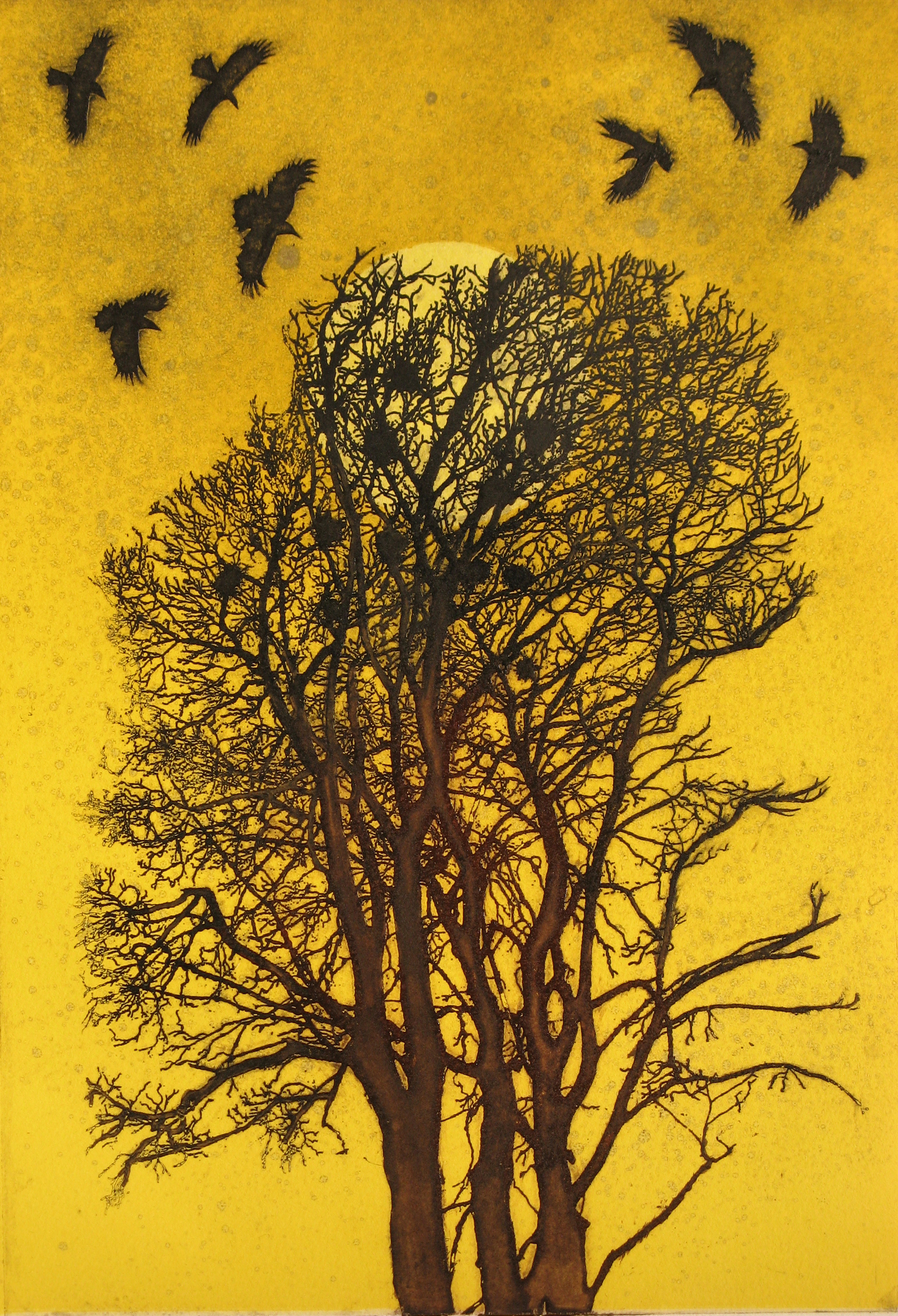
Rookery

and The Woodcat (still some available):

The Woodcat

So its a quiet time for me but a good one. I’m running most days to keep SAD at bay, keep me inspired and to enliven me for the time spent in my studio and I’m going to make the most of getting plenty of sleep and time to think before I’m back to busy times of eating on the move and midnight printing!

The Watcher

Happy new year everyone! I’m currently preparing and making plans for my printmaking in 2013. My main resolution is to be a bit more selective in the teaching that I take on and careful with the planning of my year so that I allow myself time to develop new ideas, get absorbed in my printmaking and undertake any projects that come up. I’ll write more about that in a future post but I did promise to tell you about the process of making a collagraph and so I’ll do that now 🙂

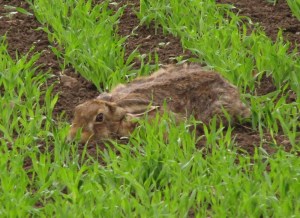
I’ve always been fascinated by hares and over the years I’ve made a series of collagraphs inspired by them. Many of these have been titled using names found in Seamus Heaney’s translation of a middle English hunting poem called ‘The Names of the Hare’. I am really fortunate to see hares regularly in the countryside where I live and I know a couple good places for watching up to fifteen of them at a time! I have taken numerous photos for reference and spend plenty of time just observing them. It has been a while since I’ve made a new hare collagraph, I seem to have been concentrating on birds lately, but The Lime Gallery in Settle asked me if I would consider creating some new designs for their winter exhibition ‘Feast’. From a purely commercial point of view, hares sell! There has been a huge increase in their popularity as a subject for artists and an ever growing group of customers desiring to own an image of one. From a personal point of view, I love them and making prints of them is never a chore!

hare

I decided to combine another favourite with the hare, an umbellifer. Plants such as Cow Parsley, fennel, dill and angelica have beautiful flower and seed heads that have an architectural quality.

I ought to say a quick word about what a collagraph is. In the true sense of the word, a collagraph is a print made from a collage but it has become a more general term for mixed-media printmaking. In my opinion, it is the most diverse method of making prints. Collagraphs can be printed in relief or intaglio but I prefer to print intaglio. This is when you apply ink to the indented surface of the plate and wipe the excess away from the raised surface. Dampened paper is then laid on top of the plate and passed through a press so that the pressure forces the soft paper into all the nooks and crannies and transfers the ink to create the image. You start with a thin base plate of card, wood or metal and apply textures to the surface (you can also cut into it) and the rougher the texture, the more ink that will be held and darker the tone that is created. If you apply smooth surfaces, they will wipe more cleanly and create a lighter area. An infinite number of materials can be used to create a collagraph plate and part of the fun comes from experimentation.

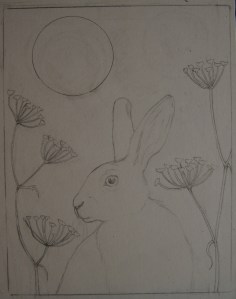
I always start my designs by doing some rough thumbnail drawings in my sketch book and then I work up the ones that I like best with a bit more detail before settling on my preferred composition.

022

I also hold the sketch up in the mirror so that I can see whether the design works well in reverse (intaglio prints always come out as the reverse image of the plate) and so that I can spot any defects in the drawing. This usually results in a few changes before I start to cut the plate. When I am happy with the design, I trace it using a well-sharpened soft pencil and then turn the tracing paper face down onto the cardboard and burnish the back with a harder pencil or bone folder to transfer the image. This means that you automatically reverse your original drawing and will end up with a print that looks the way round that you intended it to be. I use mountboard as my base plate because it allows me to both paint and collage onto the surface but also cut into it and peel sections away.

The next stage was to apply acrylic gesso to the areas that I wanted to be textured. I use gesso a lot because it holds the brush marks well and you can draw into it when it is wet to create design details.

024

I then let the gesso dry totally before cutting into it to create further fine detail. When that is done, I often apply small areas of pva glue to create highlights. The pva dries to a very smooth surface and so the ink wipes away cleanly leaving white areas.

The next step was to score around the outline of the hare, the sun and the umbellifers and peel away the background. I used a very sharp surgical scalpel and changed the blade regularly. I scored into the board just deeply enough to cut through the top layer of paper so that it can be peeled away to reveal the rougher texture beneath. This will print as a mid-tone.

026

Once the cutting was done, it was time to cut another layer in to add a bit of depth. In this case, I cut a further couple umbellifers. These print as a darker tone to the background.

Once the plate was completed, it had to be sealed with varnish. I used button polish. This is a shellac based furniture polish that seals the plate perfectly but does not diminish the detail. I sealed both sides and the edges and let the varnish dry overnight to make sure it is totally hardened. At this stage, I also cut the background plates that I planned to use in conjunction with the collagraph plate. For my new hare I used a blank piece of card cut to exactly the same size which I planned to roll up in a blend of colour to create a coloured background to print the detail onto.

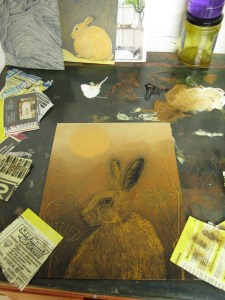
When the plates were sealed it was time to ink, wipe and print them. I already had a clear idea of what colours I wanted to use and started by rolling up a blend of raw sienna and white which I then rolled onto the base plate.

031

I then printed the rolled up plate onto dampened and blotted paper using my etching press. I made sure the paper was damp because it needs to be wet for printing intaglio and if I had printed the relief block on dry paper, it would have then expanded when I dampened it for the next stage and it would not have registered properly.

Once I’d printed the bottom layer, I applied raw sienna, white and sepia à la poupée to the collagraph plate. I always apply the ink using my fingers so that I can feel if the plate has any loose sections that need re-gluing. I use nitrile milking gloves to protect my hands and then I can just take those off when I need to handle the paper. Once the whole block was covered in ink, I carefully wiped the top surface using pieces of an old phone directory. I used the flats of my fingertips and a polishing motion to ensure that the ink didn’t get rubbed out of the indentations.

029

Once the plate was wiped, I placed the already printed block of colour face up on the bottom blanket of my etching press. This is a bit unorthodox but allows me to register my prints easily by eye. I was then able to carefully place the inked and wiped collagraph plate face down onto the block of colour, lay some acid free tissue over the top and the rest of the blankets on top of that. I then wound the whole lot through the press. Then came the exciting part of revealing the first proof 🙂

034

I was really pleased with the result. It came out just the way I wanted it to! However, something was missing and I couldn’t put my finger on it for a while until I realised. I’d forgotten his whiskers! This was easily remedied by a few quick cuts with the scalpel to the collagraph plate and the rest of the batch came out fine. You have to repeat the whole inking and wiping process every time you make a print.

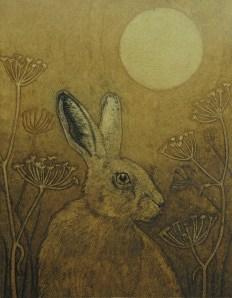
The Watcher

So here he is, ‘The Watcher’. I’ve already sold a few so I hope he will be popular.

On a final note, my lovely boyfriend surprised me on Christmas day with a hare! We had been looking at the wonderful feltwork by Emma Fountain at the October craft fair, ‘Crafted by Hand’ in Masham and I’d fallen in love with a beautiful large hare she’d made. Brian later searched for Emma on the internet and secretly commissioned her to create me my own moongazing hare. It was a total surprise and I’m thrilled to bits. Here is a picture:003


Busy busy busy!!

I can’t believe that it has been a month since I wrote a new post here. My residency in Sweden seems like ages ago and I’m feeling slightly overwhelmed by the amount of workshops that I’ve been teaching and exhibitions that I’ve been preparing for but there is light at the end of the tunnel and I am keeping my fingers crossed that by the time December comes, I’ll be able to start working on the ideas that I started at Ålgården.

In the meantime, as an update, my seven week collagraph evening course at Number Six Studio in Pateley Bridge is now three weeks in. I have seven returning students who have become ‘old regulars’ and one brand new student who has not done any printmaking before but has really thrown himself into the process and not been put off by the fact that he is also the only man on the course. I’m looking forward to seeing his collagraphs develop.

I’m also four weeks in to my Introduction to Printmaking Techniques course at ArtisOn Ltd. This is on a Tuesday afternoon and so far I’ve covered monotype, making a basic relief stamp, linocut and drypoint! My ten students seem to be enjoying themselves and we will be making collagraphs this week.

Rural Arts in Thirsk has been running taster workshops and I’ve done some three hour collagraph sessions and am about to run a two-day collagraph workshop on consecutive Fridays (16th & 23rd November). I also did a monotype class for the Leven Art Society and a linocut workshop at ArtisOn. After my linocut Christmas card workshop at ArtisOn in December it quietens down a bit and I’ll have more headspace for my own work. I enjoy teaching and it really keeps me on my toes and pushes my professional practise but it also takes up a lot of time and energy so it is important that I get the balance right and give myself enough time to work on my printmaking.

Winter exhibitions include group shows at Cambridge Contemporary Art, The Waterstreet Gallery in Todmorden, The Lime Gallery in Settle, Will’s Art Warehouse in Putney and I’ll be taking part in a two week show at RHS Garden Harlow Carr from 27th November to 9th December. Phew!

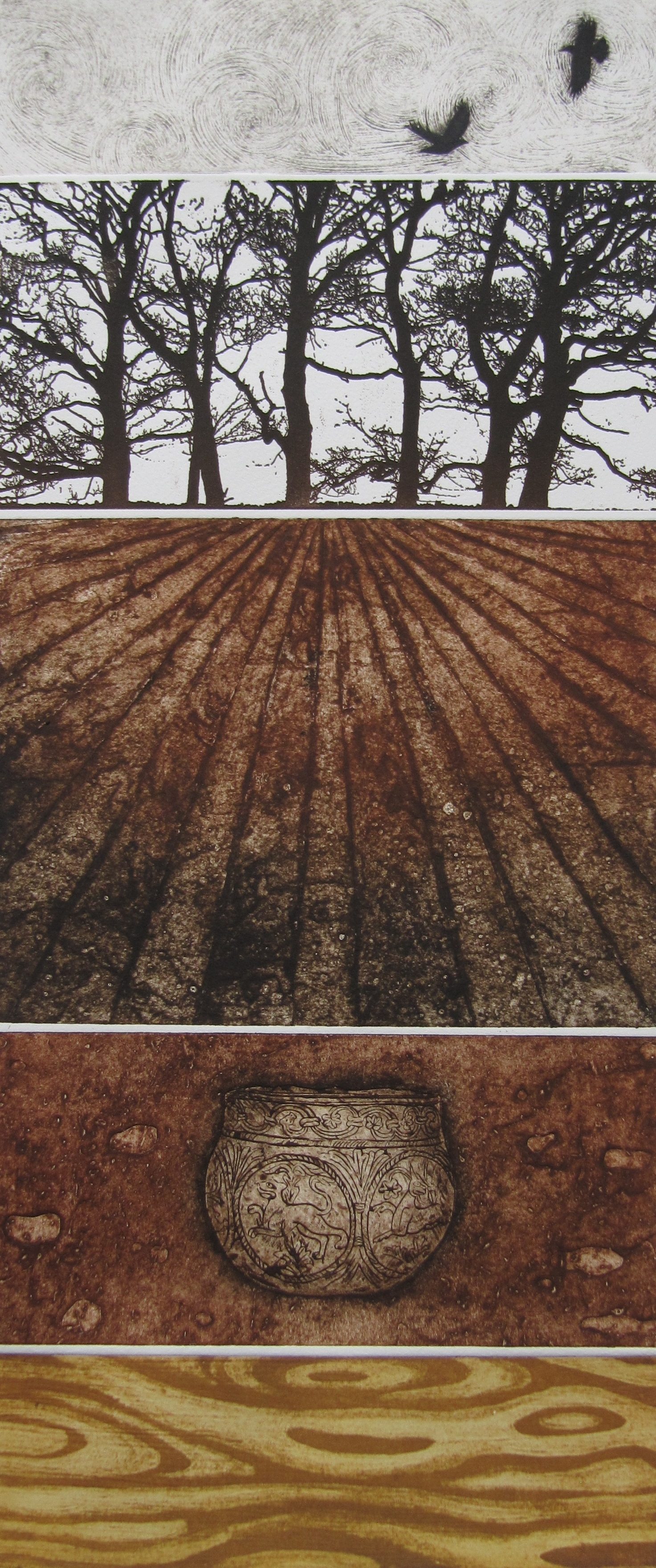
I was very pleased to be one of the fourteen printmakers selected for the West Yorkshire Printmakers ‘Flourish Printmaker of the Year’ award and had two of my prints on show at the exhibition in Mirfield. Sara Clarke won the award and there were three commended artists: Moira McTague, June Russell and Dan Booth. It was good to attend the preview and ceremony and meet up with other printmakers. This is one of my selected prints which was created during my Extending Practise Award last year. Chrysalis Arts funded me to be mentored by Jane Sellars, Curator of the Mercer Gallery in Harrogate, whilst I created prints inspired by the Vale of York Viking Treasure Horde. These went on display at the Mercer Gallery alongside the treasure.

It’s always interesting to see what sells and so far I have had quite a lot of success with my most recent print ‘The Raspberry Thief’.

This was inspired by watching a whole family of blackbirds feeding in my back garden. The male and two fledglings were stealing raspberries whilst the female wrestled with a large slug!

My most recent print was created last week and is of a mountain hare. I have been asked by The Lime Gallery in Settle to make a couple new hare prints for their winter exhibition. They are such wonderful creatures and steeped in folklore and mythology. I often watch them in the fields near where I live and have taken many photos. I’ve always wanted to see a mountain hare in its winter coat but haven’t yet. Maybe one day! Instead I have made do with making a little collagraph of a snowy hare.

I’m now working on another hare print and will photograph the different stages for my next post.

I’m already planning various exhibitions for next year and have been invited to take part in a show called ‘Flight’ at the Craft Centre and Design Gallery in Leeds. It will start in March 2013 and will feature four of my prints and four each from Janis Goodman, Pam Grimmond and Mike Smith. I’m also taking part in a group exhibition called ‘Our Feathered Friends’ at Cambridge Contemporary Arts which is also in the spring.

On a final note, I’m delighted to be having an exhibition with glass artist, Jane Littlefield at Rural Arts in Thirsk. This will take place from 16th March to 31st May 2013 and we have chosen the title ‘Telling Tails’. We met last week to discuss the show and discovered that we are inspired by the same things: wildlife, the countryside and the myths and stories that are connected to both. We plan to show glass and prints featuring birds and animals with an illustrative twist. We will both be running workshops to coincide with the exhibition.

Right, I’d better get on with the paperwork I need to finish before continuing with my new hare collagraph. More on that next time.

Final Days at Ålgården

I started this post whilst I was still at Ålgården but I had so much to do before I left that I never got the chance to finish it so here it is! The final days of my residency were quite intense but very satisfying. On Sunday I successfully exposed my latest graphite drawing as a photopolymer plate. Here is one of the first proofs. I forgot to mention the fact that all my prints are being printed onto cream Hahnemüle paper which accounts for the slightly pink/cream looking photos

I’ve been a bit obsessed with puddles in the forest and wanted to capture something of the feel of the pine forest after the rain.

It was also a beautiful afternoon on Sunday so I went for a long run with my camera to try and get as many photos as possible. I have built up a really good image bank that I hope will help me to continue my Swedish work during the winter months in the UK.

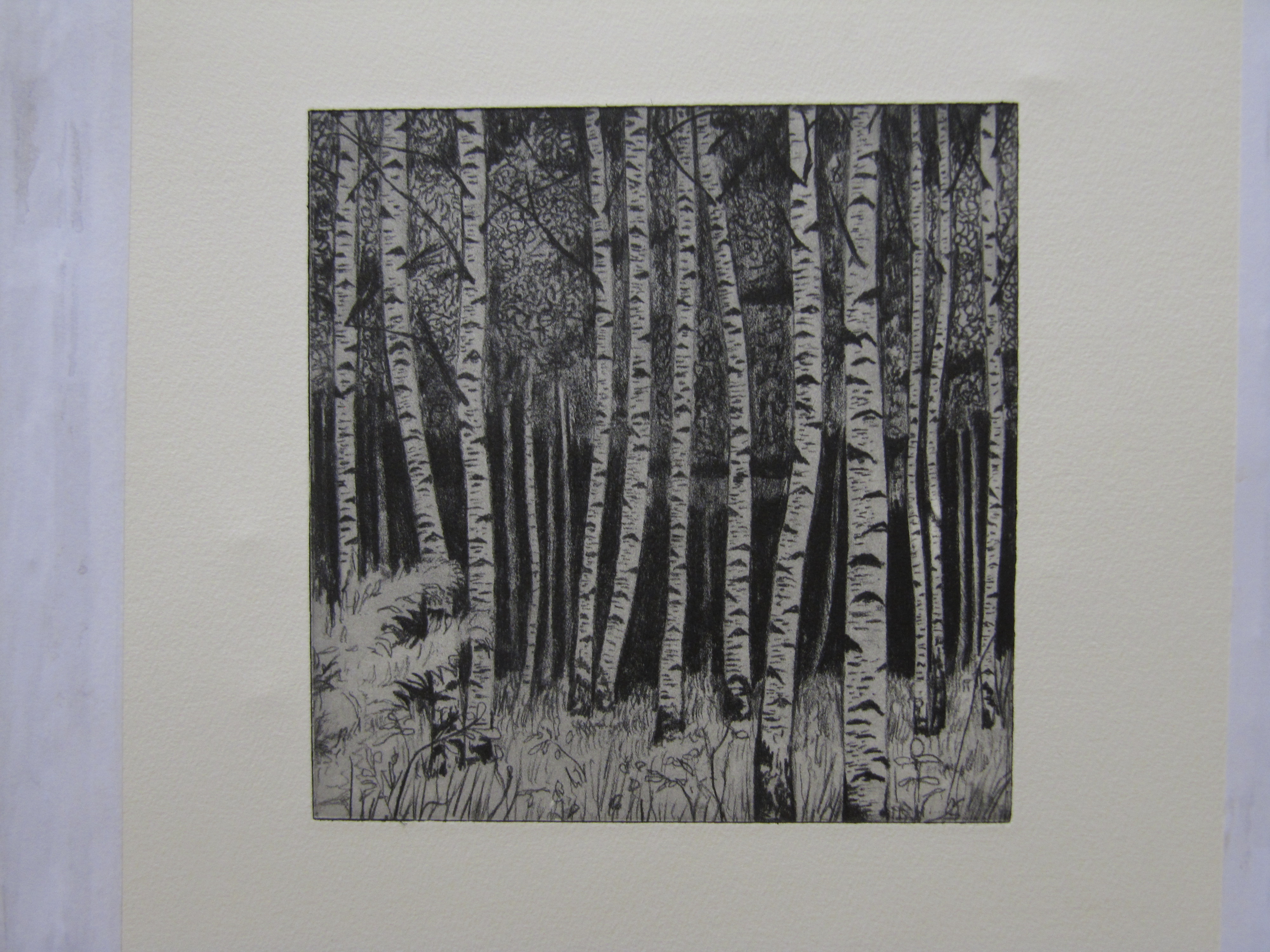
I then went into the studio with the intention of making some small monotypes of the autumn colour in the birch forest. However, I found myself making an enormous grey (not even black) monotype of the birches and it took me ages. I was so tired that I almost gave up on it but forced myself to finish. I think I wanted to make the most of having access to the huge press but it was a bit of a mistake. On Sunday night I thought it was an awful print but I looked at it in the cold light of Monday morning and it wasn’t so bad and will be useful as a reminder of things now that I am back home. Although it hasn’t travelled too well and will need resoaking. I packed all my prints up very carefully and they were fine but this was so big that I had to roll it and stow it in my case. Needless to say it is now squashed flat!

On Monday Ida Brogren, artist and illustrator http://www.syskonenbrogren.se, arrived with her camera and she took photos of me exposing the monotype transparency onto the photopolymer plate. Here are the two transparencies stuck together (there is a lot of overlap of ink).

Following all the steps described in my previous post, we exposed and developed the plate. I also exposed an identical plate using the same timings but using the aquatint screen that Björn had given me to see what the difference was. This is a picture (taken by Ida) of Christina and me examining the screens.

I’m chuffed to bits with the proof prints! (Here is the one made from the plate using the studio’s aquatint screen:

and the one made using Björn’s screen:

The dots on the above screen are more open and so you get a rougher and more grainy effect. It would be interesting on certain prints though and it is great to have it to start me off. Björn has also given me the details of the man in Gothenburg that makes the aquatint screen that I used. It would be a good investment for me to order one from him once I have made my lightbox.

I spent the rest of Monday printing and organising all my stuff for transporting back to the UK. I then found out that Modhir Ahmed was coming back to Ålgården to film people looking at his exhibition and then sharing their thoughts on his paintings. He arrived in the late afternoon and Ida stayed behind to help with the filming. She also made a beautiful meal for us of pea soup with creme fraiche and caviar with olive ciabatta and her friend arrived with the most delicious apple cake. It was a nice surprise because I’d intended working through and just snacking on a bowl of cereal! 🙂

Once we’d eaten, Modhir insisted that we were filmed looking at his paintings. I have to admit that I was a bit reluctant due to the large amount of work that I wanted to do on my last night but I managed to say a few words that I hope were meaningful before scuttling back to the studio. It got to about midnight and I decided that I needed to wind down a bit so I went to the lithography studio and made some acetate screens to take back to England. You may remember that this involves using a large and a small lithography stone with carborundum and water and it is a meditative thing to do. I made four which took about 25 minutes so I felt quite relaxed by the time I went to bed.

Tuesday was my last day at Ålgården and I was determined to say goodbye to the forest so I went for a 5 mile run in the rain. It was lovely with lots of jays and nuthatches flying about and I saw the friendly woodsman and was able to say goodbye to him too. I got back to the studio and Modhir Ahmed had a surprise in store in the gallery. He wanted us to come and look at his exhibition and in the night he had painted over all of his paintings in black and chalked a single English word on each. It was something of a shock but exciting too. He is a very interesting and well-respected artist in Sweden, full of ideas and energy. I found an article on the Ålgården facebook page that talks about it: http://www.bt.se/kulturnoje/konst/konstkuppen-malade-over-tavlorna%283472160%29.gm

I wasn’t able to do any more work but had the whole morning to pack everything up carefully and prepare a couple prints that I wanted to give to Christina and Björn and also one for Lennart who arrived just in time for my farewell lunch. He and Ute had made a print together for me too, I was really touched. Björn made veggie spaghetti bolognese and eight of us sat down to eat together. Then it was time to say goodbye 😦 Anna Mattsson kindly drove me to the airport and it was really good to spend the time with her. I managed to get through the luggage check in even though they had to mark my bag as ‘heavy’ and send it down the oversize baggage chute. They also let me on with a very heavy rucksack as hand luggage and a large parcel of prints. I was quite surprised but the plane turned out to be half empty so perhaps they were being generous with regards to the usual baggage restrictions.

I will really miss everyone that made me so welcome at Ålgården and I will also miss the fantastic opportunity to immerse myself in my printmaking without the pressures to teach or sell my prints. I already feel that it has been an extremely valuable time and I suspect that it will have a profound long-term effect on my printmaking and the way I view my work. Being amongst other professional printmakers in well-equipped studios exchanging ideas and learning new techniques has all the best attributes of being at art college but with the added maturity and insights that come from actually making a career from your artistic practise. I’ve been through some low points and some self-doubt but I have also reaffirmed the fact that printmaking is what makes me tick and is how I want to make my images. I find it exciting that, after eighteen years of printmaking, I am just scratching the surface of what can be done in one small area and now the photopolymer combined with my monotypes could be a whole new avenue for me to explore. 

I now have a really hectic couple of months with at least seven group exhibitions to prepare for and two printmaking courses to teach but I have light at the end of the tunnel in the form of the quieter months of December, January and February. I usually find this time quite uninspiring and my creativity is often at a low so I tend to just use it to restock my editions and prepare for the coming months but this winter I want to consolidate some of the ideas that I have had in Sweden, make further prints based on my experience of the forests and explore photopolymer printmaking further and see where that takes me. I need to build a light box but I have good advice from Christina and Björn as well as a good book on the subject and a friendly contact in the form of Rebecca Vincent at Horsley Printmakers (check out her lovely monotypes and etchings http://www.horsleyprintmakers.co.uk/rebecca_vincent.html).

I’ll continue to write here so please do check back in the future to see what I’m up to. Oh yes, I’m already considering the possibility of returning to Sweden once I’ve developed my ideas a bit further and also I am hoping that Art Connections will be able to develop their link with Ålgården. It would be great to see some of the Swedish artists in Yorkshire in the future and perhaps we could collaborate on something. Before I sign off for now, I’d like to say a huge thank you to everyone at Ålgården who made me feel so welcome and have become friends and also to Christine Keogh and Rick Faulkner at Art Connections for giving me this opportunity, it’s been just what I hoped for and more!

Vernissage(s)

Well, it’s been an exciting last weekend here in Borås. I’ve been continuing my experiments in photopolymer printmaking and have been to two exhibition openings (as well as a couple forays into the forest).

Modhir Ahmed, http://www.modhir.com/web/index.html, arrived on Thursday night. He is an artist from Iraq who has lived in Sweden for over thirty years and has an international reputation for his printmaking. He was here to put up his exhibition ‘Lord of the Earth’ in the gallery at Ålgården, where he is also a member. Friday was very busy with lots of people toing and froing in preparation for the opening and at lunch time we were all treated to a beautiful meal of smoked salmon and potatoes in a dill sauce (I’ve become a vegaquarian whilst I’ve been staying here as fish is a large component of most meals). In the evening, following my run in the forest, I went to the opening or ‘vernissage’ as they call such things here.

Lots of people came and when we were finally able to close the gallery doors for the evening, we all had a meal together in the Red House (the artists’ house where I stay).

Today was another busy day. It started with a lifedrawing session in the gallery. Our model today was Sassa, who was very good humoured and challenged us with no poses longer than 4 minutes and most were 2! It is interesting how the models lead the sessions here at Ålgården. All the life drawing I’ve ever done before has been led by the group, another artist or a teacher and the model played a passive role. I like the fact that the model is in control here. After the drawing, Anna Maria gave Ute and I a lift to another opening at a small town called Dalsjöfors. We stopped off at her house to pick up her husband, Peter, and were shown around their wonderful studio (they are both artists) and garden. The exhibition opening was for Ålgården member, Kristina Thun http://www.kristinathun.se/ who has been working every day since I’ve been here making beautiful lithographs and photopolymer prints.

I think her work is really atmospheric and her printmaking techniques are fascinating. She often uses up to seven different layers of greyscale to create her lithographs.

After that it was time to return to the studio and meet Anna Mattsson who had kindly offered to show me some techniques using wax including how to make image transfers and also work into wax on paper. It was really good fun and, during tonight’s run in the forest, I began to get ideas of how I might use it in my own work.

On the photopolymer front, I am currently waiting for two acetates to dry. I’ve created a much smaller version of the watery monotype that I did the other day. It was a two stage monotype but this time I wasn’t printing it and will be using it as a stencil so I needed to make two acetates to place on top of one another to create the whole picture. I used water soluble relief ink and that takes a few days to dry so I am now waiting (impatiently) for the acetates to be ready to expose onto my photopolymer plate. Ida has asked me if I will wait until Monday to make the plates so that she can come in and photograph the process. I agreed and am now glad that I did because I know what I’m like and if I wasn’t waiting for her, my impatience would have got the better of me and I’d have tried to expose them when they were still a bit wet and probably got them stuck to the plate 🙂 I’m also making another graphite drawing for a photopolymer plate and, all being well, will expose that tomorrow. A lovely surprise today was that Björn found an old ‘raster’ (or aquatint dot screen, as I now know it is called in English) that he’d made some years ago and he gave it to me as a gift to take home so that it will be easier for me to get straight on with my photopolymer printmaking. He also suggested that I prepare a load of films in the litho studio so I can take those home too.

I’m feeling really positive about this residency and the effect that it will have on my future printmaking practise. I’ve got stacks of ideas but also a real desire to experiment and push the boundaries of what I have been doing. I will talk more about that in another post but I need to get to bed now! I’ll leave you with a picture of Lennart and Kristina at the preview.

and Ålgården’s resident black rabbit 🙂

Adventures in Photopolymer!

Well, I promised that I’d write about my latest foray into photopolymer printmaking and so here goes!

To start with, perhaps I’d better explain what photopolymer is. As the name suggests, photopolymer is a light sensitive polymer. The material has been used in the commercial printing industry for years but in the last couple decades printmakers have adopted it and used it in a variety of ways to create original prints. I have used it myself and refer to it as solarplate because I use the sun to develop my plates. I first came across it when a good friend and fellow artist, Jon McLeod, was doing a residency at Highland Printmakers. I had just come back from travelling extensively overseas and was ready to create a body of work based on my travels. I wanted to include text and maps combined with my collagraphs but didn’t know how to. Jon suggested ImageOn film or photopolymer plate. He gave me a bit of a demonstration and I went off and bought a book on the subject. I basically taught myself everything I know (not a lot!) and have been able to make basic relief and intaglio plates using my photos and text which I then convert to pure black and white on photoshop and print out onto a transparency. This is then placed on top of a steel plate which is coated on one side with a light sensitive polymer (you can buy them from printmaking suppliers). The black part of the design blocks out the UV light and the clear parts let it through. Where the light hits the plate, the polymer hardens and where the black parts mask it, it stays water soluble. The great thing about it is that you can then wash out the black parts using warm water (no chemicals needed). The final stage is to expose the washed plate in the sun for a good hour or so to cure it and then it is ready for printing.

You have to do test strips to determine how much time the plate should be left in the sun and of course, the sun’s strength can vary due to the time of day and the season and you do actually have to have some sunshine in the first place! Many a day has been spent scrutinising the sky for a gap in the clouds so that I can develop my plates. I’ve actually got some good results with relief plates but my intaglio plates tend to have large areas of ‘open bite’ due to the fact that I can’t get mid-tones.

Anyway, I’ve been aware for a while that you can make really interesting photopolymer plates which will retain all the tones and fine detail of drawings and photos and will replicate the look of lithographs, etchings, drawings etc. Fortunately for me, Björn Bredstrom and Christina Lindeberg are experts in this field. Christina spent some of her valuable time teaching me to make the initial test strips today.

But…let’s not get ahead of ourselves! First you have to create the image that you intend to make into a printing plate and before you do that you need to prepare the transparency. This entailed using acetate intended for lithography. You need to roughen the surface of it to be able to draw onto it. This is a very satisfying process which involves wetting a large lithographic stone and squeegeeing your acetate onto the surface so that it doesn’t move about. You then add carborundum grit and water to the topside and take a smaller lithographic stone and grind it over the whole surface in a figure of eight for about four minutes. This gives you a surface with an even bite to it. You can then work on this with acrylic paint, graphite, tusche or any other light fast material. I used 6B and 4B pencils to create the transparency below.

The next step is to determine how long you need to expose your ‘raster’ for. I don’t know what the English name is but a raster is the Swedish word for an acetate with a random dot pattern on that replicates aquatint. You use it to pre-expose your plate before you expose it with your design. The tiny dots mean that you can get fine detail, mid tones and large areas of black without having ‘open bite’ (when you can’t avoid wiping out the ink from large areas of dark tone on your plate because it is completely washed away). I can’t explain it better than that so please google for further details if you haven’t already fallen asleep!

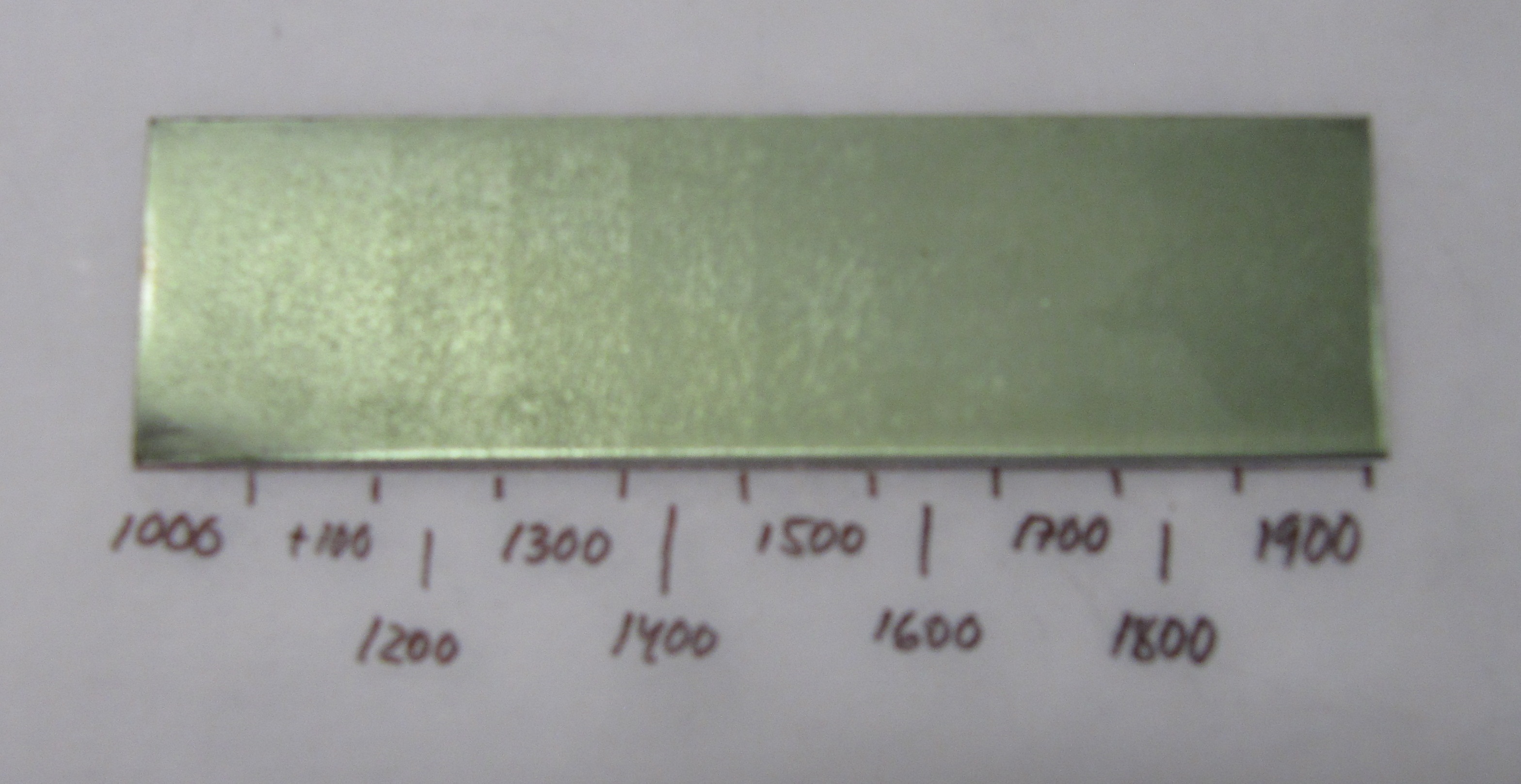
Christina helped me to make the initial test strip and Ida photographed the whole process (she is going to let me have copies) and made notes because she wanted to learn too. We had to cut a piece of the photopolymer plate and then mark a sheet of paper with sections and the timings written underneath. The numbers look odd because they are units not actual minutes and seconds.

I forgot to mention that we are not using the sun. We are using a rinky dink all singing all dancing light box!

You also have to make sure that you don’t expose the plate to light whilst you are in the process of preparing it. It is not so sensitive that it has to be done in a dark room but you do need to keep it undercover when you are in between stages and it is best to cut it in a very dim room. Once we had cut a strip of plate, we then put it in the light box and lowered the glass down onto it, set the vacuum pump to make a good seal and then exposed the whole plate for 1000 units of light….what about the ‘raster’ I hear you ask? Yes, well, we forgot all about that and only remembered when we went to cover part of the plate to start the tests. Whoops! We cut another strip (it’s expensive stuff so you learn a hard lesson when you make mistakes) and this time we laid the ‘raster’ over the top of the plate and then lowered the glass and set the vacuum. After the initial exposal to 1000 units of light, we then covered the marked sections at 100 unit intervals so that one end of the strip had been exposed to 1000 units and the other end had had 1900 units. This took quite a long time!

Next we had to develop the strip so we took it to the wash room and under a yellow light we sat it in a tray of warm water (room temperature) for a minute and then a further minute was spent gently brushing the surface of the plate under the water to remove the unexposed particles of polymer (the black dots of the ‘raster’).

We then had to dry the plate. You can use a hair dryer but here we have a great little drying box. After 5 minutes in there, the plate needs to be cured with a full dose of UV light so back it went into the light box for 15 minutes. Phew!! What a process and it was only a test strip.

After lunch my job was to ink, wipe and print the strip to see which part gave us the best black. The part that was blackest would indicate the amount of units of light needed to expose the plate. Unfortunately the test strip was inconclusive because we realised that the ‘raster’ must have moved each time we lifted the glass screen. Blast! Björn also suggested that we clean the sensor in the lightbox before we made another test strip. This time he told us to divide a strip of polymer into three segments and expose it at 750, 1200 & 1500 units. From that we should determine the range that we would need to make a further test strip. We should stick the raster down with tape so that it didn’t move when we opened the glass each time. The numbers seem a bit random and this would also mean going through the process described above twice and it was now 4pm but Ida and I decided to do as we were told in order to be ‘professional’ 🙂

Thankfully, the three segments showed us that 1200 units gave a lovely velvety black tone.

Björn told me that I needn’t make a further test but I should expose my plate to the raster for 1200 units and remove it and expose my design onto my plate for the same amount of units.

So…I went back and cut a piece of photopolymer plate to the right size and put it in the lightbox with the ‘raster’ on top of it, the glass down, vacuum on and exposed it for 1200 units. I then took away the raster and replaced it with the transparency with my drawing on and exposed that for 1200 units. I went through the developing process, drying process and curing process and after about an hour, the plate was ready to ink, wipe and print. I could see that there was a delicate design on it and I was really excited.

I printed the plate and it is just amazing…you get a perfect copy of your drawing! The only slight downside is that I don’t seem to be able to get a ‘white’. There is an overall grey tone to the print. This could be to do with the process but I suspect that the timing on the exposure of the design needs tweeking. I’ll ask Björn and Christina when they come in tomorrow. I’m now really excited about the possibilities. I am wondering if I could do a reduction monotype on acetate and instead of printing it, I could allow it to dry to make a transparency that I could expose to the photopolymer and then get a plate with all the beautiful marks that you get from monotype but that you can print repeatedly…the possibilities could be endless.

The other thing I need to do is to work out how I can transfer this process to my studio at home. I have a book that tells you how to make a lightbox and Björn says that he has had good results just using an overhead bulb or an anglepoise lamp (the light has to be uv or ‘cold’ light) but you have to make sure that the light stays at a fixed point above the plate and the distance from the plate has to be the same as the diagonal length of the plate in order for there to be an even coverage of light. There is also the small matter of the litho stones and preparing the transparencies but I am sure that improvisation might be possible. Tomorrow I am going to make a transparency using monotype techniques and ink.

Monotypes

Well, I was going to talk about photopolymer tonight but I’ve just had a busy evening in the studio and I’m not sure talking about technical processes is such a good idea at 23.00. Bear with me, I will go into some detail in my next post 🙂

I forgot to mention that I now have a housemate. Ute is from Kiel in Germany and, having enjoyed her visit last year, she has come back to Ålgården for two weeks of printmaking. She has a project that she would like to complete and has already been busy making drypoints in the studio. She’s good company and we went on a little trip to Alingsås with Lennart this morning. The idea was to visit Lennart’s favourite organic food store, the red cross second hand shop and then to have pizza in what they both promised me would be the best pizzeria ever! I’ll admit that it was pretty good and it has to be the cosiest and most colourful restaurant I’ve been to in a while. The organic food store was wonderful and I came back laden with apples, a squash and some chilli chocolate (for emergencies).

I

The drive was lovely too. The autumn colour is really beautiful at the moment. The forests are a patchwork of green, yellow, golds, reds and oranges. I’ll take some photos if the rain ever lets up!

Yesterday Lennart brought in one of his cast bronze sculptures to show me. He knows I’m  a big fan of crows and I love this one, it is so full of character and has a real presence when sat on the table next to you.

The rest of the day has been a good one. I had a sleepless night last night (possibly caffeine related!) and found myself mulling over what to do and where to go with my printmaking in order to make best use of the next few days. I knew I’d be making a photopolymer transparency but I couldn’t decide what to do for that either. So when I got back to the studio today I was really strict with myself and promised myself that I wouldn’t leave it until the transparency was drawn out. I made several starts before settling on a birch wood. I figure that it will be nice to have a few different kinds of prints of the birch forest to compare techniques. I’ll expand more on the process in my next post but once I’d finished the drawing, I felt in a really good mood and ready to make something else so I decided not to go running today in case I broke the spell and instead I holed up in the studio all evening. 🙂

I’m still frustrated about not being able to depict the pine forests and so I went back to basics and decided to do a reduction monotype. I figured that if I did it in two stages, I’d get around the problem of how to depict the dark trunks but still have a darkish background and the light coming through the trees. It took me about three hours to complete and I was using water soluble ink so I was a bit concerned about re-soaking the paper after the first plate was printed. The result was that when I printed the second stage on top of the first, the ink didn’t transfer so well because it was drying out and the paper was drying out. However, I am happily surprised by the result.

It still isn’t how I’d envisaged it but strangely enough, the ethereal pines against the very watery looking background captures more of the atmosphere that I experience on my rainy runs than I would ever have imagined that I could achieve!

I had printed the ‘ghost’ print (the traces left on the plate after the first printing) and ironically the paper was too wet so I got a really abstract result but when I printed the ghost trees over the top, because there was still a lot of ink left on the plate, I got an interesting second print.

I had a happy evening working tonight and Ute and I seem to work really well together. We are both quiet and keep ourselves to ourselves but when we hear the press going, we both tentatively wander over for a peek at each other’s work and it is a nice combination of having privacy to work but encouragement and an opinion if we want one.

I’m keeping my fingers crossed that I can get Christina or Björn to help me expose my photopolymer plate tomorrow. I will report back with my progress.