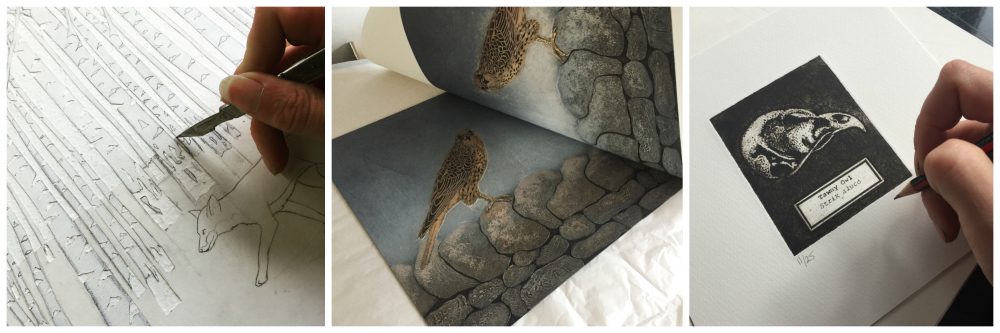
Large-scale Collagraphs

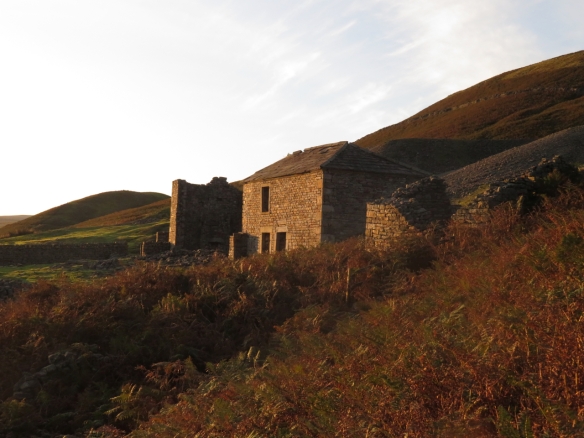
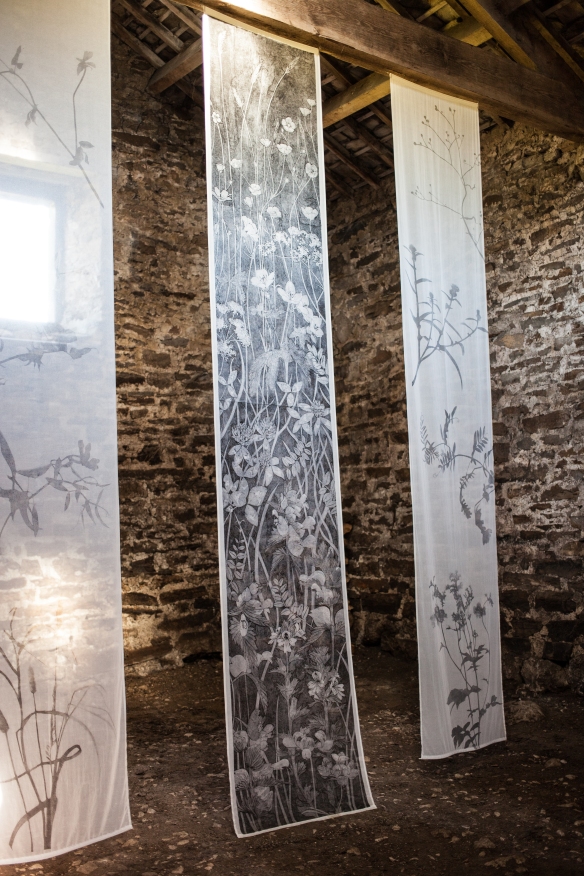
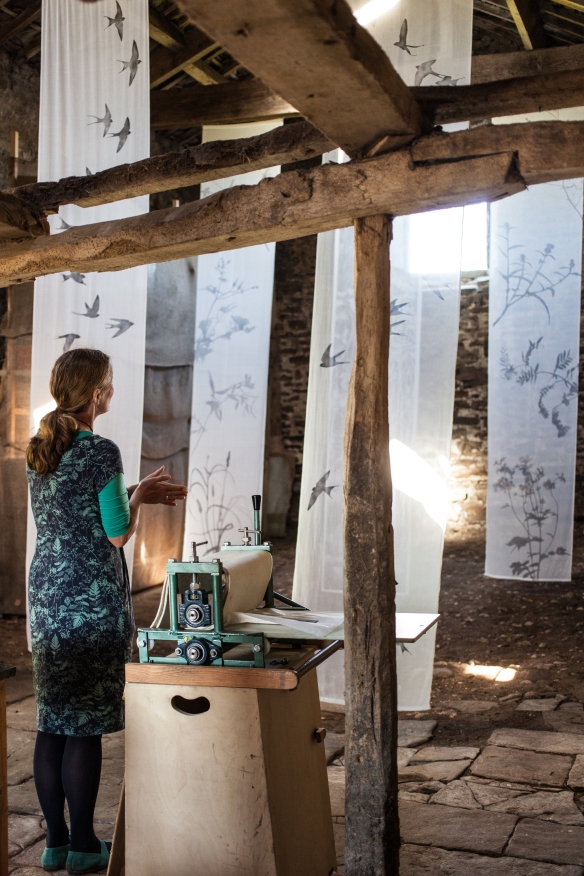
Its been a long, long road to get to this point but as I write, I’m just about to cut the final blocks for my last two hangings and will be printing them in Horton-in-Ribblesdale Village Hall later in the week. Grassington Festival is a week and half away and I’m up at the barn later today to do some final clearing up. Most importantly, I have also successfully completed my 4-metre collagraph!

I should also mention that I spent a day at ArtisOn Ltd in Masham thanks to the lovely Gaynor and Sue letting me use one of the studios for hemming the five hangings. I am also totally indebted and eternally grateful to Lorraine Garlick and Sheila Smith who gave up their free time to sew 47.5 metres of fabric for me. That is true friendship! I don’t have a sewing machine and I have very little sewing experience so what could have been a total nightmare, was actually pretty straightforward and the results are beautiful.

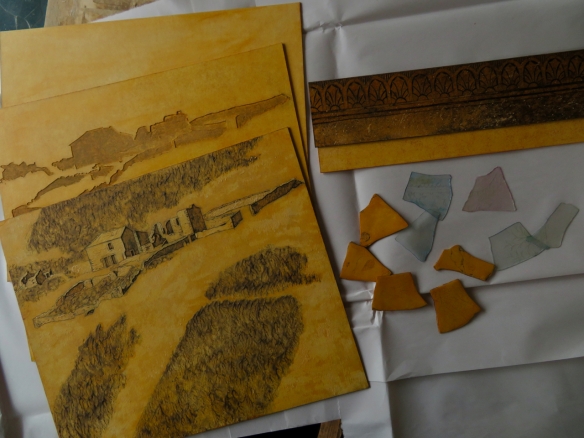
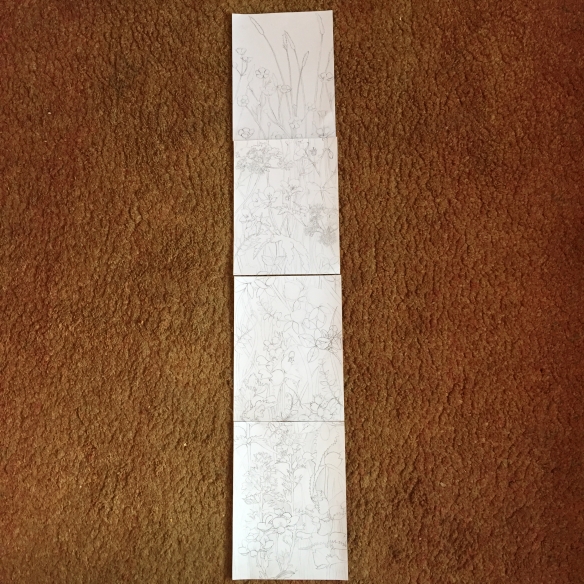
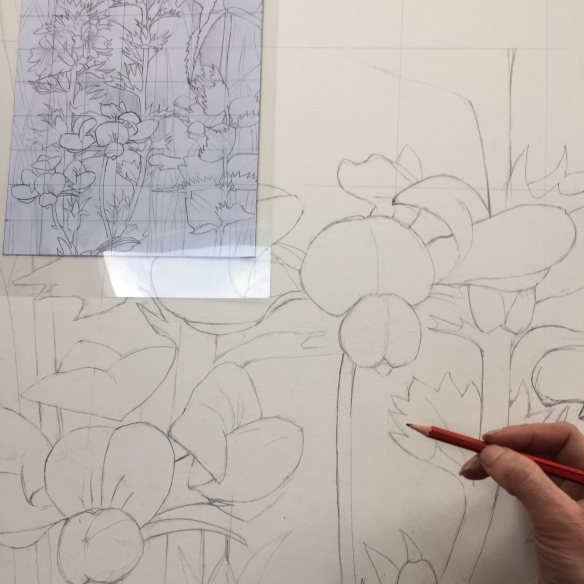
When I embarked upon this project, I don’t think I fully understood the implications of attempting to print a continuous 75 x 400cm collagraph but I’m glad that I didn’t let all of the set-backs and logistical problems put me off. Working on such a large scale has been challenging but really exciting. First I had to sort my design out so I worked on four pieces of cartridge paper that I divided into 1 inch squares (7 1/2″ x 10″) with the idea that I could then apply a grid to the large pieces of mount board and redraw the design using the sketch as a guide. This did work but the initial drawing took two and half days to do and then each plate took a day to draw out not to mention a day each to cut.

C4631020-3B27-4EE8-8617-FAF2BF57C6D5

The finished drawing (hard to photograph!).

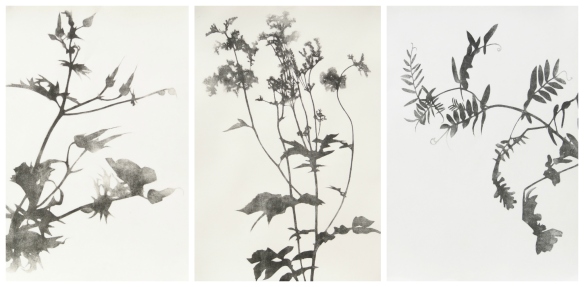
My idea was that the collagraph would be a close-up study looking through a bit of meadow with a number of different flower species represented. I chose to include eyebright, yellow rattle, birds foot trefoil, bush vetch, red clover, wood crane’s-bill, meadow buttercup, pignut and sweet vernal grass. These are all species that I’m familiar with and that are found in upland meadows here in the Yorkshire Dales. I’m a bit of a stickler for accuracy and detail so each plant needed to be researched and I wanted them to be accurately in scale with each other. FullSizeRenderUsing the grid system to upscale the drawings worked really well and took me back to my college days. I used four full sheets of mount board to make the plates and mainly used cutting, wood glue and gesso to create the collagraph.
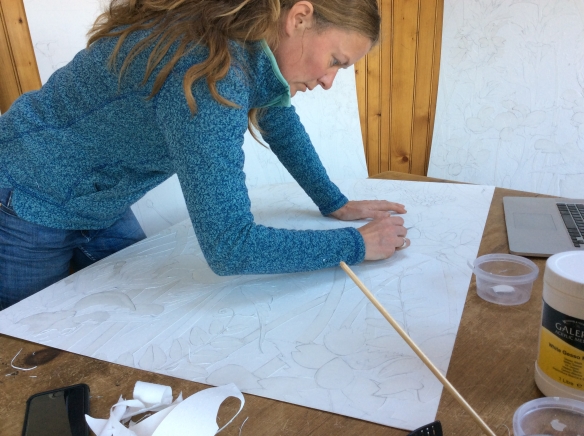
I soon realised that printing at that scale, it was best to keep things quite simple but it was still a bit of a challenge to work out how to do the veins on the leaves and pignut is a such a delicate and frothy plant that it did take a lot of work to get the look just right. In the meantime I had been searching for a place to physically print the work because I needed a press that could accommodate a 75cm wide and metre long collagraph plate. No small task and I actually found myself waking in the night and having panic attacks about not being able to print the plates once I’d made them. I even found myself trying to work out how I could get such large pieces of card over to Sweden as I know Ålgården’s press would have been perfect. Fortunately I found out that Northern Print in Newcastle have a lovely big intaglio press and I made an appointment to have an induction and to print the first plate. It is a 2 1/4 hr journey to get there on a good day (with no traffic & no accidents) and my first visit saw me getting up at 5.30am and hiring a dog walker in order to get there on time and not leave my furry pals crossing their legs all day.57F6D87A-07E4-4F88-9D71-6811EE094C84

It was an unbelievable relief to discover that when I book to use the large electric press, I have sole access to it for the whole session and so can work slowly and methodically whilst not worrying about anyone else needing the press or having to reset it. I am now a member of the studio and have plans to go back and create more large-scale collagraphs there.

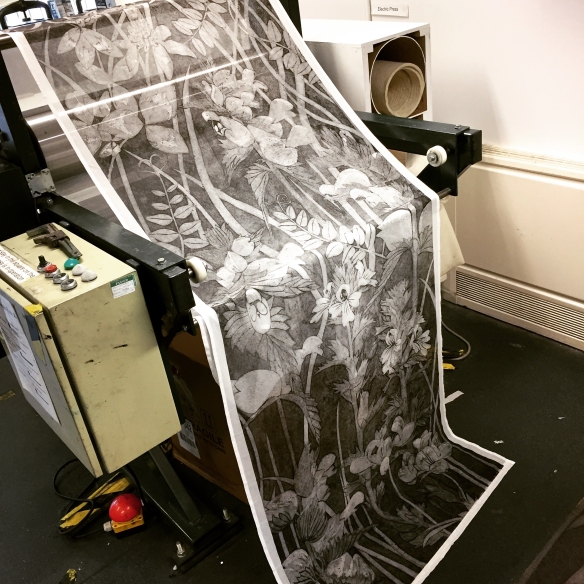
Each plate initially took an hour to ink and forty-five minutes to wipe in order to get a paper proof. I needed to do that for each one so that the plate would ‘settle’ and I could check it was printing exactly as I wanted it to. It meant that I had to book the press for 2 x three-hour sessions in order to print one section of the hanging. I won’t go into the entire process here as it was lengthy and stressful but imagine trying to handle an inky metre-long piece of card and print it onto a pristeen white piece of four metre voile and you’ll get a bit of an idea. I also had issues with the pressure on the first print and lifted a corner of the fabric to discover that the collagraph was pale and ill-defined. Fortunately I was able to lower it again and tighten the press to get a good print from it. After my first visit with the first successful section printed, I returned home triumphant to recount my exploits to my husband who then asked ‘but how are you going to make sure the plates match up and how are you going to get them all the same tone?’ To be honest, I hadn’t considered this but chose not to think about it too much and just to hope that I could work these problems out as I went along.

It took another two sessions (with the last one being from 10am to 8pm) to actually complete the design but it is fair to say that I’m really happy with it. Sure, there are a few flaws and I know that I could do it better a second time around (which I may have to if my Swedish contact does want to buy one for the hospital) but it is how I pictured it and I can’t wait to see it in situ.

IMG_1863

The first two prints successfully through the press.

IMG_1878

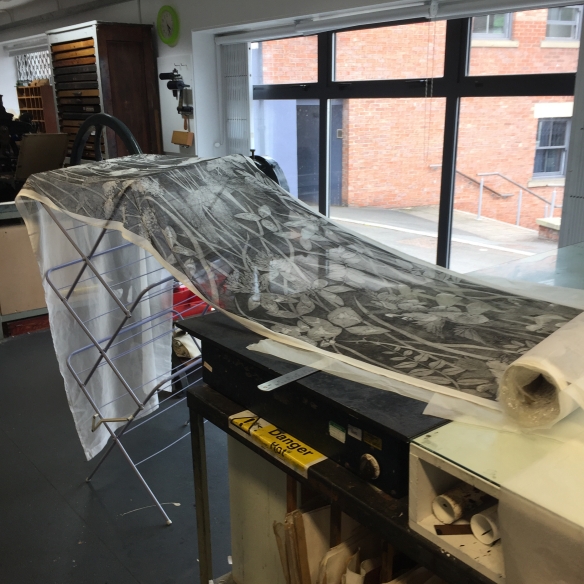
One left to print. Here I am rolling up the previous prints to protect them and make it easier to handle.

IMG_1670

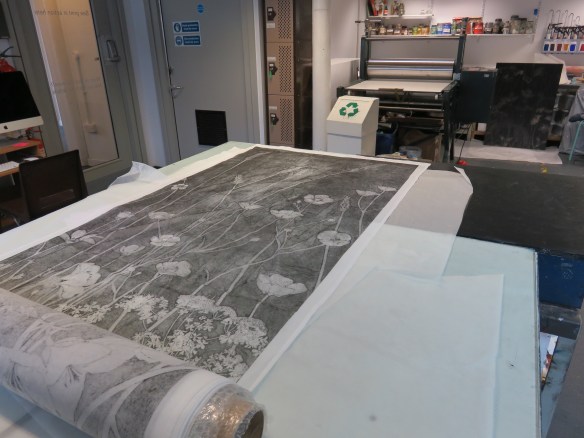
The final print! All ready to roll up with tissue paper for transportation home.

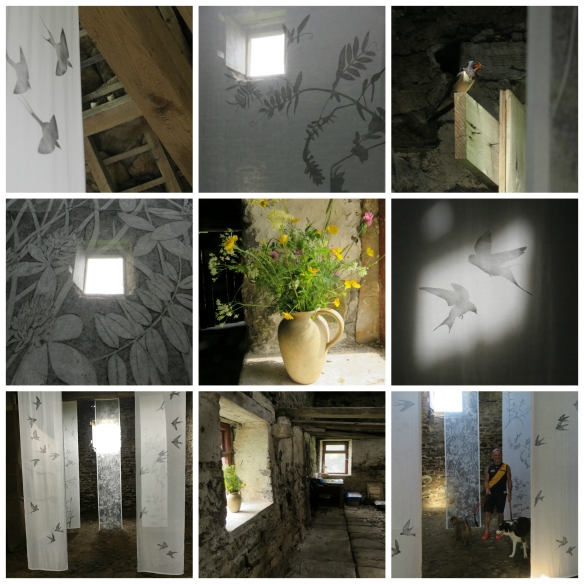
Now I’m working on two flights of swallows that will be block-printed using screen printing inks designed for fabric and won’t require a press. Mind you, there are plenty of other factors that could go wrong but I’m choosing to ignore those for now too!


Collections

So…what am I up to this year (apart from the usual exhibiting and selling in galleries)? Well, I’m making lots of new work and the majority of it will be for a joint exhibition in November. The show features my printmaking and the work of two friends and colleagues, Josie Bezant and Charlotte Morrison. Josie is an artist (and owner of Masham Gallery) who creates assemblages, collages, mixed-media pieces and paintings and Charlotte is a ceramicist. Charlotte and Josie also run Crafted by Hand (a multi-talented pair!). We’ve all exhibited together before but this is the first time the three of us have worked so closely on a project and shared a common theme.

002

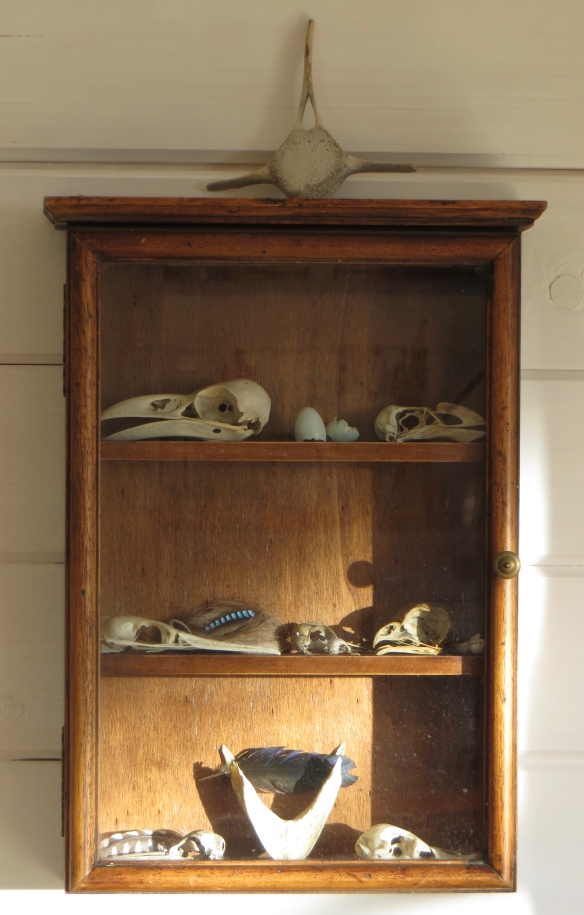
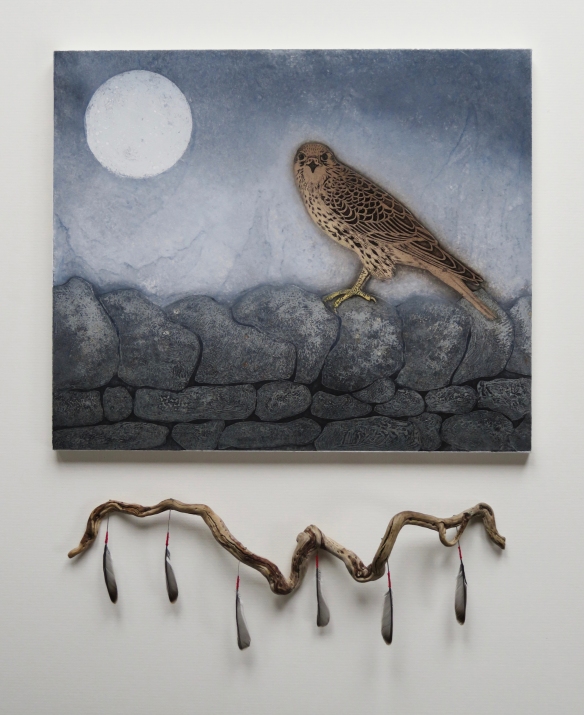
I’ve always collected natural objects: stones, bones, feathers, skulls etc., and whenever I am walking or fell running I am constantly on the look out for these ‘natural treasures’. The significance of my finds is important to me. For example I am not so interested in the skull of a rabbit, a very common animal, as I am the skull of a curlew which, for me, symbolises the wilderness, moorlands and the arrival of spring. Coming across a pile of linnet feathers with one lone tail feather from a merlin was so exciting and told a complete story of an act that is rarely seen by humans. It triggered the work below which is called ‘The Huntress’ and features a collagraph print, linnet feathers and a twisted heather branch.

The Huntress

I’m really enjoying using some of my finds within the finished pieces and there will be a number of ‘one-off’ multi-media works at the exhibition. Over the next few months I’ll be writing posts about some of the works that I’m making and you can also read more about the project at our website. Josie, Charlotte and I envisage that this will be an ongoing project and that the exhibition will tour to other venues and perhaps collect more artists along the way.


What’s happening?

Well it seems that, despite being a fan of social media, I am not awfully good at regular posting. I do love a blog though so I’m going to try to write shorter, more regular posts.

FENT__1449657899_THW_Print_Fair_Web_Banner_02

This year got off to a cracking start with a number of exhibitions and the Hepworth Print Fair. Initially my application for a wall space was rejected and I was disappointed but you have to expect rejections when you work as a full-time artist. There are a lot of us chasing the same opportunities and it is important not to take it personally. I emailed the organisers to thank them for considering me and a couple days later I received a reply saying that a table stand had become available and would I like it…yes please!

I don’t do a lot of shows and when I do I have always had hanging space of some kind, even if its the bars of a sheep pen (Art in the Pen). A table stand was a challenge but with the help of my friend and colleague Janis Goodman, who sent me photos of her table stand from the previous year, I got to work planning my stall. I can thoroughly recommend Ken Bromley Art Supplies for their collapsible easels. They pack flat so are easy to store but they are really strong and light and they look unobtrusive. I decided to cover my table with heavyweight calico which was a devil to iron and I can only thank my handsome assistant Brian for his perseverance on that score.

I had also recently purchased an iZettle card reader which proved absolutely invaluable. It links to a smartphone via bluetooth and you have an app with all of your stock on it so that you can keep track of sales and take all sorts of card payments (the change purse was a gift from my mum and a joke about my childhood dislike of peas).31444ECD-E36A-423E-A185-8903B51F333B

The event is supremely well organised but the Hepworth is tricky to get to from Horton-in-Ribblesdale and it took 2 hours to navigate safely to Wakefield and a further twenty-five minutes to find my way from the museum car park to the Calder building! I had been given a time-slot of 2-3pm to unload and that gave me plenty of time to get set-up and have a coffee and scone before the preview at 6pm. Unfortunately the lighting of my stall was a bit poor with only one spotlight pointed in my direction but it didn’t seem to put people off and I organised my work so that the prints that needed better lighting were at the appropriate end. During the day, it was much brighter than this photo!

4AA581F4-0AAF-4FA4-BCD5-AAE43B07A675The preview was buzzing and I sold one of my newest framed prints almost straight away. It was an auspicious start. Janis had offered me a bed for the night at her Leeds home.  This saved me a long journey home and back the next day and we celebrated our successes with wine and pasta.

The weekend proved to be really good for both of us. Not only did we sell a large amount of framed and unframed prints (more than I’d ever sold in an event before) but we met lots of wonderful printmakers, gallery owners, print co-operative members and interested visitors. The people that came to the print fair (about 4000 for the weekend) were generally well-informed about printmaking, asked lots of questions about the processes and were very encouraging and complimentary. It was completely exhausting and I barely found time to eat/drink or make the trip to the toilets but it was well worth it.

My stall in daylight:

5B66045A-C588-4307-A076-ED8B5B9B6B13

Janis’s stand:

12806129_10156477645015161_8867374007532948_n

The general hubbub:

3A037B3C-8FDB-4DB6-BAD8-02A9AE073F17

The people that exhibited were:

Ali Appleby / Amy Rodchester / Andy English / Ben Whittington / Beverley White / Bobshaped / Cath Brooke / Colours May Vary / Drusilla Cole / Geri Waddington / Helen Peyton / Helen Roddie / Hester Cox / Hot Bed Press / Inkylinky / Izzy Williamson / James Bywood / James Green / Jane Walker / Janis Goodman / Katie Eyre / Laine Tomkinson /Laura Slater / Lidota Studio / Little Lost Soul / Louella Moon / Nancy Haslam-Chance / Northern Printmakers / PAPER Gallery / Pica Editions / Print Wagon / Rachel Sim / Sarah Harris / Sean Mort Print Shop / Spike Island Print Studio / Staithes Studio / Stoff Studios / Studiotic / The Art House / The Lost Fox / The Modernist Society / The Owlery / Watermark Gallery / West Yorkshire Print Workshop / Wil Law / Yuck Print House / Zillah Bell Gallery

Having had such a good weekend, I treated myself to a lovely little wood engraving by fellow stallholder, Beverley White. ‘Anything Could Happen’ reminds me of my own little terrier.

286394_anything-could-happen

Then I had to pack everything up, drive back using my iPhone satnav and unpack at the other end before collapsing exhausted in front of the fire with Brian and our dogs.


Connections North: Mirror Images (Part 1)

Mirror-Images-start

Better late than never, I am writing this as Mirror Images moves to its final location at the Caithness Horizons Gallery in Thurso, Scotland. It will be on show there from 16th October to 28th November 2015.

Last summer applications were invited from printmakers based in North Yorkshire to take part in Chrysalis Arts ‘Connections North:Mirror Images’ project. This is an international printmaking project featuring the work of 40 artists from 4 countries, England (N.Yorks), Scotland, Sweden and Finland. It is a development of the connections already made between Chrysalis Arts, Ålgården Workshop in Sweden, Ratamo Printmaking and Photography Centre in Finland and Highland Print Studio in Inverness, Scotland. Artists specialising in or with a strong interest in printmaking were invited to apply to create two works each on the theme of ‘Place and Identity’. The idea was that the printmakers would create an edition with a minimum of 4 prints which would then be shown simultaneously in England, Sweden and Finland.

I was already a member of the working party that met regularly to discuss the logistics of the project and provide opinion and ideas to Chrysalis Arts but this was no guarantee of a place in the final exhibition as that was to be judged by three external selectors. These were Deborah Fahmy (Visual Arts Officer of Arts Council England), Sally Smith (Curator of the Inspired by gallery) and Martyn Lucas (a print specialist and curator). I was totally certain that I wouldn’t get selected, I’d had a previous disappointment with an application when my prints were judged to not have enough of a ‘contemporary feel with particular regards to subject matter’ and two of the selectors were from that panel! It had given me a well needed ‘kick up the backside’ to really consider how I present myself and my work and with that in mind, I sought advice about my cv, rewrote my statement and carefully selected the prints that I felt illustrated my desire to push myself and that showed best my technical ability. I was walking through Ripon checking my emails on my phone when the judgement came and, typically, the text of the letter didn’t download for ages! I really couldn’t believe that I’d been selected out of the 43 artists to apply.

MIRROR-21

I designed my two prints whilst I was at Ålgården in February of this year. I spent two weeks creating numerous test plates and tinkering with ideas and compositions. It had been snowy when I left Yorkshire and I arrived in Sweden to find thick snow and iced over lakes which suited me perfectly. I worked with idea of the contrast between the ephemeral and the enduring as the land changed daily between thaws and snowfall.

algraden

The relief and intaglio studio.

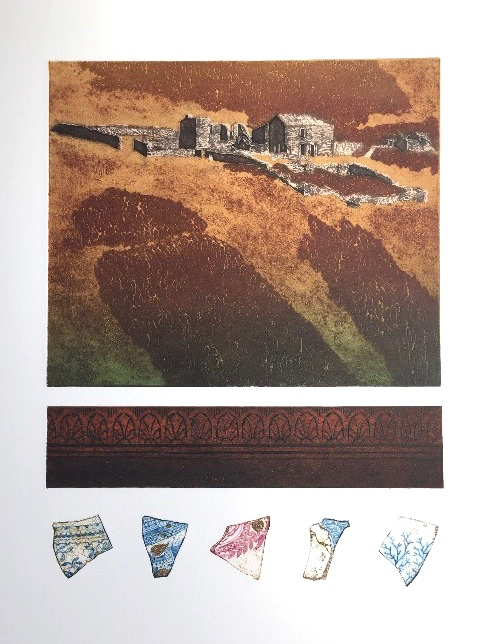
I explored themes of pathways, tracks, trods & traces which directly relates to my fellrunning but also to the landscape where I live which is essentially a playground for all adventure lovers, cyclists, walkers, runners, cavers & even the occasional paraglider. It’s also a region of quarrying & sheep farming.

image1

Ideas for a layered print about Penyghent and my fellrunning. It includes a garmin trace of the speed and ascent of an actual run that I did.

I managed to get one of my prints proofed whilst in Borås but the plates for the other print were still in the making stage.

IMG_0052

Collagraph plate varnished with seven layers of shellac to allow for drypoint techniques.

To cut a long story short, I worked on both prints for over a month and eventually was ready to proof them just before the delivery deadline (no different to my normal working methods then!). Here they are:

Hester Cox Tracks and Traces

Tracks and Traces, 6 plate collagraph print, 230x475mm

Hester Cox Enclosures

Enclosures, 4 plate collagraph print, 294x417mm

In the next post I will talk briefly about the project as a whole and some of the workshops and talks that took place as well as post some photos of the exhibition.

Life in the Slow Lane

I’m currently in Sweden at Ålgården again and for once in my life I’ve had to slow down. At the end of July I successfully completed the Lakeland 100. This is a 105 mile race around some of the most beautiful parts of the lake district and I had a really good run. I spent the followng weeks on a high, imagining the future strength I’d have and planning for a Bob Graham Round attempt. Six weeks and lots of running later and I have developed a mystery knee injury and can no longer walk without hobbling. It could be reactive arthritis or it may be an injury that didn’t hurt at the time but certainly does now! I’m being tested and examined and hopefully we’ll get to the bottom of it but it is really debilitating.

However, I’d already made plans to come to Ålgården with a friend and colleague, Barbara Greene. She wanted me to show her the ropes so I thought I’d come anyway and just do whatever I could manage. Barbara and I met through Chrysalis Art‘s Connections North project and were both selected as two of the ten printmakers from North Yorkshire to take part in the Mirror Images exhibition. I will write a separate blog post about that as it is a fantastic project involving forty Finnish, Scottish, Swedish and Yorkshire printmakers. Barbara and I hope to collaborate on a future project so it was a good opportunity to talk and exchange ideas too.

20150914_064230000_iOS

(a fellow printmaker or an accident in the DIY shop car park?)

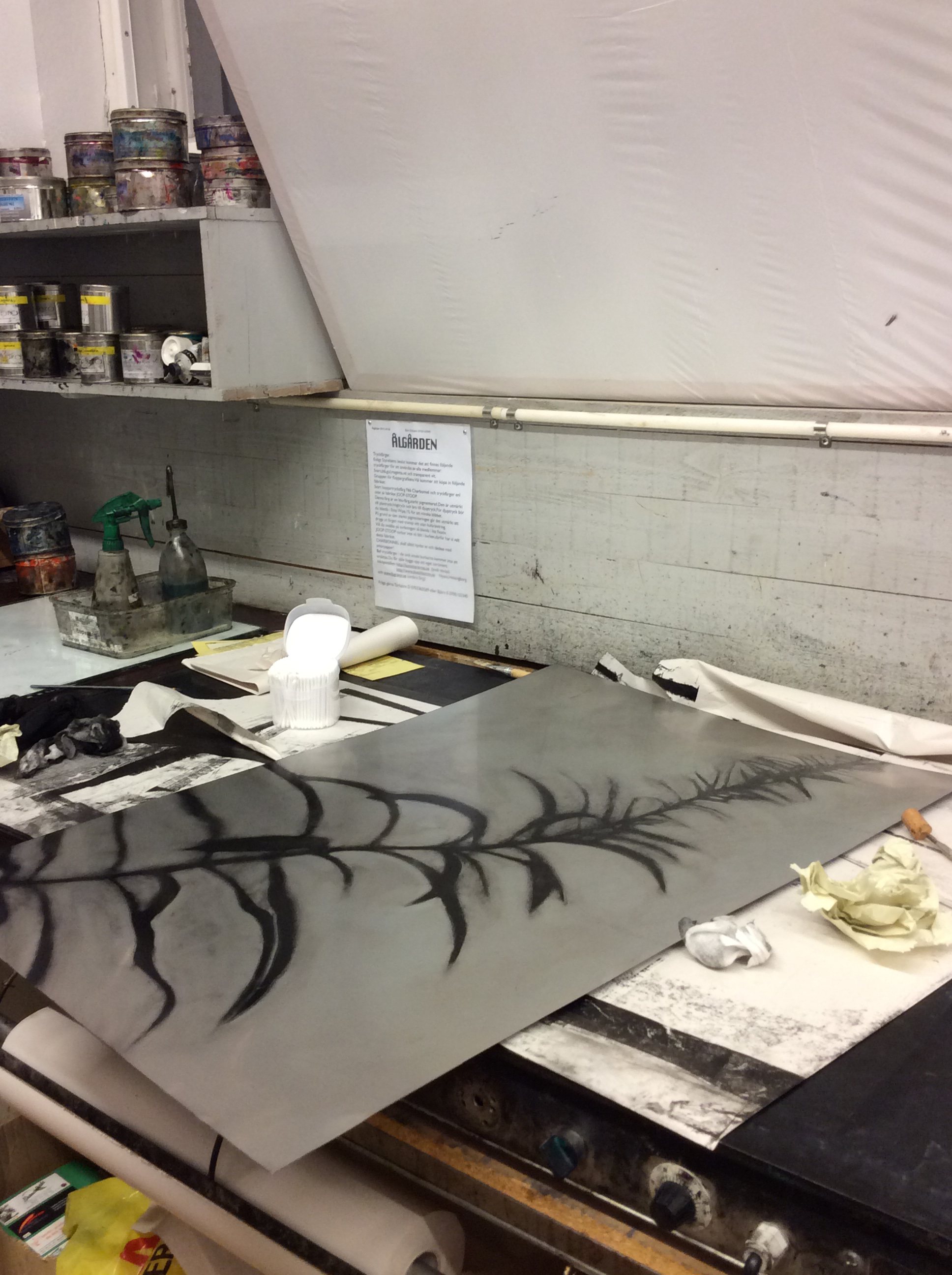
It has been frustrating to be able to see the dense forest but not be able to get into it but I’ve made myself look for inspiration closer to home and am currently exploring the traces of nature found in the city and around the studio. I’m working on a few ongoing projects simultaneously whilst exploring ideas for a future project and I’m using the time and wonderful equipment here to try out things that I wouldn’t do at home. I tested a pot of Akua Intaglio ink which I brought from home to see what it was like to work with. It is perfect for reduction monotypes because it doesn’t dry on non-porous surfaces so you can work with it indefinitely before printing. It also cleans up with soap and water and yet the print has the same velvety qualities of an oil-based print. With some precarious balancing on a stool and on one-leg, I managed to produce an A1 monotype that I printed on the lovely big etching press. It has a bed sized 1metre x 2 metres and one day I’ll use the whole thing.

20150914_183454040_iOS

Creating a reduction monotype on an old aluminium litho plate.

20150914_192644654_iOS

The beautiful etching press (the big one, there are three!) with my print drying behind.

Whilst I may not be very mobile, I’m still getting about thanks to my very kind Swedish artist friends. Christina picked us up from the airport and drove us to the studio and she also invited us to her house for dinner, Lennart has lent me a walking stick (he’s 80 but says he no longer needs it!) and Torbjörn collected me and drove me to the Borås hospital to show me their amazing art collection (and I stocked up on painkillers). He is project director for the region and organises the buying and displaying of art for public spaces such as hospitals, health centres and dental practices. I was so impressed by the work on show at the hospital and the thought that had gone into its display and selection. Not just the more figurative and accessible work that you’d expect but very good quality contemporary pieces and in all kinds of media such as painting, sculpture, printmaking, textiles and glass. Tomorrow Anna is taking us both to see an arts and crafts place called Nääs so that will be a lovely trip out too.

20150914_075231000_iOS 1-1

Today I made 12 small collagraph plates from plaster creating impressions in them from the fallen birch leaves that I’ve collected. I will print these and hope that the leaves will be very subtle. I then plan to overprint with further imagery relating to the city. I associate the birches so much with Sweden and I find their leaves everywhere, in the studio, on the pavements, in the supermarket etc. I’ve also been making monotypes of the shadows of plants growing round the studio too. All the traces of nature that creep into the city and that I seek out when confined to urban places. Really I’m just playing but that’s why I like it here, it gives me the time and headspace to do that and who knows what will develop from my experiments.

New Ground: Part 2

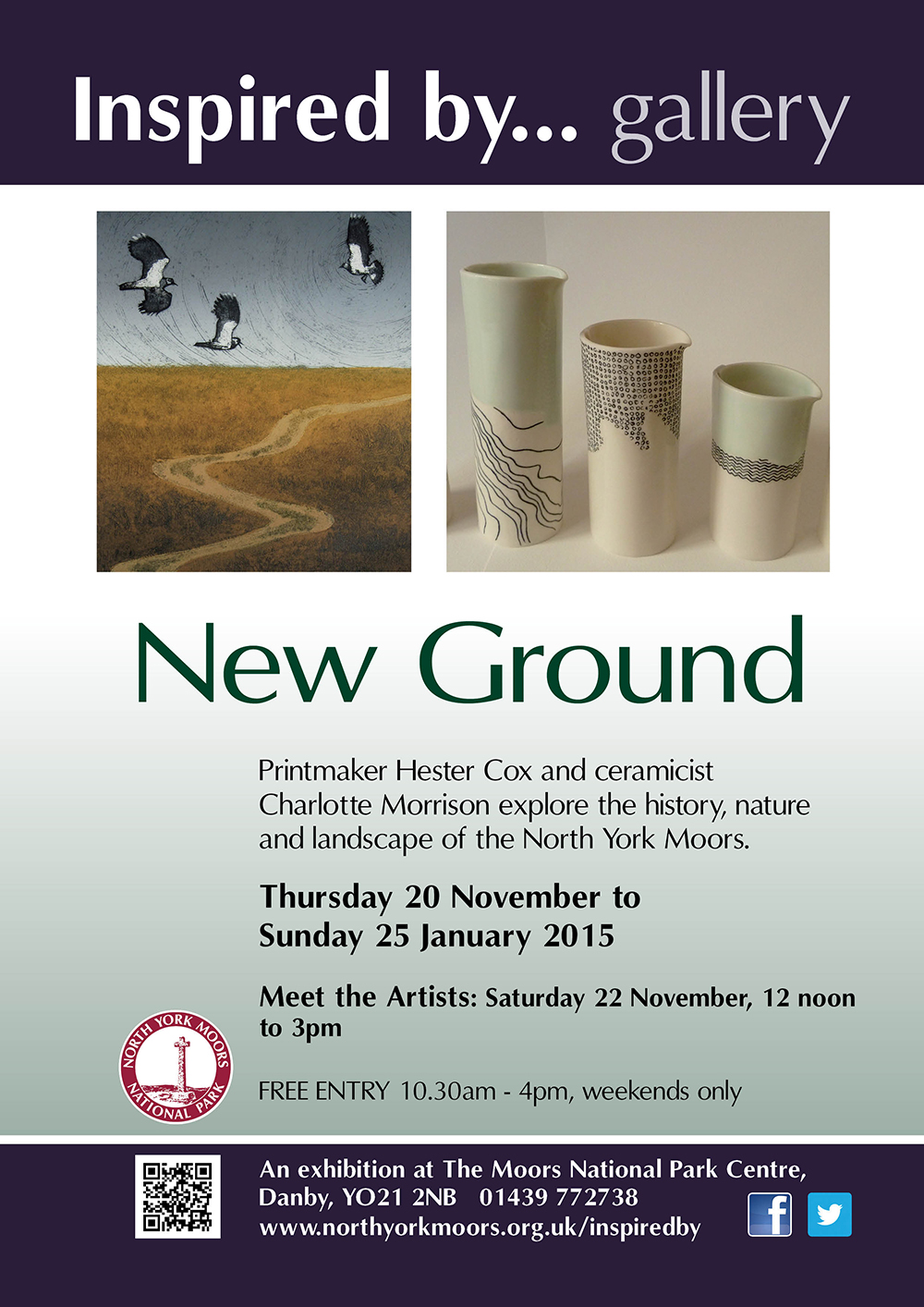
cdc752b7-98d3-4db6-b187-addd70c4bfc6My exhibition with ceramicist Charlotte Morrison is now up and running at Inspired By…Gallery in Danby. It is open daily 10.30am – 4.00pm until Christmas Eve and then it reopens for the 1st-4th January before becoming weekends only throughout January. The prints on show are a mix of collagraphs, intaglio photopolymer prints and a set of monotypes combined with drypoint. I had lots of ideas for images to create but, as usual, time restrictions and other commitments meant that I had to go with the ones that just couldn’t be shaken whilst postponing some of the others for another time. It would mean writing an essay for me to describe all of the images on show and to explain their origins but there are a few key pieces that I’ll mention here. Charlotte has created some beautiful collections of vases, cups and jugs based on old pathways, drovers roads etc. in the North York Moors national Park. Visit her website to see more of her work.

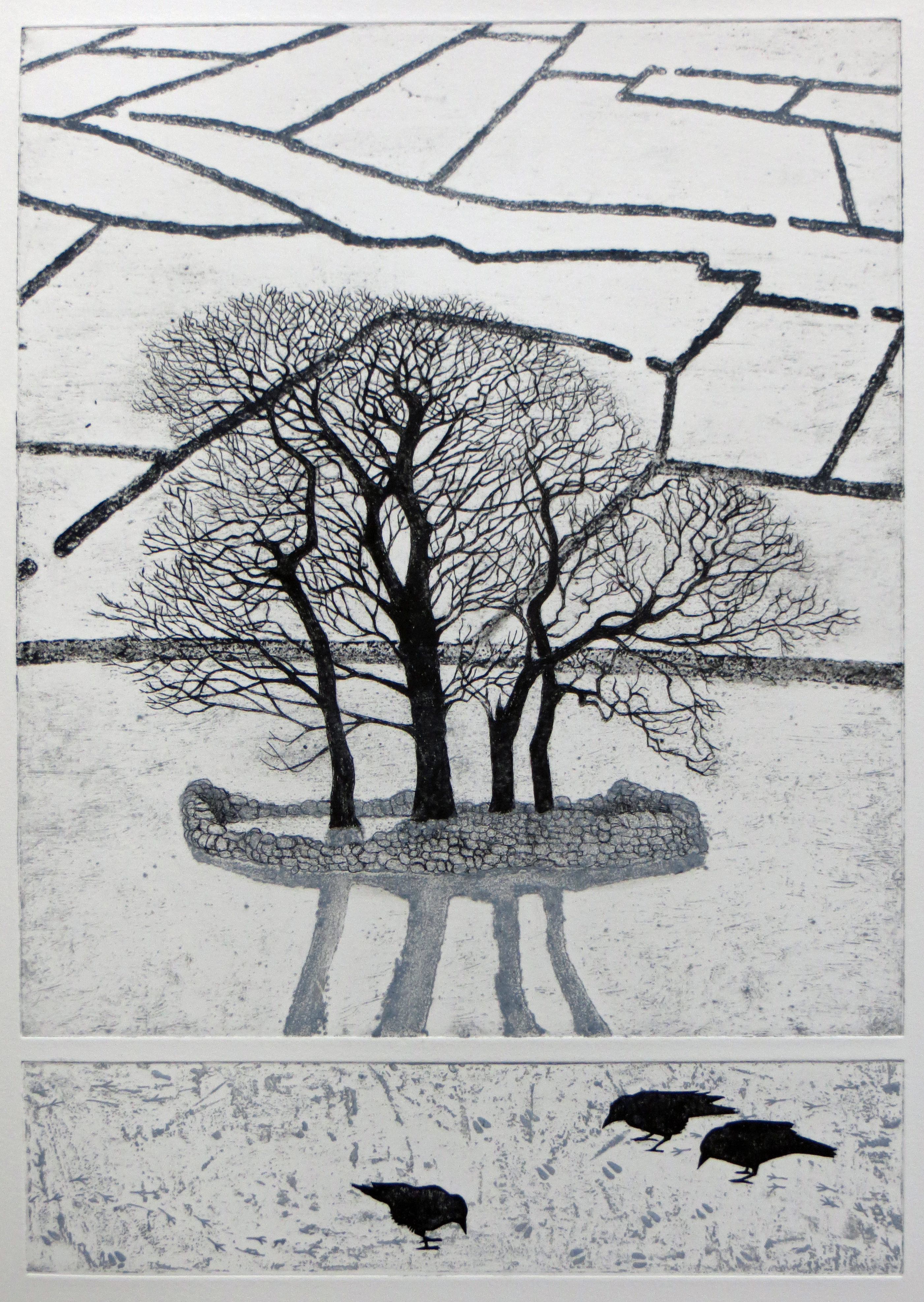
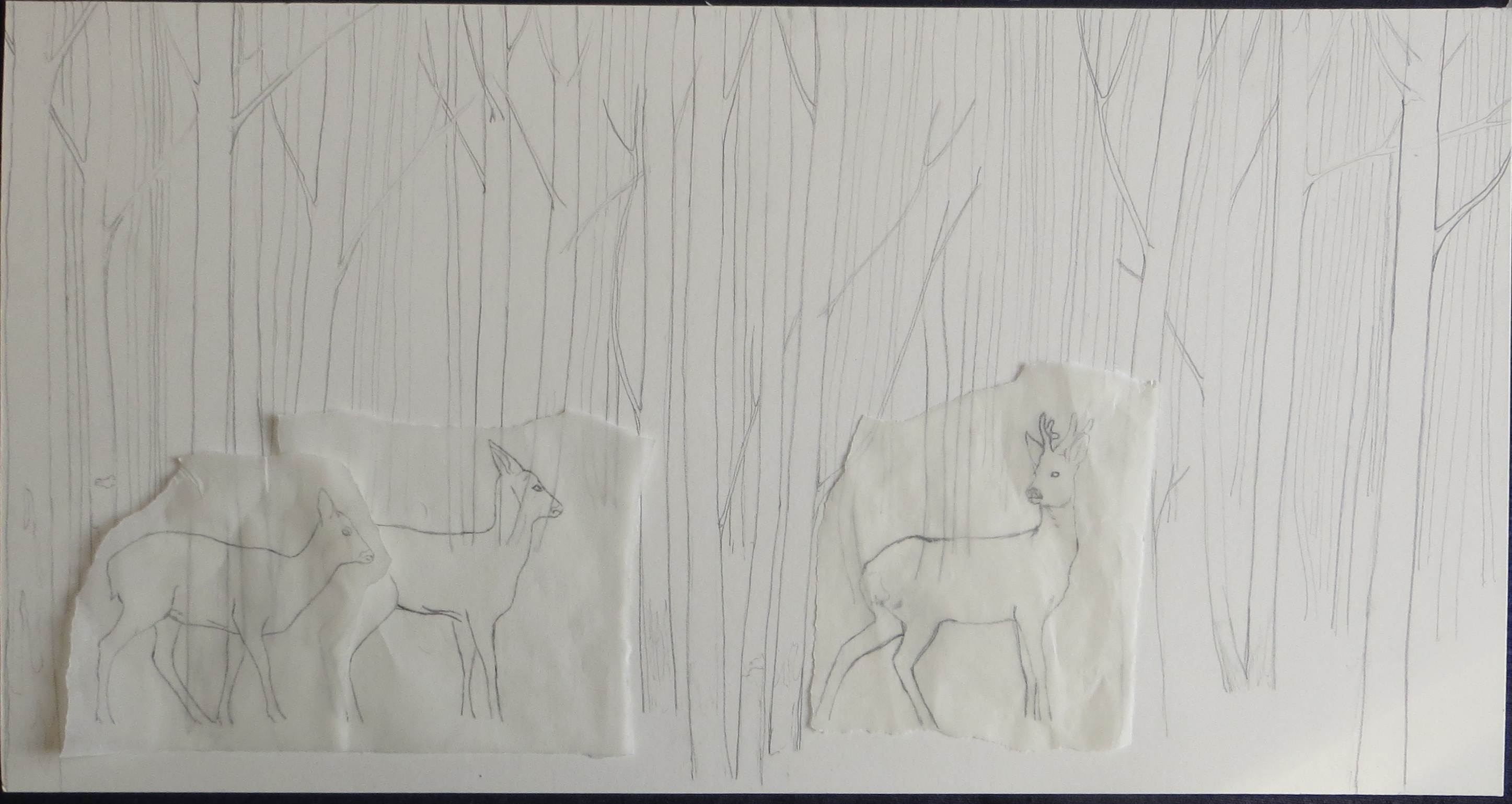
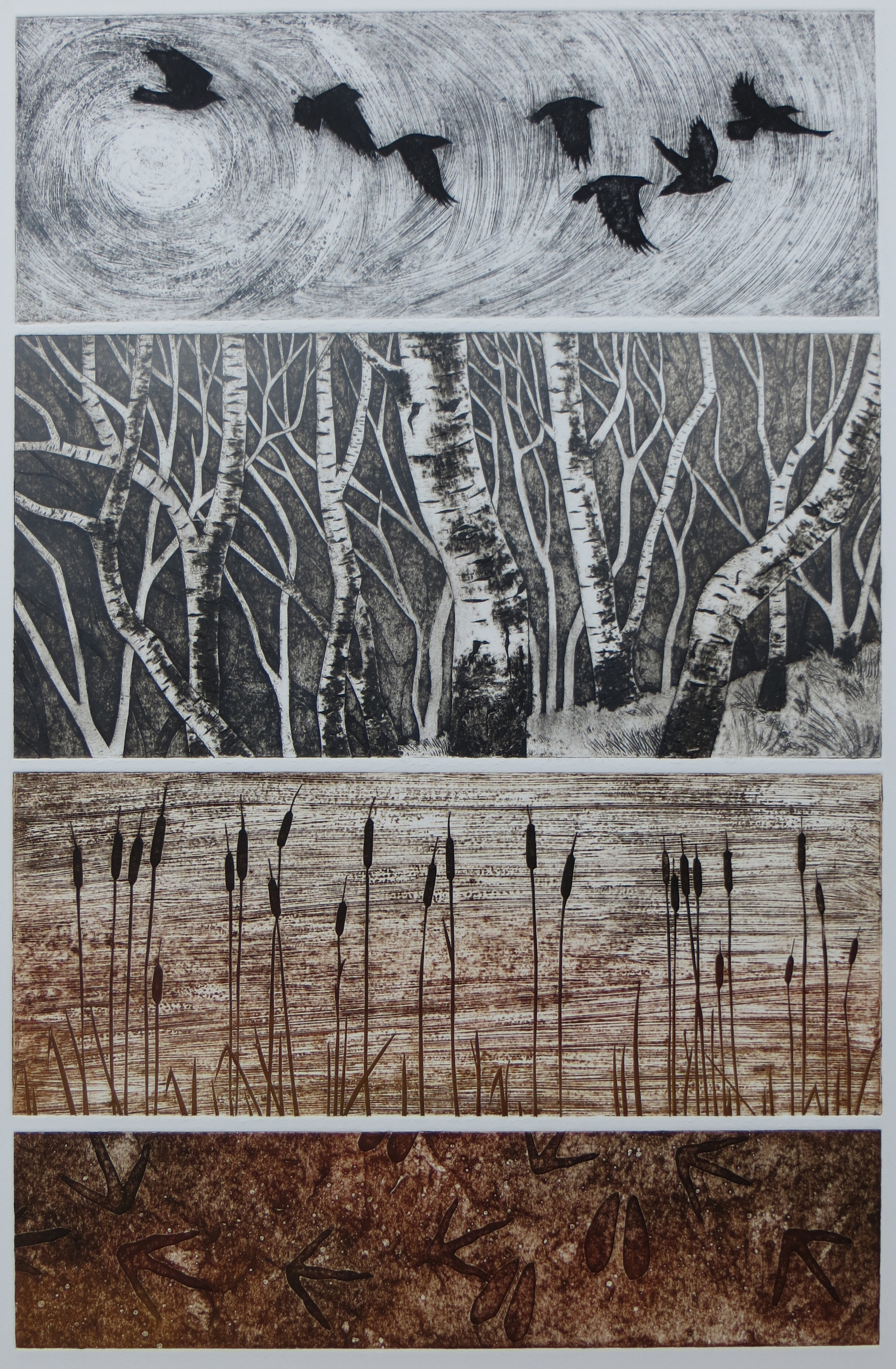
The first pieces to be made were based on a very foggy run that I went on with my partner and our dog. We parked at Sutton Under Whitestonecliff and ran to Gormire, up through Garbutt wood and onto Sutton Bank, along past the Glider club and down via the white horse, through the plantation to Hood Hill and back via Sutton bank and Gormire. Doing a large figure of 8. The ethereal woods and soft focus views triggered off a series of photopolymer prints developed when I was over at Algarden Printmaking Studio in Sweden. For more details, see my previous blog posts Seeing the Wood for the Trees & Photopolymer Experiments Continued….This is a small triptych that evolved:triptychI also spent months designing and cutting a collagraph plate inspired by the birch copse at the base of White Horse bank and of roe deer that I saw in the area. The birch forest was not too much of a problem as I had had previous success with creating a collagraph plate of one last year but I wanted a small group of deer and the grouping, positions and sizes (not to mention direction) took a lot of fiddling about in order to get it just right. The way that I work is that I’ll sketch out the forest and then I’ll sketch various deer in different positions and then trace them off onto pieces of paper that I can move around on the forest drawing. I’ll photograph all of the combinations so that I can compare them on my laptop and then I use photoshop to flip them to see what the plate will look like when printed (collagraphs print in reverse).

001

This is just one example of many attempts. Working like this also helps me to spot flaws in my design such as wonky trees, dodgy perspective and badly drawn anatomy! I ended up completing the drawings in Sweden but then decided not to make the plate until I returned home as it is such a time-consuming process and I wanted to spend the studio time developing my photopolymer work. The final piece was proofed in March.

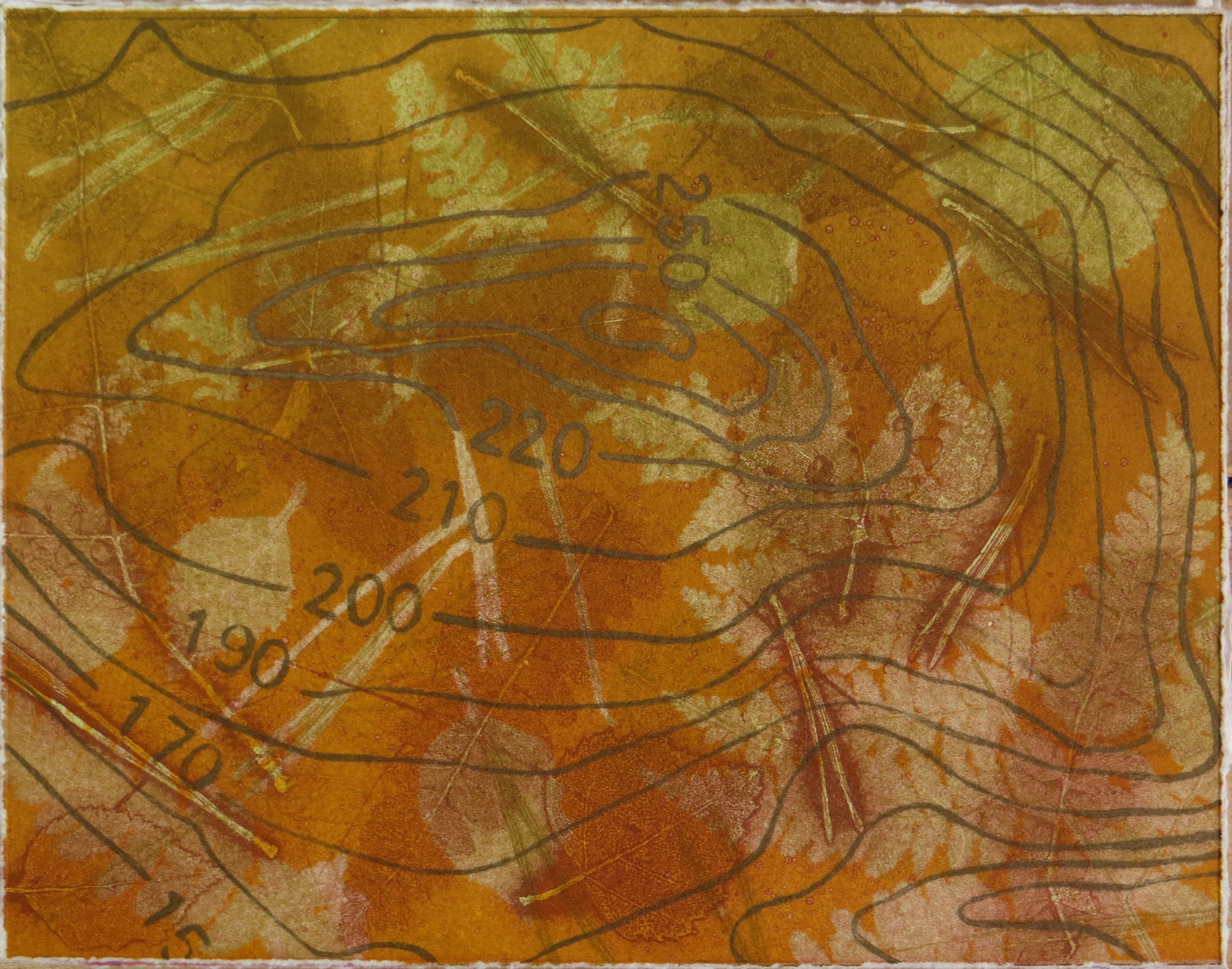
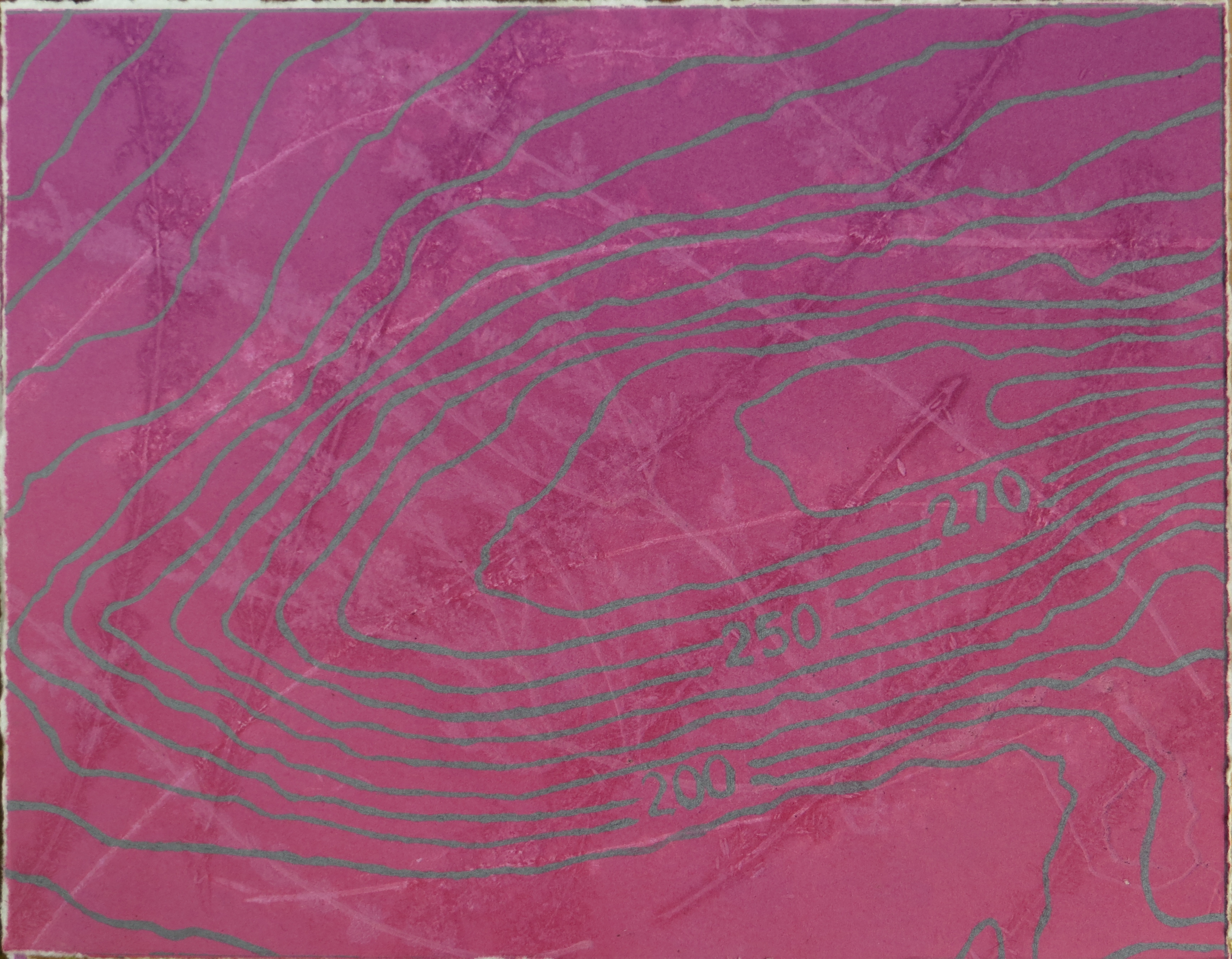
Passing ThroughOne of the key things about the project was that I was revisiting some of my favourite running routes and I wanted to allude to that in the imagery. Three places that I went to numerous times had quite different flora and topography and I decided that I could use this to make a series of prints. I set aside extra time on one of my visits with Paul Harris (who filmed me throughout the year) so that I could collect plant material from three of the sites. When I got back to the studio, I carefully pressed the different leaves and flowers in the pages of a phone directory and left them for a few weeks to dry. In the meantime, I studied an OS map of the areas and drew out the contours for the hills from where I’d collected the plants. Scratching into pieces of plastic, I created drypoints of the contours.

Over the course of a couple days, I printed the plant matter by rolling ink onto a piece of perspex that was the same size as the drypoints and by laying the plants onto the ink and putting them through the press. When I removed the plants, they left their impressions in the ink and I then printed that onto paper. I did this over and over again, changing the colours and tones of the ink and over printing the plant impressions until I had built up a number of images. I then inked up the drypoint plates and printed them as the last layer of each print. Whilst they were drying, I chose the best two sets of prints from the many variations. I painted blocks of MDF and pasted my chosen prints to the blocks using ph neutral bookbinding paste. The blocks were mounted within white box frames and hung as a series.

IMG_3818Gormire Lake:

007Hood Hill:

008Hawnby Hill:

010I’m using colours that reflect the incredible heather moorland at Hawnby for the last of these three prints. Not colours that I normally use but ones that found their way into another of my prints for the exhibition.

The Winter LakeThe Winter Lake was inspired by the view from the Cleveland Way above Whitestone Cliff. I often heard and saw flocks of jackdaws coming into roost on the cliff face above the lake and during the winter months, the birch trees around the lake were leafless but the twigs created a beautiful purple shade. The lake itself is very distinctive in shape and I couldn’t finish my work without creating at least one view of it.

There are many more prints on display including collagraphs inspired by some of the birds that I observed such as wrens, yellowhammers and skylarks but the last two pieces that I’ll include here are ‘layer collagraphs’. They are created by printing four separate collagraph plates with the aim that they will reflect the details of specific places. Textures, patterns and cross sections that I hope will give an impression of Gormire and White Horse Bank during winter and summer:

summer Winter

I have really enjoyed the year spent researching, visiting the places and creating new prints. I’ve also had a really interesting insight into film-making because photographer Paul Harris has been coming out on location, filming me at ArtisOn, visiting my studio and watching whilst I make some of the work and he has created a really beautiful piece of film as a profile of my work and life as a printmaker. Please do watch it if you can, I think it reflects the whole process very well and the film work is stunning: Hester Cox – Profile of a Printmaker by Paul Harris.


New Ground: Part 1

cdc752b7-98d3-4db6-b187-addd70c4bfc6

This is the first of a few blog posts detailing the main project that I’ve been working on this year.

Just over a year ago I was approached by Sally Smith at Inspired By…Gallery to see if I would be interested in having an exhibition in Gallery 2 this autumn. Coincidentally I had already been thinking about approaching her with a proposal so this was a great opportunity for me. The space is a lovely clean white room with lots of light and there were plinths available for 3D work so I suggested that I invite another artist to exhibit with me and was fortunate that ceramicist Charlotte Morrison was keen to do it. She had already developed a range of work that explored ancient pathways in the Yorkshire Dales and wanted to push that work further by exploring the old drove roads, monks’ trods and other pathways within the North York Moors National Park.

I am a keen fellrunner and first became familiar with some of the beautiful paths and trails within the North York Moors National Park when I started competing in the Esk Valley Fell Club fell race series. Inspired by the natural history and landscape, I started to explore the area further and soon developed my own favourite running routes.

A large proportion of the prints on display were created during 2014 in response to a calender year spent repeatedly revisiting some of my favourite routes in the Hambleton area. In this way, I was able to observe the seasonal changes that took place and experience the landscape in all weathers. Making notes, taking photos and doing occasional sketches on site, I returned to mystudio to further develop the ideas that came  to me whilst I was running or walking. I was fortunate to observe some of the birds and animals that also visited the area such as hares in the fields near Cleaves Wood, roe deer at Gormire Rigg, the jackdaws that roost in Whitestonecliff, the housemartens that nest at Rouston Scar, a yellowhammer on the edge of the gallops above Gormire and many more.

Gormire Lake has become a favourite place both for running and quiet contemplation. A site that is unique, characterful and full of atmosphere, at times sunny and serene whilst in fog or at night it can seem ethereal and haunting.

PicMonkey Collage1The lake is deep and one of the few natural lakes in Yorkshire. The first time I visited it I disturbed a roe deer that skidaddled into the woods and there were buzzards crying above the tree canopy. I also found a roe deer skeleton amongst the leaf litter near the ‘elephant tree’. It is often muddy underfoot and the smell of the earth and leaf litter is strong.

PicMonkey CollageIn early summer the woodland is carpeted with bluebells. I particularly love the circular route from Sutton Under Whitestonecliff which takes you to Gormire lake, up onto Sutton Bank, along the top trail by the glider club and down beneath the White horse, through the birch woods to the pine plantation and up to Hood Hill. From there I like to take one of a few routes back to Gormire but all mean going up the steep bank again and descending back to the lake so its great fell training.

024

Throughout the year I worked with photographer Paul Harris who has made a film about my working process and the first edit can be viewed at the exhibition. When the final version is available, I will post it to my blog for you to see.

In my next post I will talk a bit more about how I created the work on show and the journey from ideas in the studio to framed pieces in the gallery.


All Change!

The last time I wrote I was in Sweden which now seems like years ago! My main reason for not writing is that I’ve had a hugely busy year which was largely disrupted (in a good way!) by moving house and studio. After a few years of a travelling between Settle and Masham each weekend, my partner and I took the plunge and bought a house together in Horton-in-Ribblesdale. He moved in at Easter and I spent a month making the transition from my little rented cottage in Masham to our equally lovely new place. As a fellrunner this move is exciting (Horton is the starting point for the Yorkshire Three Peaks race and is surrounded by gorgeous fells) but as an artist, the fact that the house has a studio at the bottom of the garden and I can finally ‘go out to work’, it is even more so! I’m very attached to Masham, the place, the community and my friends there but I’ll be maintaining strong links with the Masham Gallery, who have championed my printmaking for 18 years, and ArtisOn Ltd who have been employing me to deliver printmaking workshops for the last three years. We’re already working on next year’s programme!

The move was pretty stressful and labour intensive mainly because I had various exhibition commitments that required me to be able to work right up to the last minute but looking back on it, it went surprisingly smoothly and I’m now settled in to my new studio and making lots of work. I’ve also got Harry the collie as a companion in the daytime!

Here are a few pictures that tell the story:

002

My Masham studio before I packed up…

018

and looking rather forlorn after I’d packed and been around with the filler and paint!

007

My lovely new workplace down the end of the garden

002

Before I turned it into a print studio…

008

and afterwards. I’ve since put up some prints and it gets cosier and more ‘arty’ every week. I’ve been talking to an electrician about getting a proper mains electricity supply to it (it is just on extension cables at the moment) and soon I’ll be able to plug things in and flick a switch for my daylight strip to come on so that I can work throughout winter. I’ll be making some heat shields so that I can use the stove and also putting in a small heater that will work on a thermostat so that it never goes below freezing (we’re quite high up here and snow is a regular occurrence in the winter).

I really enjoy working in there and am finding ways to make efficient use of the space. In my old house I used to stretch my prints on the back of the kitchen and pantry doors but now I have a selection of boards that I store in my plan chest for that purpose. I’m also adapting the paper soaking system that I used in Sweden as I am no longer able to soak my paper in the bath tub and transport it safely to the studio. I’ve found that I can spray the paper outside (or in the greenhouse in bad weather) and then stack it in polythene to keep it damp so that I have a supply on hand that just needs blotting when I’m ready to print.

After years of living on my own I’ve realised that I’m a bit of a workaholic but also a great procrastinator so I ended up making jobs last longer than I needed to, never really switching off unless I was out of the house and I regularly worked into the small hours. Now I am making far better use of my time and am limiting my evening and weekend work so that I at least have an hour or so to relax most days (although, artists never switch off, I’m always mulling over ideas!).

We live down a little lane that leads to fields and the Ribble so I can swim in the river and run in the hills straight from my house. The countryside is really wonderful and there are so many different species of bird. It is a constant source of inspiration. I love having a studio that is separate from the house and when I head down to it, it feels like I really mean business. I’m also enjoying the cups of tea that get brought out to me in the evening and have learned to ignore Harry barking at the logpile for me to throw sticks. He’s learning to get used to me disappearing out there and I’m getting used to rescuing his ball from the drain or pond so that he can carry on playing by himself until it is time for us to go out together. He still drops the occasional ball at my feet when I’m printing though 🙂

photo (3)


Last Evening at Ålgården

It the final evening of my stay at Ålgården and it has been a really good three weeks. I’m just trying to work out the logistics of getting all of my prints, printing plates and associated materials into my case so that I don’t get charged excess baggage! Fortunately I was working on relatively small-scale work and the very large birch tree was just a proof so I’ve torn the margins off so that I can keep it for reference. It does make me wonder how I’ll manage when I next come because I’d like to do some large-scale pieces here some time but I’ll cross that bridge when I come to it!

The final tally of works made is 7 new photopolymer prints (roughly 21x21cm each) and 2 small ones (although I’m hoping to get another made tonight) plus a large collagraph/drypoint, 3 x monotypes and a large collagrah designed and drawn up ready to cut. Pretty productive I reckon 🙂 I’ve also found time to run every day, go to Gothenburg for some exhibitions and have a couple trips out with my Swedish friends here. They have included a concert, an exhibition opening, trips to meet other artists in their studios, lunches at friends’ houses, a visit to Rydal Textile Museum and plenty of time in the woods.This weekend it was the opening of Bengt Johansson’s exhibition and he and his wife came to stay for a few days which was good fun. I’ve thoroughly enjoyed myself and feel very at home here.

003

(Bengt at his preview)

I feel like I’ve managed to make headway with the work that I began in 2012 and the photopolymer prints have given me a strand to my printmaking that fulfils something I feel has been missing. For a few years I have wanted to depict some of the atmosphere of the landscape in different weather conditions and have found it exceptionally hard to do with my collagraphs. By using my monotype techniques, plus some latent painting skills, I’ve been able to begin to depict some ideas that I’ve had for ages. Here is one of a pine forest:

023

I have ideas from almost ten years ago which I’ve attempted to recreate in print but that haven’t worked and now I can see a way to make them happen. I will be digging out some old sketchbooks when I get back.

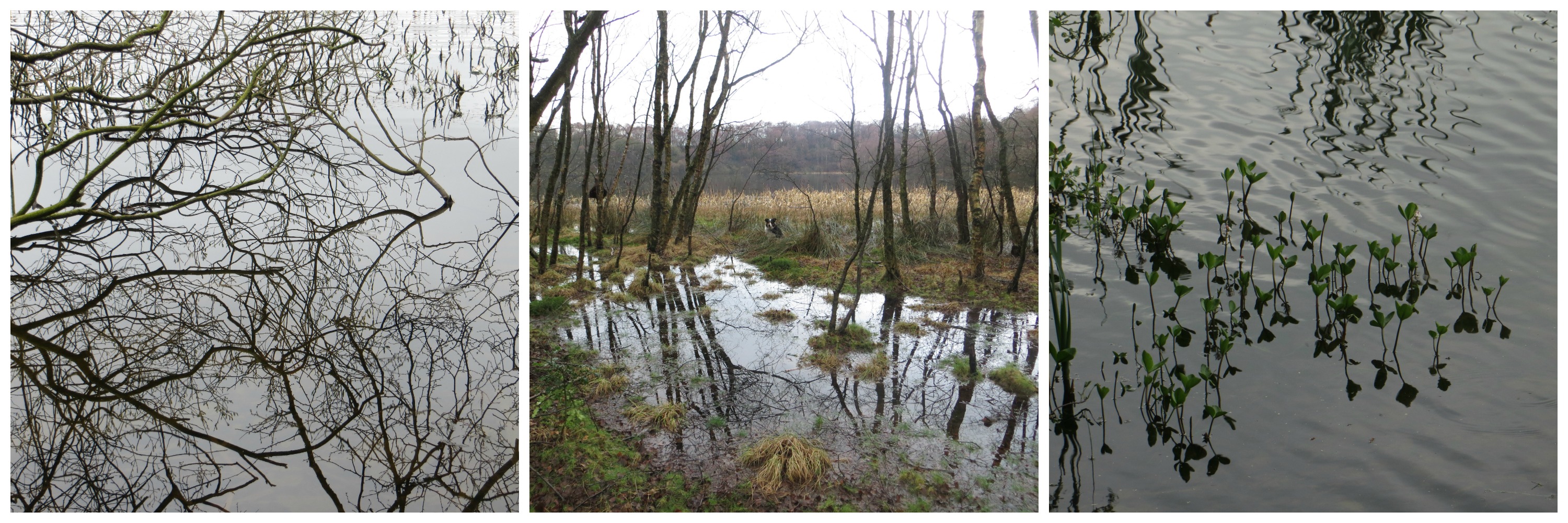
It has been very damp underfoot in the forests here (and at home!) and I’ve been seeing the most wonderful reflections of trees in the puddles. The land is quite marshy in places too. My last few photopolymers were inspired by this. I started with one design and then decided to create three on the same theme. Here is a photo of the triptych of transparencies as I was creating them. The two on the wall are drying.

009

On Friday evening I was just heading to bed and I checked them to see if they were dry and they were. I felt compelled to get on and develop them and so I stayed up until 1.30am and made the plates. I then noticed that some of the drying prints of the photopolymer birch forest design were buckling so I decided to resoak them…big mistake! I hadn’t realised that the inks were water soluble because I couldn’t read the Swedish on the tins. I walked off to do something and when I came back to them, the prints were a vivid mess of running orange ink! It was pretty disheartening as they were the two that I was the most pleased with but these things happen and I’ll be reproofing in the UK with my inks so it doesn’t matter too much. Here is the pile of prints that didn’t make the grade!

097

Anyway, lessons learned and the good news was that the sun was shining brightly the following day and the photopolymer plates were curing nicely in the studio windows all ready for me to proof on Saturday.

PicMonkey Collage2

I love the rich contrast that you can get with this kind of printmaking and making the transparencies is very satisfying. I roll the ink on to the acetate and then create the image by wiping it away and it feels like painting the light back into the image. Right, I really do want to get a third indian ink transparency made and developed on a plate so that I have a North York Moors triptych for my project so I’ll sign off for tonight but, whilst I’m sorry to be leaving, I’m feeling pretty positive about my printmaking and I’ll be coming back here again soon.


Photopolymer Experiments continued…

Well, it has been such a good week here at Ålgården. I’m feeling very happy and creative despite fatigue setting in from late nights working and morning runs. There is so much to say but I’m going to stick to photopolymer updates in this post. Last time I wrote I had been practising my reduction monotypes on paper and then I went on to do one onto acetate to act as a transparency for a photopolymer plate.

012

It was something of a labour of love to get it finished and by the time that I did, the ink was beginning to dry but it still took the weekend for it to be totally dry enough for exposure on the plate. On Monday morning Kristina Thun talked me through the various steps again because I was slightly unsure of the settings for the exposure unit and then I went about exposing the plate and developing it in water. It was very exciting to see the image appearing as I gently brushed it in the water tray.

I was impatient to print it but didn’t want to spoil the plate by rushing so I forced myself to work on one of my collagraphs whilst the photopolymer hardened in the light from the window.

My first proof was done using black charbonnel etching ink on Hahnmule paper and it worked fine although the result is darker than the final image will be because I have designed it to be printed in a soft ‘foggy’ grey.

013

Since I proofed this print, I have spent another day working on a further acetate with the intention of this one being printed using graduated colours.

046

I’ve been cutting my 30x40cm photopolymer plate up to create two plates that are 20.5 x 20.5cm and have been left with a longish strip of plate. Photopolymer is expensive stuff and I’m not letting any go to waste so I’ve divided the strip into four squares and am making little experiments using my textured acetates that I made in the lithography studio and tusch, Indian ink and other materials. I’ll try and do as many as I can so that I learn lots about the process and what results you can get whilst I have access to the equipment.

In between times I am working on two large collagraphs. Today I spent a good part of the day developing the second acetate and one of my experiments which is actually inspired by a view towards Hood Hill in North Yorkshire. I had a great printing session and proofed everything in black before mixing some colours up. That was quite a challenge as my Swedish is non-existant and there were many tins of ink so I had to look inside nearly all of them in order to find out what was on offer. I managed to mix a soft grey and a nice graduated ochre/umber.

048

I think that this will look better when printed on to a whiter paper but I’m pretty pleased with the result so far.

051

And here is the little sample using Indian ink.

054

My plan now is to make another 20.5 x 20.5cm acetate tomorrow and whilst that is drying, I’ll finish one of my collagraphs and carry on with the little experiments. I’m buzzing with ideas and am having to be strict with myself and sit down and work through them methodically or I am in danger of becoming a grasshopper and jumping about all over the place. I’m working in a totally different way to how I work at home. I normally work on one plate until it is finished, only breaking off to print up editions of existing prints if needed. Here I am working on four or five ideas and three different methods of printmaking at the same time. It feels great!